
24/7 Customer Support

Free returns

Same-day & Next-day Delivery

Quality Guaranteed

Unlock Your Welcome Offers: FREE Delivery | Up to 80% OFF | Free 30-day JoyPlus trial
Download the APP
A multi-compartment kitchen recycling bin can make it easier to separate household rubbish, recyclable materials and food scraps. However, choosing the wrong design may leave you with awkward compartments, noisy lids or a bin that does not fit beneath your worktop.
UK kitchens often have limited floor space, while household waste routines vary considerably. Before buying, look beyond capacity figures and attractive finishes. The opening mechanism, inner bucket design and external dimensions can have a greater impact on daily convenience.
A product advertised as a 60L kitchen bin may offer 60 litres across two compartments rather than 60 litres for general waste alone. Similarly, a triple compartment recycling bin may divide its capacity into smaller sections that fill at different speeds.
Check:
A 3 x 18L design, for example, gives three equal sections but a lower total capacity than a 2 x 30L double kitchen bin.
Hands-free operation is useful when preparing food, but pedal mechanisms differ in build and maintenance requirements. A narrow pedal may be uncomfortable to use, while a lid that needs forceful movement can become inconvenient over time.
A suitable pedal bin should have a stable base, a clearly positioned foot pedal and a lid that opens without requiring hand contact. If the bin has separate lids, check whether each pedal operates its own compartment.
Many stainless steel kitchen bins combine a steel outer shell with PP plastic inner buckets and ABS plastic lids. This is not necessarily a drawback: plastic buckets can be lighter to remove and easier to wash. Nevertheless, product descriptions should make the material construction clear.
Also check whether the exterior is described as stainless steel or rust-resistant steel. Keep the pedal mechanism dry and avoid abrasive cleaners, which can scratch some finishes.
For smaller households or kitchens where food scraps are collected separately, a double kitchen bin may provide a straightforward division between recycling and general waste. A triple design is more suitable when you want to keep food waste separate indoors.
Consider your collection routine. If your local council collects food waste weekly, a dedicated food waste compartment may be useful, but its capacity may need emptying more frequently. Equal compartments are simple to understand, whereas differently sized sections can better reflect how much waste your household produces.
Measure the available floor area rather than relying only on product photographs. Record:
Some models need additional clearance from the wall so the lid can operate correctly. One listed dual-compartment model recommends leaving at least 5cm between the bin and the wall.
A rubbish bin with removable inner buckets is generally easier to empty than a model where liners sit deep inside a fixed body. Handles are particularly useful when the bucket contains heavier packaging or wet waste.
Look for:
A soft-close bin does not eliminate odours by itself, so food waste should still be wrapped or emptied regularly. Avoid overloading compartments, placing heavy objects on lids or closing the lids forcefully by hand.

Why This Fits Their Persona: A practical starting point for a flat, small family kitchen or anyone beginning to separate recycling from general waste. Its two-compartment layout avoids the complexity of a triple system.
The product specifies separate pedal-operated lids, removable buckets with handles and a soft-close mechanism, rather than relying on one shared opening.
Steel outer bin, PP inner buckets, ABS lids, two pedals and 15 included rubbish bags. Dimensions are 59 x 36.5 x 62.4cm.
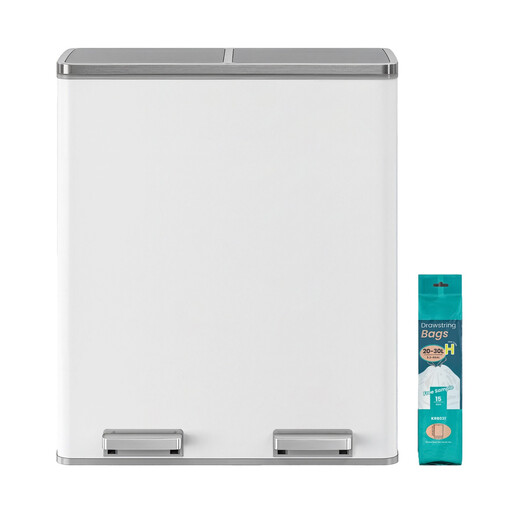
Why This Fits Their Persona: Designed for larger households and open-plan kitchens where a coordinated white and grey finish, generous capacity and quieter operation are priorities.
The stated 60L total is clearly divided into two 30L compartments, helping buyers compare usable capacity rather than a single headline figure.
Stainless steel outer body, two removable PP buckets, soft-close pedal lids, 60L total capacity and 15 included bags.
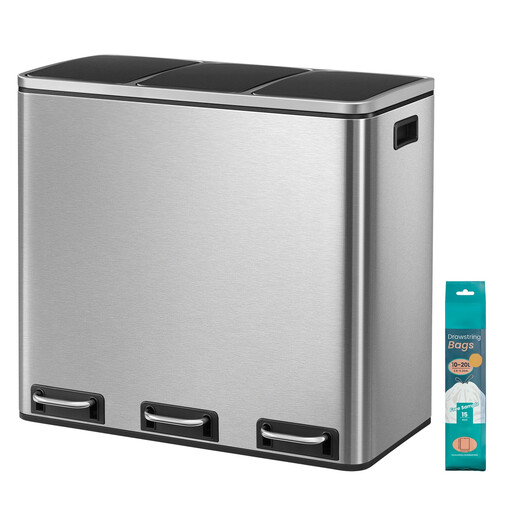
Why This Fits Their Persona: Suitable for households that want dedicated sections for recycling, general waste and food scraps within one indoor unit.
Its three separately identified 18L compartments make the intended sorting routine clear, instead of requiring food waste to share space with general rubbish.
Three pedals, soft-close lids, removable inner buckets and a rust-resistant steel body. Listed dimensions are approximately 61 x 31.5 x 55.5cm.
We have compiled a complete, real-time list of products that fully satisfy these strict selection criteria and UK safety regulations.
Place the bin on a flat, stable indoor surface, with enough room for the pedal and open lid. Fit the liners inside each removable bucket and secure the edges so they do not interfere with the lid mechanism.
For routine care:
Not always. It offers convenient separation for recycling, general waste and food waste, but it may occupy more floor space and provide less capacity per section. Measure the available area and compare your council’s collection arrangements before choosing a three-section design.
Lifespan depends on frequency of use, load levels and maintenance. Avoid forcing the lid, placing objects on top or overloading the buckets. Keeping the pedal mechanism dry and cleaning the exterior with non-abrasive products can help preserve its operation and finish.
The bin itself does not require electricity, so running costs are limited to replacement liners and cleaning supplies. A larger capacity may reduce how often you empty the bin, but food waste should still be removed according to your household routine to keep the kitchen fresh.