Weekly curry batch cookers
If you make lamb curry for several meals or a family, bowl room for browning, stirring and portioning matters more than programmes you will rarely use.


Choose the cooking route and bowl size before counting programmes. A pressure multicooker suits cooks who want a quicker route as well as sautéing; a slow-cooker-focused model suits longer cooks, while an air-frying lid is worth considering only if you will use it for meals beyond curry. Compare the fill guidance for your recipe rather than treating rated capacity as finished curry yield.
If you make lamb curry for several meals or a family, bowl room for browning, stirring and portioning matters more than programmes you will rarely use.
If dinner timing matters, look for a pressure-cooking route alongside a way to sauté onions, spices and lamb before adding liquid.
If the appliance must do more than make curry, decide whether you will actually use crisping or other additional cooking modes before accommodating extra lids and accessories.
Start with the batch size and whether you want pressure or slow cooking. Then consider the washing-up routine and whether extra cooking modes justify their accessories.
| Concern | What to check | Who this matters to |
|---|---|---|
| Batch room | Compare rated bowl capacity with your ingredients, then check the model’s fill limits and room for stirring. | If I brown lamb and make several portions at once, I need enough working space before the liquid goes in; around 36% of consumers put batch room first. |
| Cooking route | Check for pressure cooking or slow cooking on the exact model, plus a sauté or browning function if you need one. | When dinner time is tight, I want the option of pressure cooking rather than relying on a long cook; for around 29% of consumers, that cooking-route decision comes first. |
| Cleaning and workflow | Check where sautéing takes place and which removable parts can be washed as the manufacturer instructs. | Repeated batches mean repeated preparation and washing up, so I want a routine I can manage; around 21% of consumers primarily value a simpler workflow. |
| Cooking beyond curry | Check whether you would use crisping or air frying, and where any extra lid or basket would be stored. | If one appliance will also handle other meals, I may make use of a crisping function; wider versatility is the primary need for around 14% of consumers. |
Extra modes do not replace the sequence a curry needs: browning aromatics and lamb, cooking the curry, then portioning it.
Check that the exact model offers your intended pressure- or slow-cooking route and the browning step you want. Treat air frying as a separate use, not a curry requirement.
A litre rating does not tell you how much of your particular curry can be cooked while leaving room to stir or observing pressure-cooking fill limits.
Compare your usual ingredients with the bowl size and consult the exact model’s filling instructions before choosing.
Batch cooking continues after the appliance finishes: portions still need suitable cooling, storage and reheating.
Plan containers and fridge or freezer space. The Food Standards Agency advises reheating food thoroughly rather than merely warming it, and reheating it only once.
A plug description alone is not enough to establish that an appliance suits the electrical supply where you will use it.
Check the rating plate, supplied instructions and seller’s product information, and inspect the appliance and cable before use.
These ranges illustrate different cooking routes; check features on the individual model rather than assuming they apply across a brand.
Instant Pot UK lists both the 7.1L Classic XL pressure multicooker and a separate 7.1L Superior Slow Cooker.
Ninja UK describes the Foodi MAX OP500UK as a pressure multicooker with a 7.5L cooking pot and Cook & Crisp capability.
Tefal UK lists the 6L All-in-One CY505 pressure cooker and the 7.6L Turbo Cuisine & Fry CY778840 with an air-frying lid.
These choices cover a pressure multicooker, a slow cooker with a separate hob-searing step and an electric hot pot. Decide which cooking workflow fits your curry before comparing their capacities.
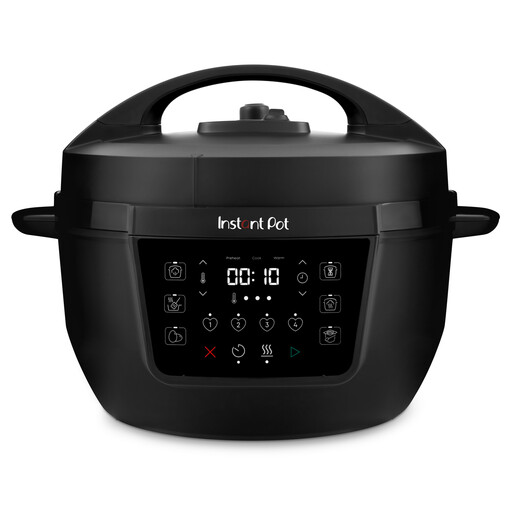 No image available
Consider this model if you want to sauté before pressure- or slow-cooking a curry batch. Its stated capacity is 7.1L; check the model’s fill guidance for your recipe and its dimensions for your worktop.
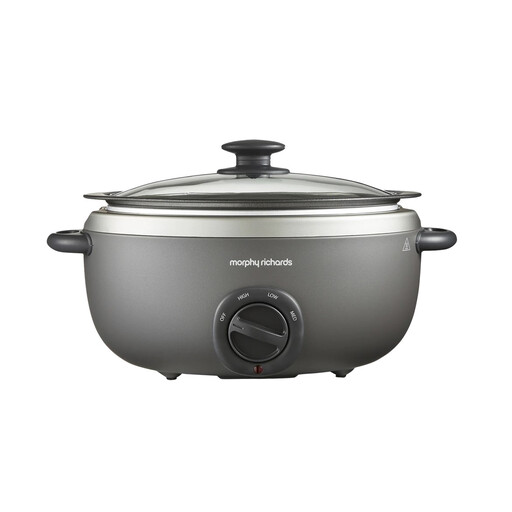 No image available
This 6.5L slow cooker suits a longer curry cook if its separate searing step fits your kitchen. Searing with its pot requires a gas or electric hob; the pot is unsuitable for induction. Check the fill guidance against your batch size.
 No image available
Consider this electric hot pot for a larger, slow-cooked curry rather than choosing it on the assumption that it pressure-cooks. Its title states 1600W and 7L; check its cooking and fill instructions if browning control or batch size is decisive, and confirm electrical-supply suitability from the rating plate.
A 6L model can suit a moderate batch, but your recipe and the cooker’s fill limits determine its practical fit. Tefal UK lists a 6L All-in-One model; if you routinely brown and stir larger quantities, compare it with larger bowls as well as the appliances’ external dimensions.
Choose pressure cooking if the quicker cooking route matters most, or slow cooking if you prefer a longer cook. Check that your chosen model also supports the browning step you want: the cited Instant Pot Classic XL has pressure, slow-cook and sauté functions, while the Superior Slow Cooker offers slow cooking and sauté/sear without a pressure-cooking route.
Do not use keep warm as a substitute for planning safe storage of batch-cooked portions. Follow food-storage guidance for cooling and chilling, and the Food Standards Agency’s advice to reheat food thoroughly, only once.
Check the appliance’s rating plate and instructions against the supply where you will use it, rather than relying on a plug description alone. Ask the seller about the intended market model if that remains unclear, and inspect the appliance and cable before use.