
24/7 Customer Support

Free returns

Same-day & Next-day Delivery

Quality Guaranteed

Unlock Your Welcome Offers: FREE Delivery | Up to 80% OFF | Free 30-day JoyPlus trial
Download the APP
A multifunctional multicooker can replace several appliances, simplify batch cooking and reduce washing-up. However, a long list of programmes does not automatically mean a cooker will suit your kitchen. The useful question is not “How many functions does it have?” but whether its capacity, heating method, controls and cleaning requirements match the way you actually cook.
For UK households, students and meal-preppers, three purchasing traps deserve particular attention.
A cooker advertised as a “10-in-1” or “14-in-1” may include several settings that work in broadly similar ways. Before buying, identify the functions you will use regularly:
Some appliances are actually electric hot pots designed mainly for boiling, simmering and hot pot dining. They may not provide pressure cooking, baking or automatic recipe programmes.
A 6-litre cooker does not necessarily hold 6 litres of food safely. Pressure cookers require space for steam expansion, while rice, pasta and pulses may swell during cooking. Always follow the manufacturer’s maximum-fill markings and instructions.
For one or two people, a 2-litre electric multicooker may take up less cupboard space and avoid unnecessary energy use. A family-sized multicooker between 5 and 6.5 litres is more suitable for shared meals and batch cooking. A 7-litre model can help when cooking for gatherings, but its larger footprint and heavier full pot need consideration.
A non-stick cooking pot can make cleaning easier, but it still needs suitable utensils. Metal tools and abrasive scourers may damage the surface. Check which parts are genuinely dishwasher-safe and whether the heating base, sealing ring and lid components need hand cleaning.
For a pressure cooker, inspect the sealing ring and steam-release parts regularly. For an electric hot pot, allow the appliance to cool fully and keep the base, plug and cable away from water.
Measure the available worktop and storage space, including room to open the lid and release steam safely. Capacity should be judged alongside the pot shape: a wide, flat base is practical for browning ingredients, while a deeper pot may suit soups and stews.
As a general guide:
Remember that the appliance’s external dimensions may be considerably larger than the removable pot.
Wattage indicates electrical input, not a guaranteed cooking speed. Higher power can support quicker heating, but results also depend on the pot design, ingredient quantity and temperature control.
A 1,200–1,600W electric hot pot may be practical for boiling and stir-frying, while a programmable pressure cooker often uses a lower rated wattage with automated pressure and temperature management. Look for adjustable heat levels or manual controls if you cook beyond preset recipes.
For UK use, check that the product has a suitable 220–240V supply and UK plug, and follow the supplied instructions. Use the appliance on a stable, heat-resistant surface, leave space around steam vents and never immerse the electrical base.
Preset programmes are convenient, but manual adjustment is valuable for adapting recipes. A programmable cooker may include a delay timer, keep-warm setting and digital display. These features can be useful for households with staggered mealtimes, although food should not be left in unsafe conditions for extended periods.
If you want a combined steamer and soup maker, check whether steaming accessories are included. Similarly, a product described as a rice cooker may offer excellent rice-focused functions without being suitable for pressure cooking or roasting.

Why This Fits Their Persona: Its 5-litre size suits small family meals, shared hot pot dinners and straightforward one-pot cooking without the complexity of pressure programmes.
The product clearly focuses on four functions—multi cooking, slow cooking, stewing and hot pot—rather than relying only on a large programme count.
5L capacity, stepless power selection, detachable power cord, glass lid and dry-burn protection.
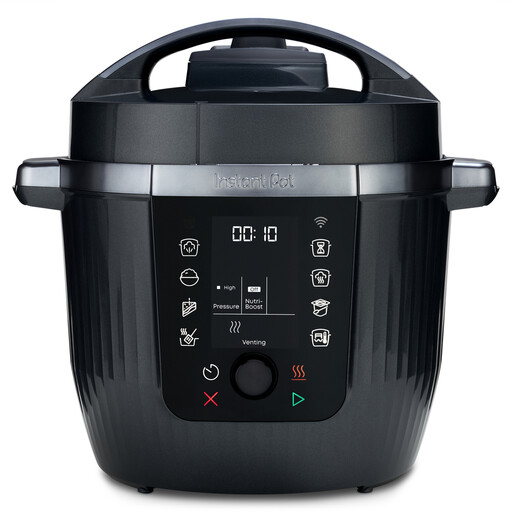
Why This Fits Their Persona: A 5.7-litre capacity and ten listed cooking functions make it suitable for households wanting one appliance for varied weekly meals.
The specification lists pressure cooking, slow cooking, steaming, rice cooking, sautéing, sous vide, warming and other functions individually, making the feature set easier to compare.
Stainless steel inner pot, digital controls, multiple built-in safety mechanisms and ten stated functions.

Why This Fits Their Persona: Its 7-litre bowl is designed for group meals, large stews, soups and hot pot gatherings where repeated cooking would be inconvenient.
Its description specifies two heat modes and identifies the appliance as a deep electric pot, so buyers can distinguish it from a pressure cooker or automated recipe machine.
7L capacity, 1600W power, high and low heat modes, non-stick coating and UK plug.
We have compiled a complete, real-time list of products that fully satisfy these strict selection criteria and UK safety regulations.
Place the appliance on a level, heat-resistant surface away from cupboards, curtains and the edge of the worktop. A pressure cooker needs clear space around its steam outlet. Do not force a locked lid open, exceed the maximum fill line or leave children near hot surfaces and steam.
Energy use depends on wattage, cooking duration and the selected mode. A 2,000W electric hot pot may heat quickly but can draw more power while switched on than a lower-wattage cooker. Pressure cooking may reduce cooking time for suitable recipes, while slow cooking uses lower heat over a longer period. Compare the appliance’s rated power with how often and how long you expect to use it.
It can be worthwhile if you regularly prepare soups, rice, stews, steamed food or batch meals and have limited space for separate appliances. It may be less suitable if you mainly need a frying pan, compact noodle cooker or dedicated rice cooker.
Lifespan depends on frequency of use, coating care, cleaning and replacement parts. Avoid metal utensils on non-stick surfaces, clean sealing and steam components as instructed and do not operate an empty pot. Check whether replacement rings, pots or accessories are available before purchase.
Not necessarily. Running cost depends on the appliance’s wattage, cooking time, quantity of food and energy tariff. A multicooker may be practical for smaller portions because it heats a smaller cooking chamber, but compare the rated power and programme duration rather than assuming automatic savings.