Family batch-stock cooks
If you want stock for a family meal and portions to store, consider the pot's usable space and shape as well as its stated capacity. Chicken, vegetables and liquid must all fit within the model's fill limit.


For family chicken stock, choose a cooker whose fill limit accommodates your ingredients, then decide whether pressure cooking, slow cooking or guided controls matter most to you. Compare sauté capability if you want to brown ingredients in the same pot, but do not treat a stated serving count as the amount of stock you will produce.
If you want stock for a family meal and portions to store, consider the pot's usable space and shape as well as its stated capacity. Chicken, vegetables and liquid must all fit within the model's fill limit.
If an all-day simmer does not suit your routine, look for pressure cooking. A browning or sauté function also lets you prepare ingredients in the cooker before adding liquid; allow time for pressure release, straining and cooling.
If pressure-cooker controls are unfamiliar, a guided display and a clearly explained release method may matter more to you than extra capacity or cooking modes.
Start with the batch you intend to make and the cooker's fill guidance. Then choose the cooking method and controls you will use regularly, rather than counting functions you may never need.
| Concern | What to check | Who this matters to |
|---|---|---|
| Usable batch capacity | Compare pot capacity and shape, then check the exact model's maximum-fill instructions for liquids and pressure cooking. | If I want a family meal and stock to store, I need room for chicken, vegetables and liquid without exceeding the fill limit. Around 42% of consumers put batch capacity first. |
| Cooking method | Check for pressure cooking, slow cooking and sauté or browning according to the method you plan to use. | When time is tight, I want the option of a pressure-cooked batch, while still being able to use the pot for other meals. For around 33% of consumers, cooking method and flexibility are the main concern. |
| Controls and handling | Look at the controls and the model-specific pressure-release instructions; check whether guided operation matters to you. | If I am new to electric pressure cooking, I want to understand each step and how to release pressure before I start. Ease of control comes first for around 25% of consumers. |
Chicken bones, vegetables and liquid use up pot space, and the maximum fill level can limit a stock batch. A claim about portions served does not tell you how much strained stock will remain.
Use serving claims as a starting point for comparing sizes, then read the exact model's fill instructions before buying or cooking.
Pressure cooking, slow cooking and sautéing serve different parts of a stock-making routine. A cooker's category name alone does not establish which of those functions it has.
Check the exact model's function list. If you want to brown ingredients without a separate hob pan, confirm that it has an in-cooker sauté or browning mode.
A quicker pressure-cooking stage still leaves preparation, heating, pressure release, straining and cooling to account for.
Choose pressure cooking if the cooking stage is your priority, but plan the full schedule around the model's release instructions and safe storage.
A family-sized batch needs a storage plan as well as a suitable cooker. Food Standards Agency guidance says cooked food should be cooled and placed in the fridge within one to two hours.
Have smaller containers ready so you can portion the stock and refrigerate it promptly.
Instant Pot UK presents larger models for family meals and batch cooking, including the 7.1L Classic XL and 8L Duo.
The 5.6L Express CSC051 offers a family-oriented option for cooks who want both pressure and slow cooking.
Tefal describes the 6L Cook4me+ CY851840 as suitable for up to six servings, with on-screen cooking guidance.
Ninja's 7.5L OL750UK is aimed at households that want cooking functions beyond stock-making.
These choices include pressure-and-slow-cook multicookers and a longer-cooking option. Compare their stated modes with the way you want to make stock, and check each model's fill guidance before deciding on a batch size.
 No image available
Consider this model if you want pressure cooking and slow cooking in one appliance for a family meal.
Its stated capacity is 5.7L, and sautéing is among the listed functions. Check the manual's pressure-cooking fill limit against your planned stock ingredients.
 No image available
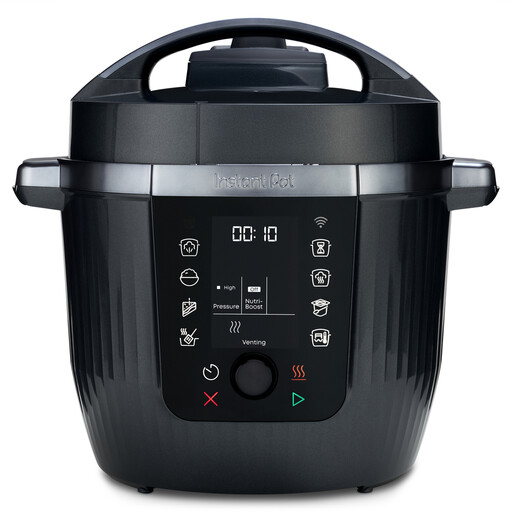
Consider this Instant Pot Pro if you want pressure cooking alongside slow cooking and sautéing.
The product title states 5.7L. Confirm the exact variant and its maximum-fill instructions before planning a large stock batch.
 No image available
This is an option for a family meal if you want to choose between pressure cooking and slow cooking.
The stated capacity is 6L, with sautéing and ten programmes listed. Read the model's pressure-release and maximum-fill instructions before making stock.
 No image available
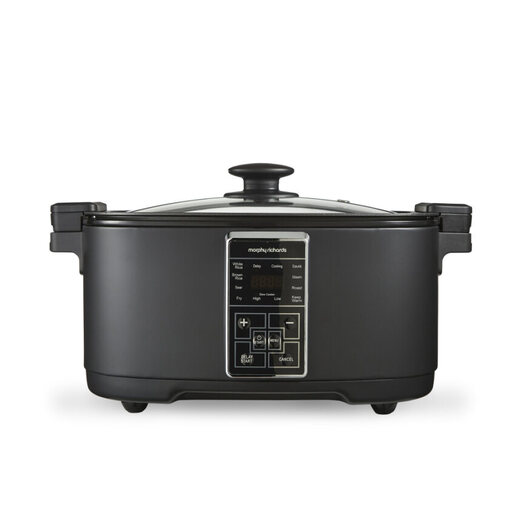
Consider this option if you prefer a longer slow-cooked batch rather than choosing a cooker for pressure cooking.
Its stated capacity is 6.5L. Searing uses the removable pot on a gas or electric hob before the pot returns to the cooker base; check the fill guidance for your stock recipe.
Compare the batch you want to make with the cooker's usable fill limit, not just its stated capacity. Instant Pot UK describes its 7.1L Classic XL and 8L Duo as serving up to eight portions, while Crock-Pot UK presents the 5.6L Express CSC051 for families and Tefal describes the 6L Cook4me+ as serving up to six. Those serving descriptions do not establish how much stock you will produce from your chicken, vegetables and liquid.
No: slow cooking is also an option if a longer cook suits your routine. Choose pressure capability when shortening the cooking stage matters, or look for both pressure and slow-cook modes if you want either method; check the exact model's function list rather than assuming every multicooker includes both.
Plan to portion and refrigerate it promptly. Food Standards Agency guidance says cooked food should be cooled at room temperature and placed in the fridge within one to two hours; dividing a batch into smaller portions helps it cool more quickly.