Weekly dhal meal preppers
If you regularly make several portions of dhal, curry, soup or grains, consider usable bowl capacity, whether you can sauté in the same pot, and how you will store the leftovers.


For regular dhal batches, choose a multicooker with enough usable bowl space for your recipe, a sauté setting if you build the base in the pot, and an inner pot you can comfortably lift and clean. A pressure model suits cooks who want that method, while a sauté-and-slow-cook model can suit a slower approach; guided screens and air-fry modes are worth considering only if you will use them for other meals. Check the exact model’s maximum-fill guidance before deciding on capacity.
If you regularly make several portions of dhal, curry, soup or grains, consider usable bowl capacity, whether you can sauté in the same pot, and how you will store the leftovers.
If you want to make dhal in one appliance but are new to pressure cooking, clear controls, guidance and the steam-release arrangement may matter more to you than extensive manual settings.
If dhal is only one of several meals you plan to make, weigh the extra cooking modes against the appliance’s size, weight and the space available to store it.
Start with the batch size your recipe requires and the cooker’s fill guidance, then decide which cooking method and day-to-day controls you will use.
| Concern | What to check | Who this matters to |
|---|---|---|
| Usable batch capacity | Compare bowl size with the model’s pressure-cooking fill limits, and check its dimensions and weight. | If I cook several portions at once, I need room for lentils and liquid without filling the pot to its limit; around 31% of consumers choosing for batch dhal would put usable capacity first. |
| Cooking control | Look for sauté or browning and the simmer, slow-cook or pressure settings your recipe needs; check manual controls if you vary recipes. | I change lentil types or prefer to adjust how my dhal cooks rather than rely on presets; roughly 31% of consumers choosing for batch dhal would prioritise cooking control. |
| Cleaning and handling | Check which parts are dishwasher-safe, how steam is released and how you will lift a hot, full inner pot. | Lifting a full pot safely and cleaning up after regular batches matters to me; about 23% of consumers choosing for batch dhal would put ease of handling first. |
| Other cooking modes | Consider air frying or grilling only if you expect to use them, and measure the space available for the appliance. | If this cooker will cover meals beyond dhal, I want extra modes I will actually use; around 15% of consumers choosing for batch dhal would prioritise versatility. |
A bowl’s stated capacity is not necessarily its safe pressure-cooking fill level. Instant Pot’s Duo Plus manual specifies a limit of two-thirds of capacity, or one-half for foods that expand during cooking.
Plan portions using the manual and fill markings for the exact model and recipe, rather than treating the bowl label as usable recipe volume.
Air-fry and combi-steam modes serve cooking tasks beyond the core dhal steps of sautéing and cooking the lentils.
Consider a wider-function model if you will regularly use those modes; otherwise compare the cooking settings and usable capacity you need for dhal.
A timer does not make it suitable to leave perishable ingredients unrefrigerated while cooking is delayed.
Use delayed start only when the recipe ingredients and storage conditions make the planned wait safe.
A large batch is harder to cool promptly as one mass. GOV.UK advises dividing cooked food into smaller portions to help it cool quickly before refrigeration or freezing.
Transfer dhal into smaller containers for cooling and storage, handling the hot inner pot with care.
Its pressure-led range includes larger bowls for cooks who frequently make one-pot batches.
Its 6L pressure multicookers offer a choice between adjusting your own recipe and following on-screen guidance.
Its Foodi MAX SmartLid range is relevant if you plan to use pressure cooking alongside other cooking modes.
These two cookers represent different ways to prepare a dhal batch: pressure cooking with a sauté step, or a non-pressure approach using sauté and slow cooking.
 Image unavailable
This model suits dhal batches that begin with sautéed aromatics before pressure cooking. It has a stated 5.7L capacity and ceramic non-stick coating. Check its manual and fill markings before deciding how much dhal to cook under pressure.
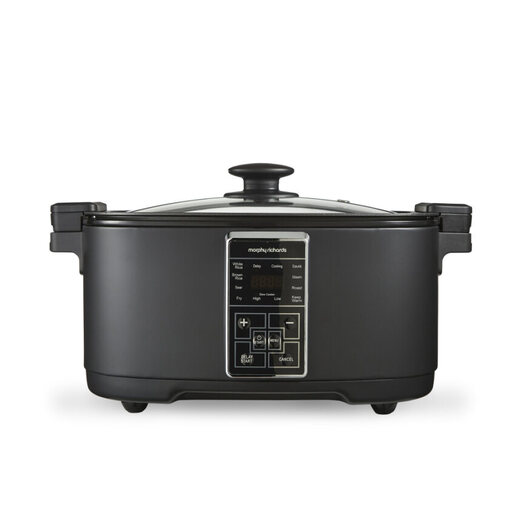 Image unavailable
This model suits cooks planning to sauté a dhal base and then slow-cook it without pressure. Its stated specifications include a 6.5L pot, 1350W rating, 10 preset functions and a dishwasher-safe pot and accessories. Check the pot’s fill guidance when planning a batch.
Compare the portions you normally cook with the usable fill level, not just the bowl label. For example, Instant Pot’s Duo Plus manual limits pressure-cooking fill to two-thirds of capacity, or one-half for foods that expand; check the instructions for the model and recipe you choose.
No: a cooker with suitable sauté and simmer or slow-cook settings can make dhal without pressure. Choose pressure cooking if you want that cooking method, and check for adjustable settings if you regularly change lentils, quantities or preferred texture.
Divide the cooked dhal into smaller portions so it cools promptly before refrigeration or freezing. GOV.UK advises refrigerating cooked food within one to two hours, keeping the fridge between 0°C and 5°C, and eating refrigerated leftovers within 48 hours or freezing them.
Read the exact model’s manual before cooking, including its liquid, fill, valve and pressure-release instructions. Instant Pot’s manuals warn against forcing a lid open before pressure has fully dropped and note that a full inner pot can be hot and heavy.
Check the guarantee terms for the precise model, whether registration is required, who handles repairs and what the seller’s return policy covers. Confirm those details for the listing you intend to buy rather than assuming that every model from a brand has the same terms.