
24/7 Customer Support

Free returns

Same-day & Next-day Delivery

Quality Guaranteed

Unlock Your Welcome Offers: FREE Delivery | Up to 80% OFF | Free 30-day JoyPlus trial
Download the APP
A multi cooker can replace several countertop appliances, but choosing the wrong model may leave you with unused programmes, difficult cleaning and a pot that is too small for your household. Marketing often focuses on the number of functions, yet the more useful questions are simpler: how much food can it prepare, how easy is it to clean and does it suit the way you actually cook?
Before buying an electric multi cooker, watch for these common pitfalls.
A cooker advertised as “10-in-1” or “14-in-1” may include several settings that overlap. A soup programme, stew programme and slow-cook programme may all use similar heating methods, while a separate pressure cooker function changes the appliance more significantly.
Prioritise functions you will use regularly, such as:
A kitchen multi cooker is more useful when its controls match your recipes rather than simply offering a long list of presets.
A 5L or 6L appliance does not always allow you to fill the pot to the rim. Pressure cooking requires headspace and ingredients such as rice, beans and pasta can expand during cooking. Always follow the manufacturer’s maximum-fill markings and recipe guidance.
For many UK homes, a 5L multi cooker or 5.7L model is suitable for everyday family meals and batch cooking. Larger households may prefer a 6L multi cooker or 6.5L slow cooker, while a 7L electric hot pot can be practical for shared meals.
The cooking pot is the part you handle after nearly every meal. Check whether it is removable, dishwasher-safe and compatible with your preferred cooking method. A non-stick surface may simplify cleaning, but it still requires suitable utensils and careful handling to reduce scratching.
Also check the lid, sealing ring, steam valve and accessories. Pressure models generally need more components cleaned than a basic digital slow cooker.
Capacity should reflect both the number of diners and how often you batch cook.
Remember that the outer dimensions may be considerably larger than the pot itself. Measure your worktop and storage cupboard, especially if you have a compact kitchen.
A traditional slow cooker uses steady, low-temperature cooking over several hours. It is straightforward and convenient for meals prepared before work. A pressure multi cooker uses a sealed lid and pressure to shorten cooking time, but it requires more attention to liquid levels, lid locking and steam release.
An electric hot pot is different again. It is generally designed for direct boiling, simmering, frying or shared hot pot dining rather than sealed pressure cooking. Some include a steamer, making them useful for vegetables, dumplings and fish.
Look for clear controls, readable displays and a timer that fits your routine. A programmable slow cooker with delay or keep-warm settings may be more valuable than extra speciality modes.
Common options include ceramic, aluminium with a non-stick coating and stainless steel. Each has practical differences:
For pressure cooking, also inspect the steam-release design and safety instructions. Never force open a locked lid, exceed the maximum-fill line or place the base in water. Use a stable, heat-resistant surface with clear space around steam vents.
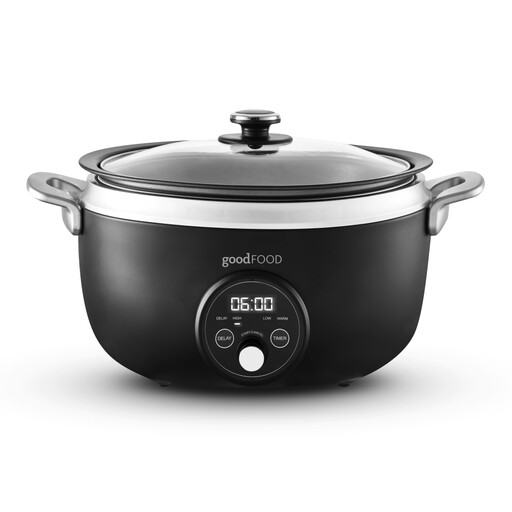
Why This Fits Their Persona: Its 3.5L capacity suits smaller households, while digital timing and delay functions help organise weekday meals without the complexity of pressure cooking.
It presents clear information about capacity, wattage and timing rather than relying only on a long programme count. The removable pot can be used on a non-induction hob for searing.
LED controls, a 3.5L pot and dishwasher-safe components support simple everyday use.

Why This Fits Their Persona: This option suits home cooks wanting one appliance for pressure cooking, rice, steaming, slow cooking, sautéing and additional speciality programmes.
The 5.7L capacity is stated clearly and the cooker includes manual controls alongside 14 presets. Its instructions also specify pressure-release and maximum-fill precautions.
Ceramic non-stick inner pot, LED progress display, recipe book and 12 listed safety mechanisms.

Why This Fits Their Persona: The large pot is designed for group dining, substantial stews, soups and hot pot meals where a standard family appliance may feel restrictive.
It is presented as a dedicated electric hot pot rather than a pressure appliance, so expectations are clearer. Two heat modes separate rapid boiling from slower cooking.
7L capacity, 1600W power, a wide 30.5cm opening and a glass lid.

Why This Fits Their Persona: A 6L format and combination of pressure, slow cooking, rice cooking and steaming suit households preparing varied meals through the week.
Its listed accessories and 10 programmes make the cooking scope easier to assess, while the stainless steel inner pot avoids dependence on a coated surface.
Includes a steamer, steaming rack, measuring cup and two serving spoons, plus a warming function.
We have compiled a complete, real-time list of products that fully satisfy these strict selection criteria and UK safety regulations.
Place the appliance on a dry, level, heat-resistant surface close to a suitable wall socket. Do not cover ventilation areas, immerse the base in water or use a damaged cable. For pressure cooking, add the required liquid, keep below the marked limit and follow the instructions for natural or quick pressure release.
Electricity use depends on wattage, cooking time and your household tariff. A 150W to 320W slow cooker may draw less power while operating for several hours, whereas a 1200W or 1600W hot pot heats more quickly but uses more electricity during active heating. Check the appliance’s wattage and compare it with your tariff rather than relying on general claims about savings.
They serve different cooking habits. A multi cooker offers several methods, including pressure cooking, rice cooking and steaming. A slow cooker is simpler and focused on long, low-temperature cooking. Choose a multi cooker if you want variety; choose a slow cooker if stews and scheduled meals are your main priorities.
A 5L to 6L model is a useful starting point for many UK families and batch cooks. Consider a 6.5L or 7L appliance for larger portions, dinner parties or shared hot pot meals. Do not assume the full stated volume is available for pressure cooking.
Lifespan depends on frequency of use, cleaning and how replacement parts are maintained. Keep sealing rings, valves and lids clean, avoid metal utensils on coated pots and follow the manufacturer’s inspection guidance. Replace damaged components rather than continuing to use the appliance.