Desk-constrained record keeper
You need to print, copy and scan A4 records without giving separate devices space on the desk. Measure the available surface and allow room to load paper, collect output and open the scanner.


For mainly black-and-white donation records, consider a mono laser multifunction printer; if you regularly copy or scan batches of forms, prioritise an automatic document feeder (ADF). A colour inkjet or refillable-tank model may suit recurring colour documents, but scanner design and consumables differ by model. Whichever route you consider, measure the desk and the space needed to operate the printer before choosing.
You need to print, copy and scan A4 records without giving separate devices space on the desk. Measure the available surface and allow room to load paper, collect output and open the scanner.
You regularly copy or scan batches of donation forms or receipts. An ADF lets you load multiple originals together; Epson United Kingdom specifies a 30-page ADF for the WorkForce WF-2950DWF.
You produce colour donor communications as well as routine records, so the type of ink supply and paper capacity matter alongside print, copy and scan functions. Compare stated consumable yields with the documents you expect to produce.
Check physical fit and how you handle originals before comparing print features. Then decide whether your records need colour or are predominantly black and white.
| Concern | What to check | Who this matters to |
|---|---|---|
| Desk fit and access | Measure the surface and compare it with the exact model’s dimensions and the clearance needed for paper, output and scanner access. | I need one device for records, but I still have to reach its tray and scanner on a crowded desk. Around 36% of consumers would make workable desk fit their primary concern. |
| Batch scanning and copying | Check for an ADF, its stated capacity and whether the required scanning workflow is supported; duplex printing does not establish duplex scanning. | When forms arrive in batches, placing each sheet on a flatbed would interrupt the task. Roughly 29% of consumers would put handling multi-page originals first. |
| Black-and-white records | Confirm that every required document can be printed in mono, then compare automatic duplex printing and paper-tray capacity. | Most of my output is text, so I care more about producing routine records without frequent paper refills than about colour. Around 21% of consumers would prioritise black-and-white document output. |
| Recurring colour output | Confirm that colour is needed and compare the exact consumables, their stated yield basis and the printer’s scanner design. | I regularly prepare colour communications and want to plan ink replacement, while accepting that a flatbed model means handling originals individually. About 14% of consumers would make recurring colour output their main concern. |
A printer may need more usable space than its closed dimensions suggest when you load paper, collect output or open a scanner lid or ADF.
Measure the intended position and check the exact model’s dimensions and operating-clearance guidance before ordering.
Epson United Kingdom specifies a 30-page ADF for the WorkForce WF-2950DWF, while Canon UK identifies a flatbed scanner for the MAXIFY GX1050. On a flatbed, each page of a batch needs individual handling.
If multi-page copying or scanning is routine, check for an ADF and confirm that its scan functions suit your documents. A flatbed may be sufficient for occasional single pages.
Automatic two-sided printing describes printed output, not necessarily how the printer handles two-sided originals.
Check print, copy and scan functions separately for the exact model, particularly when donation forms have information on both sides.
Printed records can contain personal data. The Information Commissioner’s Office advises secure destruction when such information is no longer needed; Recycle Your Electricals also advises removing removable items and resetting a printer before recycling.
Follow your organisation’s retention schedule, arrange secure destruction of paper records and check the device manufacturer’s instructions for clearing stored information before reuse or recycling.
A reference point for A4 mono laser multifunction models intended for document work.
A reference point for A4 colour inkjet multifunction models with batch-document features.
A reference point for refillable-tank colour multifunction models used for recurring documents.
These multifunction models cover different approaches to A4 records, including mono printing, colour printing and options to consider for batch paperwork. Check each model’s scanner functions and operating space against your own tasks; their order does not establish which will fit your desk.
 No image available
Consider this model if you handle recurring colour documents or batches of paperwork. Check its feeder functions and the space needed to load and retrieve documents on your desk.
 No image available
For A4 records that need printing, copying and scanning, this model combines those functions with Wi-Fi. If you regularly process multi-page originals, check its feeder and scanning functions as well as the clearance available above the desk.
 No image available
Consider this all-in-one inkjet if colour documents and multi-page paperwork are part of your workflow. Confirm the feeder functions, desk capacity and access space for this model before choosing it.
 No image available
A mono laser option to consider when donation records do not require colour. This model uses a flatbed rather than an ADF for originals, and two-sided printing requires manual handling; check that those steps suit your workload.
 No image available
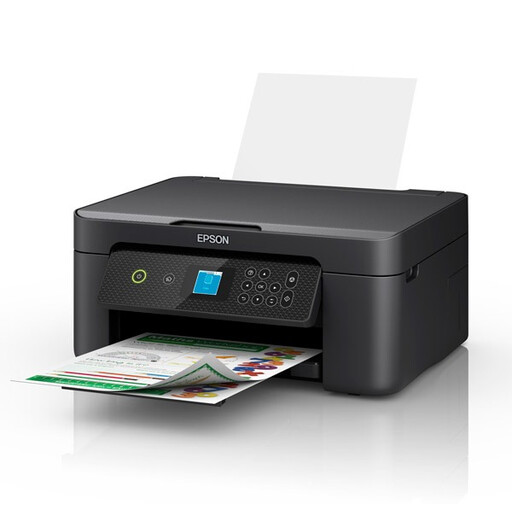
For colour A4 records when batch scanning is not a priority, this model offers print, copy and scan functions, Wi-Fi and automatic two-sided printing. Its scanner is a flatbed, so multi-page originals need individual handling; compare its dimensions with your available space.
Measure both the available surface and the space needed to use the printer. Compare those measurements with the exact model’s dimensions and guidance for loading paper, collecting output and opening its scanner lid or ADF; the word “compact” alone cannot establish fit.
Prioritise an ADF if you regularly copy or scan multi-page originals. Epson United Kingdom specifies a 30-page ADF for the WorkForce WF-2950DWF, whereas Canon UK identifies a flatbed scanner for the MAXIFY GX1050; a flatbed can suit occasional single-page work.
Follow your organisation’s retention schedule and destroy records containing personal data securely when they are no longer needed. The Information Commissioner’s Office advises safe, secure destruction and describes shredding or a reputable secure-shredding service as practical methods; your organisation’s purpose and records policy determine the applicable retention period.
Check how to clear stored information before passing on or recycling the printer. Recycle Your Electricals advises removing cartridges and memory cards where applicable and restoring the device to factory settings; follow the manufacturer’s instructions and use an appropriate reuse or electrical-recycling route.