Studio users preserving postcards
You need to handle older cards carefully and create a reusable master image before prioritising everyday printer features.


Start with a multifunction printer that has a documented flatbed scanner: Hampshire County Council identifies flatbeds as suitable for flat archival items, while an automatic document feeder should not be the default for old postcards. Then weigh the studio’s printing workload and shared-access needs against scanner specifications, card fit and the care each original requires.
You need to handle older cards carefully and create a reusable master image before prioritising everyday printer features.
Several users need practical ways to connect, scan, copy and print, with clear arrangements for where shared files are saved.
Alongside occasional postcard scans, you regularly print ordinary documents and need to consider consumables, paper handling and shared workflow.
For a shared studio digitising old postcards, check how the cards will be handled before deciding how much shared-access equipment or print capacity the printer needs.
| Concern | What to check | Who this matters to |
|---|---|---|
| Postcard handling and master images | Confirm the flatbed type and usable bed size. Choose scan settings and a master-file format suited to the originals. | With worn or bowed cards, I want to avoid feeder handling and keep a useful master image; around 42% of consumers put careful capture first. |
| Shared access | Check the exact model’s connection options and decide how users will name, save and access scans. | When several people use the device, I need routine jobs and saved files to be easy to manage; roughly 33% of consumers prioritise shared workflow. |
| Routine printing | Compare the print workload with the model’s paper handling and replacement consumables, separately from its scanner specification. | If our studio prints documents regularly, I want fewer interruptions for paper and consumables; approximately 25% of consumers put print workload first. |
An automatic document feeder can help with suitable ordinary paper, but its capacity says nothing about how it will handle an old postcard. UKOLN advises taking the original’s condition into account before using automated digitisation procedures.
Confirm that the exact printer has a flatbed, check that each card fits and assess its condition before scanning.
Optical resolution is worth checking, but it does not determine the condition of the original or whether the resulting file will serve as a useful master.
Check the scanner’s optical specification and plan suitable settings, file naming and storage for the studio’s originals.
Refillable tanks address printing consumables; they do not establish a particular printer’s flatbed type or postcard-capture suitability.
If frequent printing makes an ink-tank model appealing, separately confirm its scanner type, optical specification and fit for the cards.
In a shared studio, connection options alone do not decide who can send jobs or access saved scans. The UK consumer connectable product security regime has applied since 29 April 2024, according to GOV.UK.
Check the exact UK model’s applicable security information and set rules for credentials, scan destinations and file access before shared use.
Canon’s PIXMA TS5350i and TS7750i are multifunction inkjets with documented flatbed scanners.
Epson offers refillable-ink multifunction printers for studios with recurring print work, as well as separate flatbed photo scanners.
HP’s Color LaserJet Pro MFP 3302fdw is an office-oriented option for shared document work.
This A4 inkjet option is relevant to studios considering flatbed postcard scanning alongside everyday printing. Check its usable scanner-bed size and optical scan settings against the cards you intend to digitise.
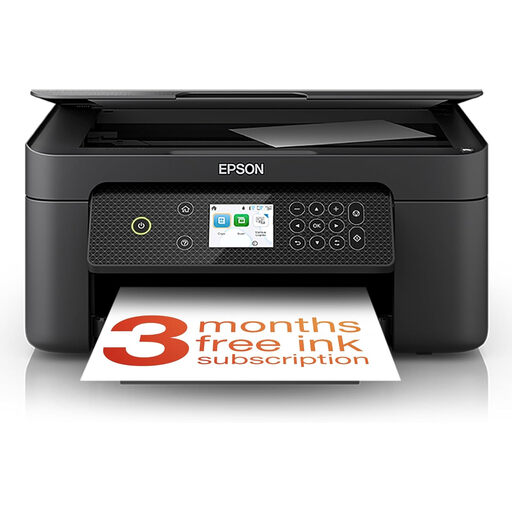 Image unavailable
For postcard scanning alongside routine studio printing, check that its stated flatbed fits each card and that its optical scan settings meet your master-image needs.
A4 inkjet model with Wi-Fi. Confirm how studio users will save and access scans.
Do not use the feeder as the default for old postcards. Hampshire County Council identifies flatbeds as suitable for flat archival items, and UKOLN advises considering an original’s condition before automated handling; inspect fragile, dirty or bowed cards before placing them on the flatbed.
Keep a master image made at suitable resolution and bit depth, then create smaller copies for sharing. Record practical details such as the scan date, original size and file format, and store the files in two locations.
Consider a dedicated flatbed when postcard capture, restoration tools or a scan-first workflow matters more than using one device for scanning and printing. Epson specifies its separate V39II scanner at 4800 dpi; assess the complete scanning workflow rather than choosing on that figure alone.
For a consumer connectable printer supplied in the UK, check the exact model’s applicable product-security statement and security-update information. GOV.UK states that the UK consumer connectable product security regime took effect on 29 April 2024; the studio should also decide who can access the device and its saved scans.
Check the local authority’s or retailer’s current collection arrangements for electrical equipment rather than putting the printer in general waste. GOV.UK describes the UK waste electrical and electronic equipment framework as supporting recovery, reuse and recycling.