Teams sharing one desk
If several colleagues print, copy and scan A4 briefs through one device, check how each person will connect. An ADF and automatic two-sided printing may also reduce repeated handling of multi-page jobs.


For a shared desk producing A4 project briefs, start with a connection method every intended user can access, automatic two-sided printing and an automatic document feeder (ADF) for multi-page originals. Then compare compact inkjet, office-oriented colour and refillable-ink models against the team’s print frequency, available space and consumable needs; an ADF alone does not establish that a printer can scan both sides automatically.
If several colleagues print, copy and scan A4 briefs through one device, check how each person will connect. An ADF and automatic two-sided printing may also reduce repeated handling of multi-page jobs.
For recurring handouts, marked-up drafts or client-facing packs, compare compatible consumables and paper capacity alongside the printer’s document-handling features.
If the printer must sit in a compact work area, check its dimensions and the clearance needed to load paper, scan originals and replace consumables. A larger tray is useful only if the device fits where it will be used.
Choose the document-handling and connection features the team needs before comparing printer types. Manufacturer specifications show different ways to meet that brief, but the right fit depends on the jobs sent to the shared desk.
Consider it when: A small team regularly produces A4 briefs and wants shared network access; Epson lists duplex printing and scanning, a 50-sheet ADF, Ethernet and Wi-Fi for its WorkForce Pro WF-C4810DTWF.
Check: Cartridge options and whether the chosen model’s rated output suits jobs arriving close together.
Consider it when: Several people send brief packs in succession; Brother lists a 50-sheet ADF, 250-sheet tray and rated 30-page-per-minute colour and monochrome printing for the MFC-L8340CDW.
Check: The model’s dimensions, connection options and compatible toner before committing desk space.
Consider it when: Recurring colour briefs make consumable choice a priority; Canon lists an ADF, Wi-Fi and Ethernet for the MAXIFY GX4050.
Check: Compare bottle options and expected document coverage rather than treating Canon’s own running-cost calculations as a result for every team.
| Concern | What to check | Who this matters to |
|---|---|---|
| Shared access and workflow | Check connection methods against the team’s devices and network rules, then confirm whether an ADF handles the usual originals. | If several colleagues use one desk, I need each person to send a job and copy a brief without repeated manual setup. Around 33% of consumers put shared access and workflow first. |
| Recurring consumables | Compare compatible ink or toner, stated yield conditions and the team’s expected mix of colour and monochrome pages. | When colour drafts are a regular task, I want to understand what replacing consumables will involve. Roughly 33% of consumers make recurring consumables their primary concern. |
| Batch handling | Compare paper and ADF capacity, rated colour and monochrome speed, automatic duplex printing and, if needed, duplex scanning. | Brief packs arriving close together make interruptions for paper or originals particularly inconvenient. For about 25% of consumers, handling batches is the main priority. |
| Desk fit | Measure the space available, including clearance for trays, scanning and consumable access. | With little room left on the shared desk, I need the printer to fit while remaining practical to load and use. Around 9% of consumers prioritise desk fit above the other factors. |
Print, copy and scan functions do not establish that a printer has an ADF or can scan two-sided originals automatically. Those distinctions matter when colleagues repeatedly copy or digitise brief packs.
Check ADF capacity, automatic two-sided printing and duplex scanning as separate specifications.
A speed rating does not tell you how often users will refill the tray, load originals or wait to access the printer. Actual throughput also depends on the documents and connection used.
Compare rated colour and monochrome speeds with paper capacity, ADF capacity, duplex functions and the team’s connection method.
Canon’s yield and ownership-cost statements for its MAXIFY range use the manufacturer’s own calculation conditions. Your page coverage, document mix and compatible consumables affect a comparison with cartridge or toner models.
Use the same expected brief workload and comparable yield conditions when assessing each shortlisted model.
A shared-office printer is electrical equipment, so its eventual disposal needs a suitable route rather than an assumption that it belongs with general waste. GOV.UK identifies the Waste Electrical and Electronic Equipment Regulations 2013, as amended, as the basis of the UK WEEE framework.
Check the organisation’s disposal process and the collection or take-back options available when the device reaches the end of its use.
These examples illustrate model-specific features to compare, not capabilities shared by every printer from a brand.
Brother’s UK range includes A4 colour inkjet and colour LED multifunction models for different office workflows.
Epson’s WorkForce Pro business inkjet range includes models aimed at shared A4 document workflows.
Canon’s MAXIFY MegaTank range is relevant when a team wants to compare refillable ink with other consumable systems for recurring colour documents.
HP’s UK business multifunction range includes inkjet and colour laser models aimed at differently sized teams.
These multifunction models offer different inkjet, refillable-ink and colour LED options to consider for a shared desk. Check each listing against the team’s connection, document-handling and space requirements before choosing.
 No image available
Consider this model if recurring colour briefs make a refillable-ink option worth assessing. Confirm that its feeder and network connections suit the team, and check duplex scanning separately if colleagues need to digitise two-sided originals.
 No image available
This colour wireless LED model is an option for teams considering a shared printer for brief packs. Check how each colleague will connect, whether two-sided scanning is needed and how much clearance the device requires.
 No image available
For a team considering an inkjet for repeated briefs, compare this model’s paper handling and connection methods with the jobs colleagues actually send. Check its desk footprint and whether its supported paper formats are useful to the team.
 No image available
This A4 EcoTank model is an option if refillable ink is part of the team’s comparison. Confirm its physical dimensions before assigning desk space, and check the scanning workflow if briefs include two-sided originals.
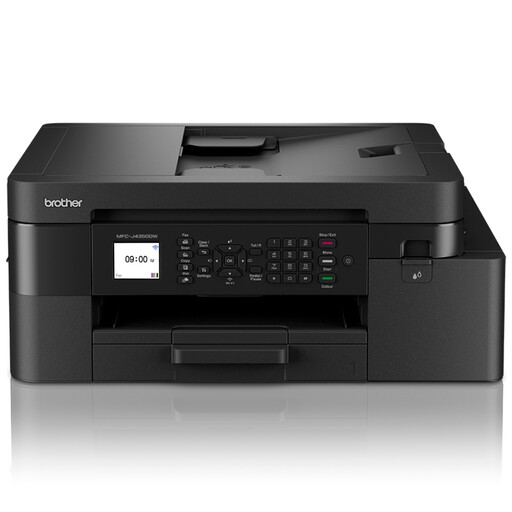 No image available
Consider this inkjet where a smaller shared-desk setup is the priority. Compare its feeder with the team’s usual brief length, and check whether the intended scanning jobs require automatic handling of two-sided originals.
Check that every intended user can connect, then confirm automatic two-sided printing and an ADF suited to the team’s multi-page briefs. If colleagues scan two-sided originals, verify duplex scanning separately; the presence of an ADF is not enough.
No. An ADF feeds original pages for copying or scanning, while automatic duplex printing prints on both sides of a sheet. Duplex scanning is another capability to check when the original briefs themselves have content on both sides.
Compare compatible consumables using the same expected number and mix of colour and monochrome briefs, alongside the stated yield conditions. Canon’s calculations for refillable MAXIFY models are manufacturer claims, so assess them against the team’s own document coverage rather than assuming the same outcome for every workload.
Check the organisation’s electrical-equipment disposal process and available collection or take-back route. GOV.UK identifies the Waste Electrical and Electronic Equipment Regulations 2013, as amended, as the basis of the UK WEEE framework; the appropriate practical route depends on how the organisation handles its retired equipment.