Choose a multifunction printer with a flatbed if bound sketchbook pages need to be placed individually on the glass. Check that the artwork fits the stated scan area and that the book opens sufficiently flat; prioritise an ink-tank model if printing is frequent, or an automatic document feeder if loose studio paperwork is a substantial part of the workload. A feeder does not replace the flatbed for bound pages.
Who this choice affects
Artists digitising bound sketchbooks
Start with a flatbed whose stated scan area fits your pages. HP identifies flatbeds as suitable for books and magazines, but how closely a page can be captured near the spine depends on the particular book and scanner.
Studios sharing artwork and admin equipment
Consider how colleagues will connect and how many loose documents need handling. Brother lists a 20-sheet automatic document feeder on the MFC-J4540DWXL, but a feeder is for suitable loose sheets, not a bound sketchbook.
Creative workspaces that print frequently
If proofs and paperwork use substantial amounts of ink, consider replenishment alongside scanning. Epson describes the EcoTank ET-2950 as an A4 print, copy and scan model with refillable tanks and quotes yields for its supplied ink set; those yields are not a prediction of your studio’s output.
What to check before buying
Establish whether your sketchbook can be scanned on the flatbed first. Then consider shared-document handling and ink replenishment according to the work the printer will actually do.
| Concern |
What to check |
Who this matters to |
| Bound-page fit |
Measure the artwork against the flatbed’s maximum original size; check whether a representative page can lie flat enough near the spine. |
If my artwork reaches the gutter, I need to know whether I can position the book without losing part of the page. Around 42% of consumers put bound-page fit first. |
| Shared workflow |
Check connectivity for the studio’s devices and whether paper capacity or an automatic document feeder would help with loose sheets. |
When several people share the device, I want routine paperwork to move through it without holding up everyone else. Roughly 33% of consumers prioritise that shared workflow. |
| Ink replenishment |
Estimate black and colour printing volume; compare the applicable cartridge or supplied-ink yields without treating different manufacturer tests as directly equivalent. |
If we print proofs and paperwork regularly, I want to know how often ink will need replacing. Around 25% of consumers make replenishment their primary concern. |
Mistakes to avoid
-
Assuming a document feeder scans bound books
An automatic document feeder handles suitable loose sheets. HP identifies flatbeds as suitable for books and magazines, while Brother’s 20-sheet feeder specification for the MFC-J4540DWXL describes a separate document-handling feature.
Check flatbed access and the stated scan area, and try a representative sketchbook if possible. Consider feeder capacity separately for loose studio paperwork.
If a bound page cannot be positioned safely, it may require a separate book-scanning approach.
-
Choosing A4 printing without measuring the artwork
Printer paper size does not establish how much of a bound page the scanner can capture. Canon states a maximum flatbed original size of 216 mm × 297 mm for the PIXMA TS6550i; artwork beyond that area or close to a raised spine needs particular attention.
Measure the page and its artwork, including the gutter area, against the exact scanner specification before choosing a model.
Artwork beyond the usable scan area may need separate scans and stitching, or another scanning method.
-
Overlooking ink replacement when printing is frequent
Scan specifications alone will not tell you how often a shared printer needs ink. Canon lists 180 A4 colour-document pages for each standard black and colour cartridge on the PIXMA TS6550i; Epson quotes up to 8,500 black and 6,500 colour pages from the supplied ink set for the ET-2950. The figures come from different manufacturer specifications and are not direct predictions of studio use.
Estimate the studio’s black and colour output, then check the ink system and the conditions behind each model’s stated yields.
Frequent cartridge changes can interrupt a busy shared-printing workflow.
Relevant brands for reference
Canon
The PIXMA TS6550i is a compact multifunction example for artwork that fits its documented A4 flatbed area.
- Canon specifies a 216 mm × 297 mm maximum original size and 1,200 × 2,400 dpi optical scan resolution for this model, alongside wireless functions and automatic duplex printing.
- Canon lists standard black and colour cartridge yields of 180 A4 colour-document pages each. Check replenishment needs if the studio prints frequently; these specifications do not describe every Canon printer.
Epson
The EcoTank ET-2950 combines A4 flatbed scanning with refillable ink tanks for studios that also print regularly.
- Epson specifies a 1,200 × 2,400 dpi optical scan resolution and quotes up to 8,500 black and 6,500 colour pages from the supplied ink set.
- Its A4 flatbed specification does not establish whether every thick or tightly bound sketchbook can lie suitably on the glass.
Brother
The MFC-J4540DWXL is relevant where loose office documents make up a substantial part of the shared workload.
- Brother specifies a 20-sheet automatic document feeder, 400-sheet paper capacity and wireless connectivity for this model.
- Those loose-document features do not establish how a bound sketchbook will scan. Check the exact model’s flatbed area and access for the artwork.
Joybuy products for this task
The product below represents the compact A4 flatbed route for scanning individual sketchbook pages in a shared studio. Its stated scan area must still fit your artwork, and the book must be positionable on the glass.
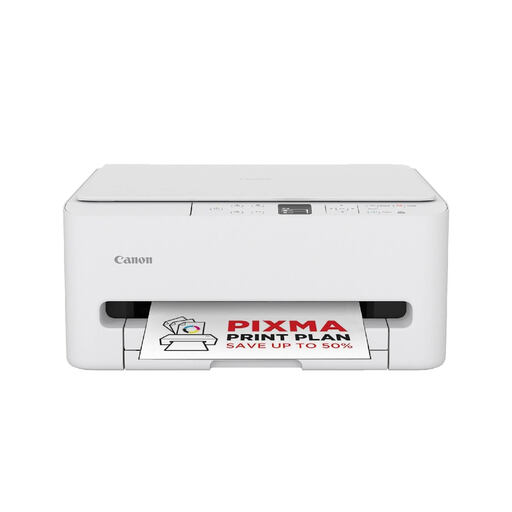 Image unavailable
Canon PIXMA TS6550i
Consider this model for individual sketchbook pages that fit its flatbed and can be placed sufficiently flat on the glass.
Canon specifies a maximum original size of 216 mm × 297 mm and 1,200 × 2,400 dpi optical scan resolution for the PIXMA TS6550i. It also lists wireless functions and automatic duplex printing.
Check gutter access and lid clearance with your sketchbook; the stated scan area alone cannot establish how a tightly bound page will appear.
View on Joybuy
Frequently asked questions
Should an automatic document feeder decide which printer I buy for sketchbooks?
No: choose a flatbed for bound pages that need placing individually on the glass, and assess a feeder separately for suitable loose sheets. HP identifies flatbeds as suitable for books and magazines, but neither scanner type alone confirms that a thick or tightly bound book can be captured close to its spine.
Which scan dimensions should I check?
Compare the artwork’s dimensions with the exact model’s stated maximum original size, then consider whether the binding prevents the page from lying flat. Canon specifies 216 mm × 297 mm for the PIXMA TS6550i flatbed; an A4-labelled cover does not establish that artwork near the gutter will fit cleanly.
What should a UK studio do with an old printer?
Arrange an appropriate electrical-equipment recycling route rather than putting the printer in ordinary waste. GOV.UK describes the UK’s waste electrical and electronic equipment framework; check the collection arrangements available through your council or a relevant retailer or manufacturer.


