Batch-document digitiser
You have loose family paperwork to scan in runs. Feeder capacity, permitted paper types and a manageable scanning workflow matter more to you than photo-printing features.


For batches of loose A4 paperwork, look for a multifunction printer with an automatic document feeder (ADF), while keeping a flatbed option for fragile or awkward originals. If records often have information on both sides, check for a double-sided ADF rather than assuming duplex printing also means duplex scanning. How much you expect to print afterwards, and where the printer will fit, should shape the final choice.
You have loose family paperwork to scan in runs. Feeder capacity, permitted paper types and a manageable scanning workflow matter more to you than photo-printing features.
You need room for the device and its scanning workflow in a small or shared flat, and may also use it for coursework. Placement, connectivity and the ink system all affect the choice.
Your family records often contain information on both sides. An explicitly specified double-sided ADF matters more to you than automatic two-sided printing alone.
Start with the size and condition of the originals, then consider how much you will print later and whether the printer has enough space to operate.
| Concern | What to check | Who this matters to |
|---|---|---|
| Batch scanning | Check ADF capacity and the permitted sizes and paper weights of originals. | If I have a stack of loose family papers, I want to scan them without placing each sheet by hand; around 42% of consumers put batch scanning first. |
| Later printing | Compare the appropriate cartridges or ink bottles for your expected use, and confirm what ink comes with the exact listing. | Once the family files are scanned, I may still need to print coursework and forms without frequent ink changes; roughly 33% of consumers prioritise ongoing printing needs. |
| Fit and two-sided records | Allow space to load paper and open the scanner; check for a double-sided ADF if you need automatic scanning of both sides. | In a small flat, I need space to use the printer, and I would prefer not to turn two-sided records by hand; about 25% of consumers place fit and two-sided handling first. |
An ADF and automatic two-sided printing do not establish that both sides of an original can be scanned automatically. Epson describes the ET-4800 as ADF-equipped but explicitly specifies a double-sided ADF for the ET-4951.
If two-sided family records are common, check the exact model for a double-sided ADF or duplex-scan specification.
Otherwise, scanning both sides may mean turning pages manually.
Feeders have model-specific limits. Brother specifies permitted paper types and weights for the DCP-J1460DW feeder, so its presence does not mean every family original belongs in it.
Sort the records before scanning. Feed only suitable loose sheets and use a flatbed for fragile, folded, thick or irreplaceable documents.
Canon and Epson publish page yields for refillable-ink models under manufacturer-specified conditions. Your mix of coursework and other printing may differ.
Compare yields only on a like-for-like basis, then check the compatible ink and what is supplied with the exact model.
A product page can remain visible after an item becomes unavailable.
Check the current listing, full model number and ordering options before relying on it for your purchase.
Brother has ADF-equipped inkjet multifunction models relevant to loose-page document scanning.
Canon’s MAXIFY MegaTank range includes refillable-ink multifunction models for scanning and continued document printing.
Epson’s EcoTank range includes refillable-ink multifunction models with different ADF capabilities.
These multifunction printer choices are relevant to scanning loose family paperwork alongside later printing. Check the feeder, ink system and space requirements of the exact model against your originals and your flat.
 No image available
Consider this model for loose-page batches and continued printing. Before buying, confirm which originals its feeder accepts, whether it scans both sides automatically and how much operating space it needs.
 No image available
Consider it if family-document scanning will be followed by regular printing. The product name specifies A4 and Wi-Fi; confirm what the +Ink listing includes, as well as its double-sided scanning capability and operating clearance.
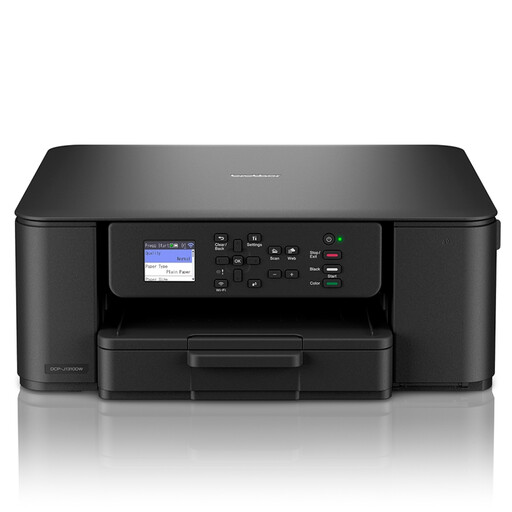 No image available
Worth considering when you need to handle both loose sheets and originals better placed on a flatbed. Check the feeder’s capacity and permitted media, whether it scans both sides automatically and which cartridges suit your printing plans.
 No image available
Consider this model for loose-page batches only if you have suitable space to place and use it. Check its full dimensions, feeder media limits and double-sided scanning specification before committing desk space.
No. Use an ADF only for originals that meet the exact model’s feeder rules. Brother specifies permitted media for the DCP-J1460DW; a flatbed is the safer choice for fragile, folded, thick or irreplaceable originals.
No. Duplex printing and double-sided scanning are separate capabilities. Epson explicitly describes a double-sided ADF on the ET-4951; check for equivalent scan wording on any other model you are considering.
The Information Commissioner’s Office says the fee is not required when personal data is processed only for personal, family or household affairs. That condition does not address records handled for an organisation or in a business capacity.
Check your local authority’s household electrical-recycling options or a retailer’s take-back terms. GOV.UK identifies the Waste Electrical and Electronic Equipment Regulations 2013, as amended, as the framework underpinning UK recovery, reuse and recycling measures.