People archiving bound programmes
If you keep stapled, folded or thick booklets, look for scanner glass that accommodates the pages you need to capture. A feeder intended for loose sheets does not replace scanning a bound programme page by page.


Choose an A4 flatbed multifunction printer if your theatre-programme pages fit on its glass and you scan them occasionally: bound pages can be placed on the glass rather than fed through an automatic document feeder (ADF). If covers or fold-outs exceed A4, check the larger model’s actual flatbed dimensions; an ADF is useful chiefly when you also scan loose paperwork regularly.
If you keep stapled, folded or thick booklets, look for scanner glass that accommodates the pages you need to capture. A feeder intended for loose sheets does not replace scanning a bound programme page by page.
If you mainly digitise covers, cast lists and notes and print only occasionally, a compact A4 flatbed multifunction printer is a starting point, provided every page you need fits its scan area.
If loose documents are a regular part of your workload, an ADF can reduce manual loading for those sheets. Keep the flatbed in mind for the programmes themselves.
Start with the condition and size of your programme pages; consider feeder capacity and printing supplies only after the scanning method fits the originals.
| Concern | What to check | Who this matters to |
|---|---|---|
| Handling bound pages | Confirm there is a flatbed and check its glass size and lid clearance for a thick booklet. | With a stapled or bound programme, I need to place pages on the glass rather than feed the booklet through rollers; around 36% of consumers put gentle handling first. |
| Page size and artwork | Compare the largest cover or fold-out with the flatbed’s maximum document dimensions; check optical scan resolution for fine detail. | If artwork or small print runs across a larger page, I want to capture what matters without cutting off the edges; around 29% of consumers prioritise page coverage and legibility. |
| Loose-sheet scanning | Check ADF capacity and whether the model scans both sides of a loose sheet, rather than merely printing on both sides. | When I regularly scan loose cast sheets or correspondence alongside programmes, loading each sheet by hand takes time; roughly 21% of consumers put loose-document throughput first. |
| Printing alongside scanning | Check the ink format, stated yields and paper input against how often you print catalogue sheets or notes. | If I print archive labels and notes regularly, I need a supply format that suits that use as well as a suitable scanner; about 14% of consumers prioritise printing convenience. |
An ADF handles loose sheets; its capacity does not tell you how a stapled or thick programme will scan. The flatbed still requires you to position pages individually.
Check the flatbed size and how the lid accommodates your booklet before treating feeder features as a benefit.
Paper-handling and scanning dimensions are separate specifications. An A3-capable printer may have a smaller feeder or scan area.
For an oversized cover or fold-out, confirm the exact model’s maximum flatbed document size before buying.
The UK Intellectual Property Office says copying an entire work would not generally be fair dealing under the non-commercial research or private-study exception. Owning the printed programme does not, by itself, settle whether you may copy or share it.
Check the applicable permission before copying an entire programme or distributing scans.
The PIXMA models considered here include a compact A4-flatbed option and an A3-capable all-in-one.
The EcoTank ET-5150 is an A4 multifunction option for people who print regularly as well as scan.
The MFC-J5740DW and MFC-L8390CDW address office-style printing and loose-document scanning alongside programme work.
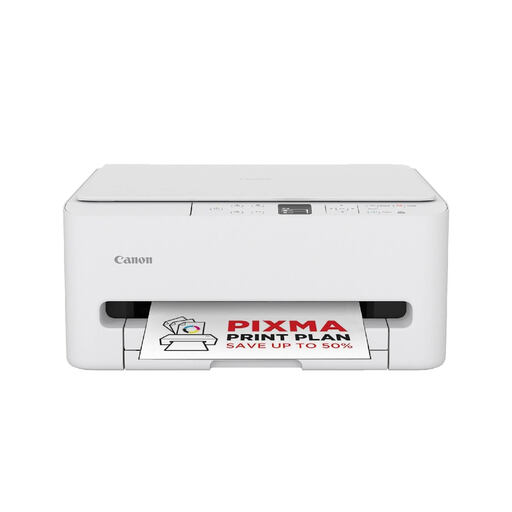
This A4 flatbed option is relevant when you scan bound theatre-programme pages individually and the pages fit within A4.
 No image available
Consider this model for scanning bound programme pages one at a time when they fit its A4 flatbed.
Canon UK specifies a maximum flatbed document size of 216 × 297 mm and optical scan resolution of 1200 × 2400 dpi. Larger pages will not fit in one scan; if the booklet is thick, check that the lid accommodates it without forcing the original.
Use the scanner glass for a stapled, bound or thick programme rather than feeding the booklet through an ADF. Brother’s scanner-glass guidance describes scanning one page at a time; reserve the feeder for suitable loose sheets.
Compare every page you need to capture, including covers and fold-outs, with the model’s maximum flatbed document size. Canon UK specifies 216 × 297 mm for the PIXMA TS6550i; an A3 printing specification on another model does not establish its scan area.
An ADF matters when you also scan loose, multi-page paperwork frequently. Epson UK lists a 35-page ADF for the ET-5150, but that capacity does not change how you scan a bound programme on the flatbed.
Do not assume that owning the programme permits whole-work copying or sharing. The UK Intellectual Property Office says the non-commercial research or private-study exception is subject to fair dealing and that copying an entire work would not generally qualify; check whether you need the rights holder’s permission.
Follow your model’s cleaning instructions for the document path before scanning more loose sheets. Epson advises cleaning dust or dirt from the clear portion of the paper-path guide when addressing scan-quality problems.