Loose-sheet note archivists
If you periodically scan stacks of loose A4 notes, an ADF reduces page-by-page placement. Check its stated capacity and confirm duplex scanning if your notes have content on both sides.


Choose a multifunction printer by the condition and size of your workshop notes before comparing print features. Loose A4 batches favour an automatic document feeder (ADF), but two-sided notes need confirmed duplex scanning; use the scanner glass for originals unsuitable for feeding and check for A3 scanning if plans exceed A4. If you also print regularly, consider the supply system without assuming that a refillable-tank model scans both sides automatically.
If you periodically scan stacks of loose A4 notes, an ADF reduces page-by-page placement. Check its stated capacity and confirm duplex scanning if your notes have content on both sides.
If your records include loose notes, sketches, photographs or originals needing individual handling, keep the scanner glass in your workflow. Epson’s scanning guidance directs users to place photos on the glass rather than in the ADF.
If you scan notes and regularly print work documents, consider the printer’s supply system, paper handling and connectivity as well as its scanning method. An ADF alone does not establish automatic two-sided scanning.
Start with how your originals must be handled, then check their size and whether regular printing will also be part of the job.
| Concern | What to check | Who this matters to |
|---|---|---|
| Scanning loose batches | Check ADF capacity and supported original size; confirm duplex scanning separately if notes have content on both sides. | When loose notes pile up, I want to scan a batch without placing every page on the glass or making a separate pass for the reverse sides. Around 50% of consumers would put low-handling batch scanning first. |
| Handling individual originals | Check for a scanner glass and consult the exact model’s feeder instructions before inserting an original. | If my notes include photos or pages that need careful placement, I would rather handle them one at a time than feed them automatically. Protecting individual originals would come first for around 30% of consumers. |
| Printing alongside scanning | Compare compatible supplies and their stated yield basis, then check that the scan workflow still suits your notes. | When I print work documents regularly as well as scanning notes, replenishing ink or toner becomes part of my choice. Around 20% of consumers would make ongoing printing needs their primary concern. |
An ADF and automatic duplex printing do not establish automatic duplex scanning. Canon UK says the MAXIFY GX4050 requires manual duplex copying and scanning through its ADF, so two-sided notes need turning and reloading.
Look for an explicit two-sided scanning specification for the exact model rather than relying on the word duplex alone.
Not every original belongs in a feeder. Epson’s ScanSmart guidance specifically directs users to scan photos on the scanner glass.
Inspect the original and the model’s feeder instructions; use the glass when individual placement is needed.
A3 scanning addresses oversized originals, but adds no scanning-size benefit when every note fits on A4.
Measure the largest plan or diagram you need to capture at its original size, and check the printer’s maximum scanning size—not just its printing size.
Check that an A3 device will fit in the space available on your desk.
A printer used for both scanning and frequent document printing also needs an ink or toner replenishment plan. A refillable tank or a larger paper tray does not, by itself, tell you whether its scanning workflow suits your notes.
Check compatible supplies, the stated page-yield basis and your colour-printing needs alongside the ADF and duplex-scanning details.
Epson’s WorkForce models illustrate different A4 and A3 scanning setups for a home office.
Canon’s MAXIFY GX4050 is a refillable-tank option to examine when regular document printing and an ADF both matter.
Brother has cited A4 colour-inkjet and mono-laser multifunction models with different feeder sizes.
HP’s OfficeJet Pro A4 range includes home-office models with document feeders.
These multifunction printers are choices to consider for loose-sheet scanning alongside home-office printing. Match the feeder, two-sided scanning method and maximum original size to your own notes; an A3 printing feature alone does not establish A3 scanning.
 No image available
Consider this model if you scan loose-sheet batches and print regularly using refillable ink. Confirm its two-sided scanning method and check the feeder instructions before handling photos or other originals that need individual placement.
 No image available
For loose A4 notes and regular home-office printing, assess this refillable-ink model against your usual batch size. Automatic duplex printing does not confirm automatic duplex scanning, so check the scan method if your notes have content on both sides.
 No image available
Consider this model for batches of loose notes, particularly if a searchable-PDF workflow matters to you. Check the maximum size of an original it can scan before choosing it for A3 diagrams, and confirm the two-sided scanning method separately.
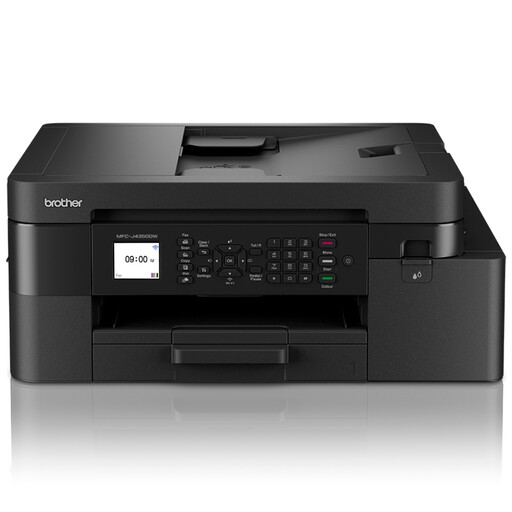 No image available
Consider this model when your loose-sheet scanning batches are modest. Check whether its feeder suits your typical originals and confirm how it scans two-sided notes before relying on an automatic workflow.
Choose an ADF when your notes are mainly loose sheets and you want to scan several in one loading session. Keep a scanner-glass option for originals that need individual placement, and check the model’s feeder instructions before inserting them.
No: check duplex scanning separately for the exact printer. Epson United Kingdom states duplex scanning for the WF-C4810DTWF, while Canon UK says the MAXIFY GX4050 requires manual duplex scanning through its ADF.
Choose A3 scanning when a plan, diagram or record exceeds A4 and you need to capture it at its original size. Epson United Kingdom specifies A3 duplex scanning for the WF-7840DTWF; for any other model, check the maximum scanning size rather than relying on its printing size.
They can if the exact printer and its software support optical character recognition (OCR). On supported Epson products, the Epson ScanSmart workflow requires an OCR language selection and may require the OCR component to be installed; check the software supplied for the model you choose.