For mostly A4 music exercises on a shared desk, choose a multifunction printer whose paper access and scanner clearance fit the space. A compact cartridge model suits intermittent printing, while an ink-tank model is worth considering for regular batches; choose A3 capability only if your scores need the larger format. Whichever route you take, check the exact duplex-paper rules and print a representative exercise PDF before relying on small notation being legible.
Who needs which setup?
Occasional A4 printer on a shared desk
If you print exercise sheets now and then but also need to scan or copy them, start with the room the device can occupy while it is in use. Paper loading and scanner-lid access matter as much as its closed dimensions. Canon describes the PIXMA TS7550i as a space-conscious model with front controls that does not require rear access.
Regular handout printer
If lessons or rehearsals generate repeated batches of A4 sheets, compare how often you would need to replenish ink and paper. Epson and Brother offer ink-tank models with stated high-yield ink supplies, but those figures do not establish how many of your particular music PDFs a set of ink will print.
Large-score and batch-work user
If you need large scores or frequently copy and scan multipage material, check A3 print capability and document-feeder capacity separately. London Music Preparation describes A4 as standard for parts and small scores and A3 as a format for large scores. A larger-format machine also needs a deliberate workspace plan.
What matters when choosing?
Start with the size of the exercises you actually print and the space needed to operate the printer, not just its closed footprint. If printing is frequent, compare ink replenishment and paper handling alongside those constraints.
| Concern |
What to check |
Who this matters to |
| Desk space and access |
Measure the installed footprint and allow room to load paper, collect pages and open the scanner lid. Check how every desk user will connect. |
I need to keep working at the desk and reach the printer without moving other equipment; around 46% of consumers put shared-desk access first. |
| Recurring A4 printing |
Compare the ink system, replacement-ink availability and tray capacity against how often you print. Treat stated page yields as model-specific figures, not your expected output. |
When exercise packs are a regular task, I want fewer interruptions to replenish ink or paper; roughly 36% of consumers prioritise that recurring-print workflow. |
| Score format and batches |
Confirm A3 printing only if your scores require it, and distinguish A3 scanning from A3 printing. Check document-feeder capacity and the permitted paper for automatic duplexing. |
If I handle large scores or multipage originals, the format and copying workflow determine my choice; about 18% of consumers make format and batch handling their primary concern. |
Mistakes to avoid
-
Assuming automatic duplex works with every paper
A printer may accept a paper type for one-sided printing without supporting automatic two-sided printing on it. Canon specifies automatic duplex on the PIXMA TS7750i for A4 or letter-size plain paper; that rule should not be applied to other models without checking them.
Before buying heavier music or presentation paper in bulk, check the chosen model’s duplex sizes, media types and paper-weight limits. Plan for one-sided or manual two-sided printing if your paper is outside those limits.
-
Buying A3 simply because the pages contain music
London Music Preparation describes A4 as standard for parts and small scores, with A3 used for large scores. An A3-capable multifunction printer addresses a different format need and requires space for the machine and its paper.
Open the exercises and scores you expect to print at their intended page size. Choose A3 printing only when the layout calls for it, and check separately whether you also need A3 scanning.
-
Treating a stated ink yield as your running cost
Epson and Brother state page yields for particular ink-tank models, but your output will depend on factors including page coverage, colour use and print settings. A yield figure alone cannot settle the cost of your exercise sheets.
Estimate your own printing frequency, then compare the replacement ink available for the exact models you are considering. Include the practicalities of refilling and loading paper.
-
Checking the printer’s functions but not the shared workflow
A device that prints, scans and copies still needs accessible trays, space above the scanner and a connection method its users can operate.
Map where paper goes in and comes out, how far the scanner lid opens and whether each intended computer or mobile device can use a supported connection. A front-access layout is particularly worth checking where rear clearance is limited.
Relevant brands to consider
Canon
Canon’s PIXMA TS7550i illustrates a compact A4 print, scan and copy route for a shared workspace.
- Canon describes the TS7550i as having front controls and no requirement for rear access; it also specifies a 35-sheet automatic document feeder.
- Check paper and duplex rules for the exact model. For example, Canon limits automatic duplex on the related TS7750i to A4 or letter-size plain paper.
Epson
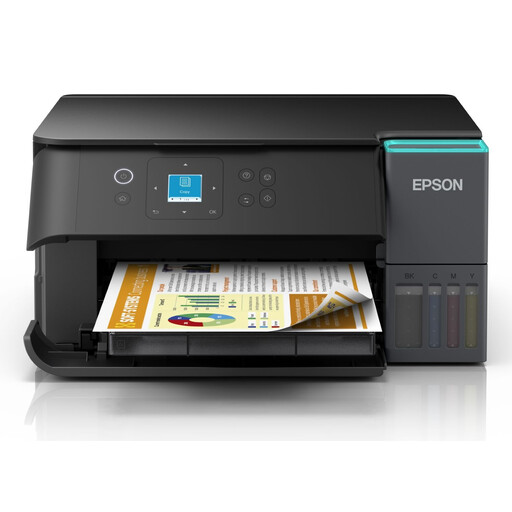
Epson’s EcoTank ET-2951 illustrates an A4 ink-tank route for people who print exercises regularly.
- Epson specifies print, scan and copy functions, wireless connectivity and automatic A4 double-sided printing for the ET-2951. It rates one set of inks for up to 8,500 black or 6,500 colour pages.
- Those manufacturer yields are not a promise for music exercises. Check rear paper-loading clearance and whether your chosen paper can be used for automatic duplexing.
Brother
Brother offers distinct routes represented here by the A4 DCP-T780DW ink-tank model and the A3-print-capable MFC-J5955DW.
- Brother specifies a 150-sheet input tray for the DCP-T780DW. For the MFC-J5955DW, it specifies A3 printing and two 250-sheet trays.
- Do not choose the larger-format route on tray capacity alone: check the space available and whether your work requires A3 printing, A3 scanning or both.
A4 ink-tank printers on Joybuy
These A4 ink-tank multifunction printers are relevant if exercise printing is regular enough to make ink replenishment and paper handling part of the decision. Their place on a shared desk still depends on your available operating clearance, and a sample music PDF is the practical way to assess the notation you need to read.
 No image available
Epson EcoTank ET-5150 +Ink A4 multifunction printer
Consider this A4 print, scan and copy model for recurring exercise sheets if it fits the space needed to operate it. Its listed name specifies Wi-Fi; confirm that every intended user can connect, allow room for paper and scanner access, and try a representative music PDF.
View on Joybuy
 No image available
Canon MAXIFY GX6150
Consider this model for regular exercise-printing batches if its paper format, print, scan and copy functions, and connection options match your workflow. Measure the space available for the printer, paper access and scanner lid before deciding whether it belongs on the shared desk.
View on Joybuy
 No image available
Epson EcoTank ET-2951 A4 wireless colour ink-tank printer, black
For regular A4 exercises, this print, scan and copy model offers refillable ink and wireless connectivity. Epson and Joybuy specify automatic A4 double-sided printing; check the permitted paper before using thicker sheets. Allow space for its rear paper input and print a representative notation PDF.
View on Joybuy
Common questions
Do I need an A3 multifunction printer to print music?
Not simply because you are printing music. London Music Preparation describes A4 as standard for parts and small scores and A3 as a format for large scores. Check the intended size of your actual files, then establish whether you need A3 printing alone or A3 scanning as well.
Can I automatically print exercises on both sides of thicker paper?
Only if the exact printer supports that paper for automatic duplexing. Canon specifies A4 or letter-size plain paper for automatic duplex on the PIXMA TS7750i; this example does not establish the limits of another model. Check its duplex media and paper-weight specifications before buying specialist sheets.
What matters most when a printer shares a desk?
Measure the space needed while the printer is working, including paper loading, finished-page collection and scanner-lid clearance. Check connections for everyone who will use it. If rear access is tight, a front-access layout may help: Canon describes the PIXMA TS7550i as having front controls without a rear-access requirement.


