Bound-sketchbook digitiser
You need to place pages from a bound book on scanner glass. Check the specified flatbed, maximum scan area and space for the binding against your actual sketchbook.


For a bound sketchbook, start with a multifunction printer that has a specified flatbed scanner, then check that its scan area accommodates your pages without forcing the binding. If you also make colour prints, compare the printing features; if you print frequently, consider a refillable-ink model, but check its scanner fit just as carefully.
You need to place pages from a bound book on scanner glass. Check the specified flatbed, maximum scan area and space for the binding against your actual sketchbook.
You scan artwork and also make colour reference or portfolio prints. Compare colour-printing features only after confirming that the scanner accommodates your pages; Canon’s PIXMA TS8750, for example, is a six-ink print, scan and copy model.
You print regularly alongside scanning and want to assess refillable ink and replacement supplies. Epson’s EcoTank ET-2870 and Brother’s tankbenefit DCP-T780DW illustrate that route, but their printing features do not establish whether your bound pages fit the scanner.
Check whether the sketchbook fits the scanner before comparing scan settings, colour printing or the ink routine for regular use.
| Concern | Purchase checks | Who this matters to |
|---|---|---|
| Bound-page fit | Confirm a flatbed, maximum original dimensions and room for the book under the lid; do not infer scan area from print-paper size. | My sketchbook pages are attached to a binding, so I need them to rest on the glass without forcing the book. Around 42% of consumers put bound-page fit first. |
| Colour and scan detail | Match optical scan resolution and file options to your intended output; assess colour-printing features separately from scan accuracy. | When I edit scans and make colour proofs, I need capture settings and printing features that suit both jobs. Around 33% of consumers prioritise colour and usable scan detail. |
| Regular printing | Compare the exact model’s ink system, replacement supplies and connection options against how often you expect to print. | If I produce proof sheets regularly, I want an ink routine and scanning workflow I can keep using. Around 25% of consumers put regular printing and workflow first. |
A printer’s paper format does not establish the largest original its scanner accepts. Canon specifies a maximum scan document size of 216 × 297 mm for the PIXMA TS3150.
Measure the page and any border you need to capture, then compare those dimensions with the exact scanner specification.
An automatic document feeder handles loose sheets; its presence does not establish that a bound book can rest on scanner glass.
Confirm the flatbed and check how the lid accommodates your sketchbook. Consider a feeder separately if you also scan loose pages.
Higher settings create more image data: Canon explains that doubling scan resolution quadruples it.
Choose a setting for the intended screen display, print size or enlargement rather than automatically using the maximum.
Page yields published by Epson and Brother for specified tank models do not predict ink use for artwork with different coverage or printing habits.
Compare the exact replacement supplies and the types of pages you expect to print, while checking scanner fit independently.
HP’s Smart Tank range includes refillable-ink all-in-ones. HP specifies a flatbed scanner and optical resolution up to 1200 dpi for the Smart Tank 525.
Canon’s PIXMA models include flatbed all-in-ones and colour-printing options. Canon specifies a CIS flatbed and a 216 × 297 mm maximum original for the TS3150; the TS8750 is a six-ink print, scan and copy model.
Epson’s EcoTank ET-2870 is an A4 print, scan and copy model with refillable ink tanks.
Brother’s tankbenefit DCP-T780DW combines printing, scanning and copying with an ink-tank system and scanning to a PC or mobile app.
This model is a flatbed option to consider for a bound sketchbook. Check the scan area and lid clearance against your pages before choosing it.
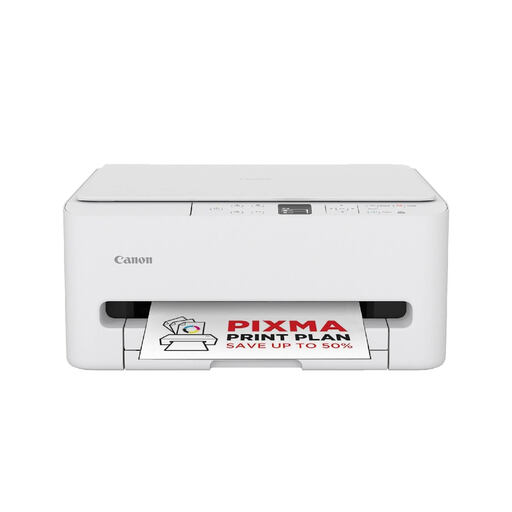 No image available
Consider this model for a bound sketchbook if its flatbed scan area and lid clearance accommodate your pages. Check its optical scan resolution against your intended use for the images.
Check the exact model’s maximum scan document size and flatbed specification before relying on its A4 printing capability. Canon specifies a 216 × 297 mm maximum original for the PIXMA TS3150, but another model may have different scanning limits; allow for any page border you need to capture.
Choose resolution for what you will do with the scan, rather than using the highest setting automatically. Canon explains that doubling scan resolution quadruples image data, so a file intended for enlargement may call for a different setting from one intended only for screen viewing.
It may suit a workflow with frequent printing, provided the exact model also scans your sketchbook pages. Epson and Brother publish yields for specified tank models, but those manufacturer figures do not predict ink use for your artwork, paper choices or printing habits; compare the replacement supplies and scanner specifications separately.
Take an unwanted printer through an electrical-waste collection route rather than putting it in ordinary household waste. GOV.UK says waste electrical products can be taken to a local household waste recycling centre.