
24/7 Customer Support

Free returns

Same-day & Next-day Delivery

Quality Guaranteed

Unlock Your Welcome Offers: FREE Delivery | Up to 80% OFF | Free 30-day JoyPlus trial
Download the APP
A multifunctional electric cooker can take the place of several kitchen appliances, from an electric hot pot and rice cooker to a steamer, slow cooker or pressure cooker. However, a long list of programmes does not automatically mean better everyday value. The right choice depends on usable capacity, heating control, cleaning requirements, electrical safety and how you actually prepare meals.
By Joybuy Product Recommendation Officer
A 5L or 6L cooking pot may sound spacious, but the usable amount can be lower once you allow room for boiling, stirring and steam. Pressure cooking also requires attention to the maximum-fill line, particularly with rice, pasta and ingredients that expand.
For solo meals, a 1.2L to 2L compact electric cooker is usually easier to store and quicker to fill. Couples may prefer around 2L to 4L, while households preparing batch meals or hot pot dinners may benefit from a 5L multi cooker or larger model.
Some appliances advertise ten or more functions, but many households mainly need three or four: boiling, frying or sautéing, steaming and slow cooking. A digital display is useful only if the controls are clear and the programmes suit your recipes.
A simple two-setting ramen cooker can be more practical for noodles, soup and porridge in a student flat. Conversely, a programmable multi cooker can be worthwhile for meal preparation, rice, stews and delayed cooking.
“Non-stick” does not mean scratch-proof or dishwasher-safe in every component. Check whether the inner pot is removable, whether the lid or steamer can go in a dishwasher, and whether the base must be wiped rather than washed.
Use silicone, wooden or nylon utensils with a non-stick electric cooker. Metal tools and abrasive pads can damage the coating. Never immerse the electrical base, plug or cord in water.
Measure the worktop and storage area, including space for the handle, cable and steam release. A portable electric cooker should be easy to move without placing it near the edge of a counter.
As a practical guide:
Capacity is not the only consideration. A wide, shallow pot may be convenient for frying and serving, while a deeper pot can help contain soups and stews.
Wattage indicates electrical input, not guaranteed cooking speed. A 600W cooker can suit small portions, while 1,200W–2,000W models are more appropriate for larger volumes and rapid boiling. Higher power may also require a suitable wall socket and careful placement.
Look for at least two heat levels if you want to switch between rapid boiling and gentle simmering. Stepless controls or multiple temperature settings offer more flexibility for stir-frying, braising and slow cooking.
Choose a product with clear operating instructions and a compatible 220–240V UK plug where specified. Useful features include auto shut-off, boil-dry or overheating protection, a secure lid, heat-resistant handles and a stable base.
These features reduce risk but do not replace supervision. Place the cooker on a level, heat-resistant surface, keep vents clear and avoid extension leads unless the manufacturer expressly permits them. Hot oil, steam, lids and cooking surfaces can cause burns. For pressure cooking, never force the lid open and keep away from the steam-release valve.

Why This Fits Their Persona: Its compact format suits students, couples and small kitchens, while the 1.2L capacity is practical for one to three people.
It avoids paying for an oversized appliance, with two power settings rather than an unnecessarily complex programme menu.
600W high and 300W low settings, a steam basket, glass lid and auto shut-off with dry-boil protection.

Why This Fits Their Persona: It is designed for households wanting pressure cooking, steaming, rice, slow cooking and other functions in one 5.7L appliance.
The product information specifies pressure-release guidance, maximum-fill precautions and a range of built-in safety mechanisms.
9 cooking functions, 14 preset programmes, ceramic non-stick inner pot and LED progress display.

Why This Fits Their Persona: Its large vessel is suited to family gatherings, shared hot pot meals and substantial stews where a small electric cooking pot would require several batches.
The 7L capacity and 30.5cm opening are clearly specified, helping shoppers judge serving space instead of relying on vague “family-size” wording.
1600W power, high and low heat modes, a glass lid and a UK plug are listed in the specifications.
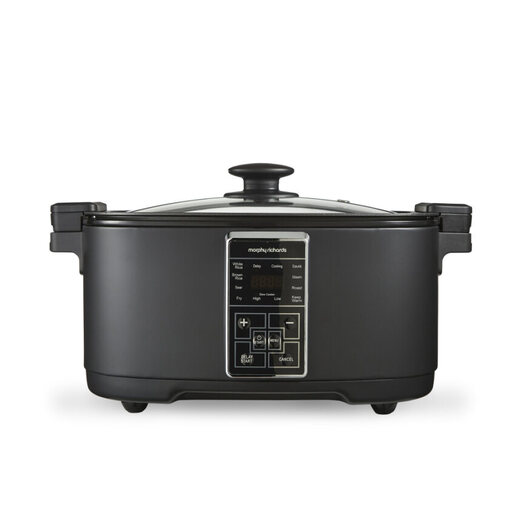
Why This Fits Their Persona: A 6.5L pot and preset cooking modes support batch cooking, entertaining and varied family meals.
The functions, dimensions and dishwasher-safe components are set out clearly, making it easier to assess whether the larger footprint is worthwhile.
Ten preset functions, hinged tempered-glass lid, steam rack and dishwasher-safe pot and accessories.
We have compiled a complete, real-time list of products that fully satisfy these strict selection criteria and UK safety regulations.
Running cost depends on the appliance’s wattage, cooking time, recipe and household electricity tariff. A smaller cooker may use less electricity for a single portion because it heats a smaller vessel, but a 1,600W or 2,000W model draws more power while operating. Check the rated wattage and avoid leaving any cooker running unnecessarily.
Check the accommodation, landlord or workplace rules before purchase. Some halls and offices restrict appliances with exposed heating surfaces or cooking functions. Always use the cooker on a stable, heat-resistant surface and never leave it unattended.
There is no single lifespan that applies to every model. Longevity depends on frequency of use, heat levels, cleaning and utensil choice. Follow the manufacturer’s instructions, avoid overheating an empty pot, use non-abrasive tools and replace the appliance if the coating, cable, plug or safety controls become damaged.