
24/7 Customer Support

Free returns

Same-day & Next-day Delivery

Quality Guaranteed

Unlock Your Welcome Offers: FREE Delivery | Up to 80% OFF | Free 30-day JoyPlus trial
Download the APP
A multifunctional food processor and blender can replace several countertop appliances, but impressive-looking feature lists do not always translate into practical everyday use. A compact model may be convenient for smoothies yet struggle with family meal preparation, while a large machine may offer useful attachments but take too long to assemble and clean.
Before choosing a food processor with blender functions, UK shoppers should look beyond motor wattage and promotional language. Capacity, included tools, cleaning requirements and safe operating limits have a direct effect on how useful the appliance will be.
Motor power is a useful indicator, but it does not describe the complete performance of an appliance. A 750W food processor may be more suitable for chopping and slicing than a smaller blender, while a 600W multifunction blender may be sufficient for smoothies, sauces and smaller batches.
Check the intended functions, blade design, speed controls and recommended operating time. A high-wattage motor is not a guarantee that the appliance is suitable for kneading dough, crushing ice or processing large quantities of dense ingredients.
A stated 1.8L or 2L bowl does not necessarily mean you can fill it to the rim. Ingredients need room to move, and liquids may require a lower maximum level to reduce splashing. Always check the fill markings and instruction manual.
For a family-size food processor, compare both the food-processing bowl capacity and the blender jug capacity. These are often different. A large bowl may be practical for slicing vegetables, while a smaller jug may be more suitable for smoothies or soup.
A 3-in-1 food processor may include chopping blades, slicing discs, grating tools, a blender jug and a personal cup. However, attachments only add value if they are easy to store, assemble and wash.
Look for detachable parts, dishwasher-safe components where specified, and a storage solution that suits your kitchen. Also check whether the motor base can only be wiped clean, as it should never be immersed in water.
For general household preparation, compare the motor rating alongside the tasks you regularly perform:
Speed settings and a pulse function can be as important as wattage. Short pulses help control texture when preparing salsa, chopped vegetables or breadcrumbs. Variable speed may be useful for gradually blending sauces or mixing ingredients.
Choose capacity according to the amount of food you prepare, rather than the largest number in the product title. A 1.5L blender jug can suit everyday drinks and soups, while a 3L food processor bowl is more convenient for batch cooking.
Measure the space between your worktop and wall cupboards before buying. Also account for the height of a blender jug, the width of the base and storage space for discs and blades.
A stainless steel blade is commonly used for chopping, slicing and grating. Check which tools are actually included rather than assuming that every pictured accessory comes with the listing. Some products are sold in different configurations.
For UK households, check the product information for the correct 220–240V electrical specification, supplied plug arrangement, warranty terms and applicable conformity information. Sharp blades should be handled carefully, and the appliance should be unplugged before changing attachments or cleaning.
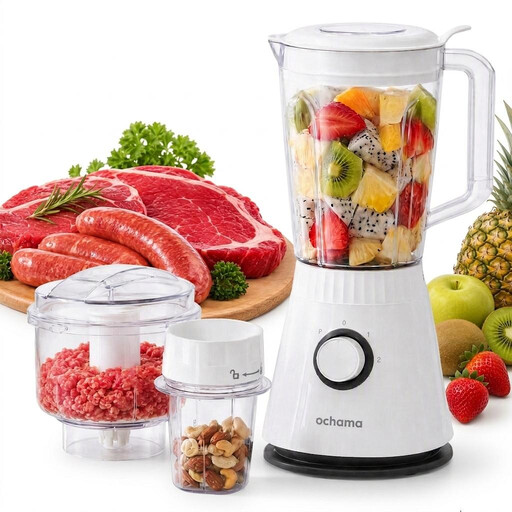
Why This Fits Their Persona: A practical option for smaller kitchens, smoothie routines and everyday chopping without investing in a larger multi-attachment system.
The listing specifies a 1.5L pitcher, 600W motor and three speed settings, making its intended scale clearer than a vague all-purpose claim.
Ice-crushing, meat-chopping, spice-grinding and baby-food purée functions are listed, with detachable components for cleaning.

Why This Fits Their Persona: Suitable for home cooks who want integrated weighing, batch capacity and several preparation tools from one countertop base.
The specification lists a 3L bowl, 1.5L jug, 13 accessories and dishwasher-safe components, so the convenience claims can be checked against clear features.
The 1000W motor, variable speed, pulse function and integrated EasyWeigh scale support measured meal preparation.
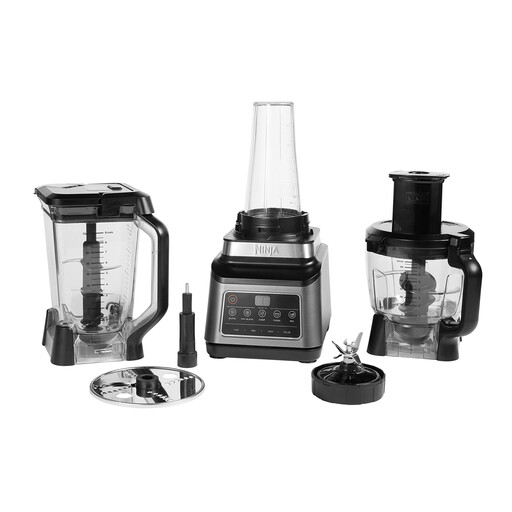
Why This Fits Their Persona: Designed for households that switch between family meals, frozen drinks, doughs, sauces and individual smoothies.
Separate 1.8L processing, 2.1L blending and 700ml drinking formats reduce the need to compromise between batch size and portability.
The listed 1200W motor, five automatic programmes, slicing/grating disc and dishwasher-safe parts cover varied preparation routines.
Place the appliance on a stable, dry surface and secure the bowl, jug and lid before switching on. Use the correct attachment for the task and avoid exceeding the stated maximum fill line. Short processing intervals can help manage heat and texture, particularly when working with dense ingredients.
Electricity use depends on motor rating, processing time and frequency. A 1,200W appliance does not necessarily consume 1,200 watts continuously; it uses that rated power while operating under the relevant load. Shorter processing cycles and preparing several portions together may be more practical than repeatedly running a small appliance.
For cleaning, disconnect the plug first and wait until blades have stopped. Wash or place removable components in the dishwasher only where the product instructions allow it. Handle blades and grating discs by their edges, and wipe the motor housing with a damp cloth.
We have compiled a complete, real-time list of products that fully satisfy these strict selection criteria and UK safety regulations.
It can be useful for puréeing cooked ingredients, but check the manufacturer’s instructions, batch size and temperature limits. Do not process hot liquids unless the manual specifically permits this. Allow food to cool as required and follow appropriate food-safety and feeding guidance.
Lifespan depends on build quality, frequency of use, cleaning and whether the motor is operated within its stated limits. Avoid overfilling, forcing ingredients into the feed chute or exceeding recommended continuous operating times. Keep proof of purchase and check the warranty before ordering.
A 2-in-1 food processor or 3-in-1 food processor may reduce the need to buy separate chopping and blending appliances. However, compare the included accessories, usable capacities and storage requirements. Paying for attachments that will remain unused may not represent good value for your cooking routine.