Listeners who want a stereo stage
If you can accommodate two speaker positions, a powered pair gives you a physical left and right channel for recordings with singers, chorus and orchestra.


Choose a powered stereo pair if you can give two speakers separate positions and want a physical left-right layout for voices and orchestra. A compact all-in-one speaker is easier to place if you mainly stream recordings and have little furniture space. Whichever format you prefer, check the connections for your actual sources; product features alone do not establish how a system will sound in your room.
If you can accommodate two speaker positions, a powered pair gives you a physical left and right channel for recordings with singers, chorus and orchestra.
If cast albums mostly come from a phone or streaming service, a compact speaker can occupy one shelf or tabletop position. Check its supported streaming and setup options before choosing.
If recordings also come from a TV, laptop, CD player or turntable, the available inputs may matter more than the speaker format. Match each source to a documented connection.
For musical-theatre recordings in a small living room, decide whether two separate speaker positions are practical, then check how you will play your recordings.
Choose it when: You want physical left-right playback and have room for two cabinets.
Allow for: More placement space and setup than a single cabinet; connections vary by model.
Choose it when: One-box placement and streaming matter more to you than separate left and right speakers.
Allow for: Less flexibility in physical speaker spacing and, on some models, accessories for wired sources.
| Concern | What to check | Who this matters to |
|---|---|---|
| Stereo placement | Check whether two cabinets are supplied and where you could position them separately. | If I want singers and orchestral parts presented across distinct left and right positions, I need space for a stereo pair; around 33% of consumers put that layout first. |
| Simple streaming | Check the supported phone-streaming options and any app or home Wi-Fi requirements. | When most of my recordings come from a phone, I would rather give up a second cabinet than rearrange the room; around 25% of consumers prioritise compact streaming. |
| Source connections | List your TV, computer and other sources, then match their outputs to the speaker inputs and any required adapters. | If I switch between a filmed production on TV and albums on other equipment, every source needs a workable connection; roughly 25% of consumers make source flexibility their main concern. |
| Close-range placement | Measure the available desk or shelf space and check whether a subwoofer output matters to you. | With a small listening position beside a desk or media unit, I need cabinets that fit there without ruling out a later bass addition; about 17% of consumers put this compact-pair need first. |
A compact all-in-one speaker may be convenient, but it cannot provide the same physical spacing as separately placed left and right speakers.
If that layout matters for ensemble recordings, measure two possible positions before choosing a powered pair.
Inputs differ between systems. Sonos says Era 100 needs its Line-In Adapter for analogue line-in, while KEF lists HDMI ARC, USB-C and optical inputs for LSX II LT.
Write down each source and its output connection, then check the speaker's documented input and any accessory it requires.
A wired source may require an adapter, cable or, for a turntable without one built in, a phono preamp.
A stated frequency-response range does not tell you how much low-frequency weight a compact speaker will deliver in your room.
If bass in orchestral passages is important to you, check for a documented subwoofer output and consider where an additional cabinet could go.
Adding a subwoofer also takes floor space and requires a suitable connection.
A convenient shelf is not necessarily a suitable one if the speaker could be exposed to moisture or heat.
Electrical Safety First advises placing smart speakers on a flat, stable surface away from moisture and heat.
These brands illustrate different speaker formats and connection choices; check the exact model rather than assuming every product from a brand has the same features.
KEF's LSX II LT is a two-speaker system for listeners who want separate positions alongside TV, computer and streaming connections.
The M20 is a powered stereo pair for listeners connecting music and other living-room sources.
Era 100 offers a compact, single-cabinet route for listeners who mainly stream.
The A2+ Gen 3 is a small powered pair aimed at desktop or compact-shelf listening.
These Edifier tabletop and desktop models are options to consider where shelf space and playback connections matter. Check the number of speaker cabinets supplied before choosing one for physical left-right separation.
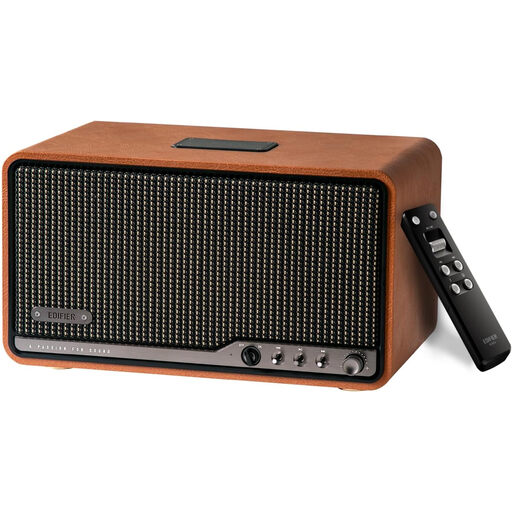 Image unavailable
Consider this tabletop format if you want one compact position for music playback. If separate left and right speaker positions are essential, confirm what is supplied and how an additional speaker would connect.
 Image unavailable
Consider the M60 for a compact desk or shelf setup with Bluetooth, USB-C or AUX playback. Its listed specifications include 66 W RMS and LDAC; confirm the number of speaker cabinets supplied before relying on two physical playback positions.
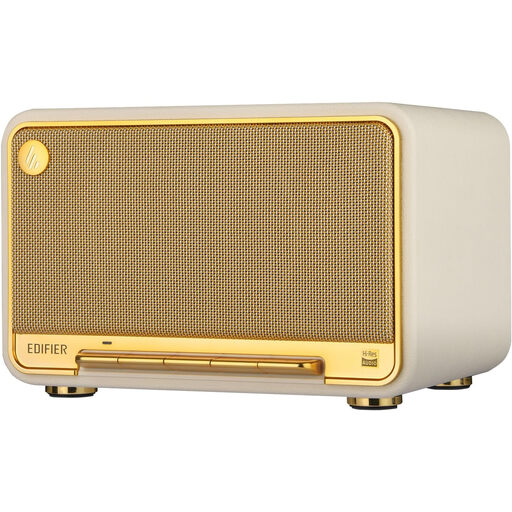 Image unavailable
This tabletop model is worth checking if you need AirPlay 2 or Bluetooth 5.3 alongside USB-C and AUX inputs. The title lists 60 W RMS; measure your available surface and confirm the cabinet layout if separate stereo positions matter.
Choose a powered stereo pair if separate left and right playback positions matter and you have room for both cabinets. Choose a compact all-in-one speaker if one-box placement and streaming are more important; neither format guarantees a particular sound in your room.
Yes, if the system has a compatible input and you have any required accessories. Q Acoustics lists turntable and CD-player connections for the M20, while Sonos requires its Line-In Adapter for analogue line-in on Era 100; a turntable without a built-in phono preamp may also need a phono stage.
Some can, but match the TV's output to the exact speaker input. KEF lists HDMI ARC and optical connections for LSX II LT, while Q Acoustics lists TV use for M20; check the required cable and your TV's available outputs.
Not necessarily. KEF says LSX II LT needs a home Wi-Fi network for its full feature set and warns that guest, public and some managed networks can prevent connection, so check your network arrangement before choosing it for Wi-Fi-dependent listening.
Use a flat, stable position away from moisture and heat. Electrical Safety First gives this placement advice for smart speakers; leave enough practical space for the speaker and its connections rather than balancing it on a crowded shelf.