
24/7 Customer Support

Free returns

Same-day & Next-day Delivery

Quality Guaranteed

Unlock Your Welcome Offers: FREE Delivery | Up to 80% OFF | Free 30-day JoyPlus trial
Download the APP
Choosing musical toys for kids can be more complicated than it first appears. A colourful instrument may attract attention in a product photo, but the real questions are whether it suits the child’s age, fits comfortably in small hands and remains enjoyable after the first few days.
Parents and gift buyers in the UK should also look beyond character branding and claims about “educational” play. A thoughtful purchase balances safety, sound control, durability, size and the child’s interests.
Character designs from Bluey, Peppa Pig, Disney Frozen, Toy Story, Spider-Man and PAW Patrol can encourage children to pick up an instrument. However, a familiar character cannot compensate for an unsuitable size or difficult controls.
Check the recommended age, dimensions and grip before buying. A 53cm first guitar may suit a child aged 3 or above, while a toddler musical toy with large buttons may be more appropriate for younger children.
Musical play can encourage rhythm, creative expression, hand-eye coordination and fine motor practice, but the results depend on how the child uses the toy. A keyboard with many sound modes may encourage experimentation, while a wooden xylophone offers a simpler way to explore cause and effect.
Treat terms such as Montessori musical toys, sensory musical toys and educational musical toys as descriptions of play style rather than guaranteed developmental outcomes. Look for practical features that children can use independently, such as responsive keys, accessible controls and stable construction.
Electronic children’s musical instruments can require batteries and may become disruptive if there is no volume control. Before buying, check whether batteries are included and whether the toy offers adjustable volume or a mute mode.
Acoustic toy guitars do not need batteries, but they may require manual tuning. The guitar options below include tuning knobs, while a tuner is not included. This is worth considering if the child expects to play recognisable notes or songs.
Always follow the manufacturer’s age guidance and product warnings. Several first guitars are marked as suitable from age 3 and carry a small-parts choking hazard warning. They should be used with direct adult supervision, particularly during early play and while packaging is being removed.
For toys for children aged 1–5, look for sturdy components, rounded edges and controls that are easy to operate without force. Toys intended for babies and young toddlers should not be treated as suitable for younger children simply because they look colourful.
A child may lose interest in a toy that is too heavy or awkward to hold. First guitars in this selection measure approximately 21 inches or 53cm, with lightweight construction and nylon strings intended to be gentler on small fingers than metal strings.
For toddlers, tabletop instruments such as a toy piano keyboard or a floor-play drum panel may be easier to access. A removable stand can also help the toy adapt to different play positions.
For wooden instruments, check whether the product specifies responsibly sourced wood, such as FSC-certified wood, and inspect the design for smooth edges. For electronic toys, look for clearly stated materials such as BPA-free ABS plastic, rounded edges and a stable base.
Volume control is particularly useful for drum sets and keyboards used indoors. It allows adults to reduce the sound during quiet periods, although it should not be treated as a substitute for sensible supervision or reasonable listening levels.
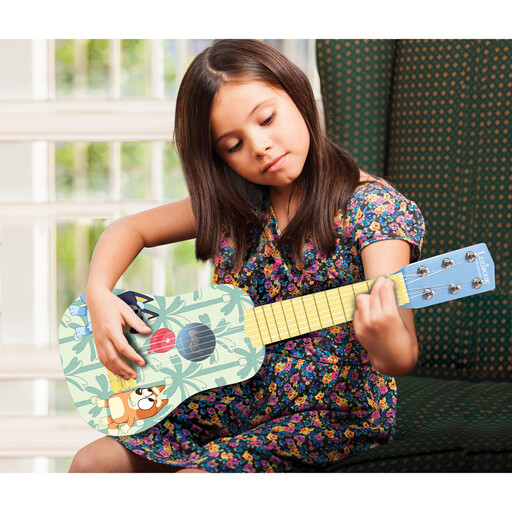
Why This Fits Their Persona: A straightforward choice for families introducing an acoustic instrument without electronic controls or battery replacement. The Bluey design may appeal to young fans, while the 53cm size is intended for children from age 3.
It does not rely on preset electronic effects or batteries. Its manual tuning design is clearly listed, with a tuner excluded from the package.
53cm format; no assembly or batteries required; includes a beginner’s guide.
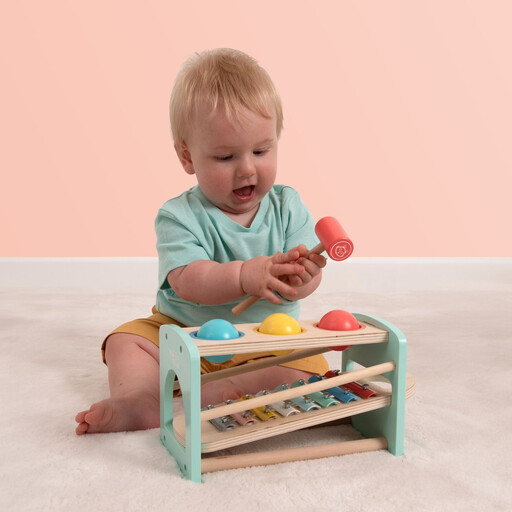
Why This Fits Their Persona: Suitable for households seeking a tactile wooden instrument that also works as an active play bench. It is listed for children from 12 months and suits supervised sensory exploration.
The play actions are clear rather than hidden behind marketing language: children can tap the balls onto the keys or strike the xylophone directly.
FSC-certified wood; includes three balls and a hammer; no batteries required.
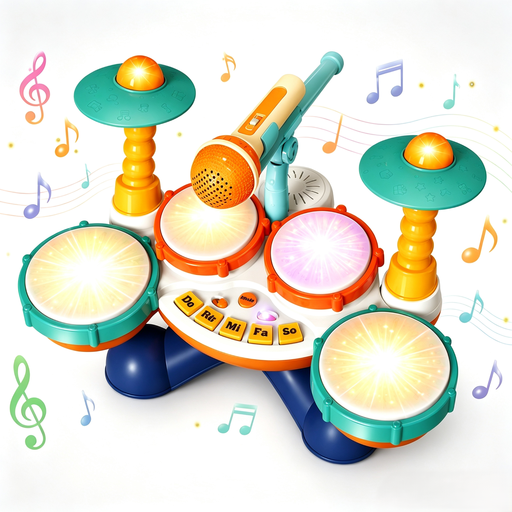
Why This Fits Their Persona: Designed for children aged 1–4 who enjoy energetic, interactive play involving singing, tapping and sound effects. It may suit families wanting a more active toddler musical toy for indoor play.
The listing specifies an adjustable volume control, helping adults manage sound levels. The wide base is also described as anti-slip.
Four light-up drum pads; two cymbals; working microphone; batteries are not included.
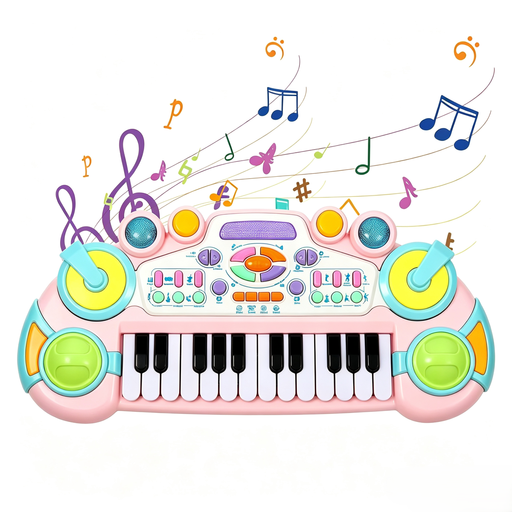
Why This Fits Their Persona: A practical option for toddlers aged 1–5 in flats, shared homes or families wanting flexible indoor play. It combines keys with sound modes while offering volume adjustment and mute functionality.
The product details specify adjustable volume and a mute mode, addressing the common problem of electronic toys being difficult to manage indoors.
24 keys; multiple sound effects and melodies; BPA-free ABS construction is specified; batteries are not included.
We have compiled a complete, real-time list of products that fully satisfy these strict selection criteria and UK safety regulations.
They can be, provided you choose a model with adjustable volume or mute mode and set clear play times. Acoustic instruments such as guitars do not require batteries, but strumming and tapping can still create noticeable sound.
Many do. The guitars listed here have manual tuning knobs, but a tuner is not included. An adult should assist with initial tuning. These instruments are intended for beginner play, so buyers should not assume they will arrive tuned like a full-size guitar.
Lifespan depends on construction, storage and how intensively the toy is used. Keep wooden instruments dry, store loose accessories safely and remove batteries from electronic toys if they will not be used for an extended period. Regularly check strings, keys, stands and small components for damage, and stop use if any part becomes loose or broken.