
24/7 Customer Support

Free returns

Same-day & Next-day Delivery

Quality Guaranteed

Unlock Your Welcome Offers: FREE Delivery | Up to 80% OFF | Free 30-day JoyPlus trial
Download the APP
Choosing musical toys for toddlers can be surprisingly difficult. Product pages often highlight flashing lights, dozens of sounds and educational claims, but these features do not always translate into enjoyable or practical play at home.
For UK families, the right choice should suit the child’s age, available space, noise tolerance and stage of development. Whether you are buying toddler musical instruments for everyday play or searching for birthday gifts for toddlers, the following guide helps you avoid common purchasing traps.
A toy may advertise numerous songs, sound effects and play modes, yet a young child might only use one or two buttons. Look for controls that are easy to find and activate, rather than assuming a longer feature list means better value.
A musical activity table with several distinct play areas can be useful because a child can move between pressing keys, spinning gears and tapping a drum. However, check whether the modes are genuinely accessible for the intended age group.
Loud electronic toys can quickly become unpleasant in a flat, nursery or shared family space. A product without volume adjustment may spend more time in a cupboard than on the floor.
Adjustable volume is a practical specification for light-up musical toys and electronic toddler instruments. A mute or quiet setting can also be useful during travel, nap times or indoor play in the evening. Even with volume control, adults should supervise use and avoid placing speakers close to a child’s ears.
A toy suitable for a three-year-old may not be appropriate for a younger sibling. Plush toys with button eyes, detachable accessories and small components require particular care.
Always check the manufacturer’s stated age range, product warnings and packaging before purchase. CE or EN71 references can indicate that the product is presented as meeting relevant European toy safety requirements, but parents should still inspect the item for damage, loose parts and accessible battery compartments.
For babies from around six months, choose sensory toys that can be used during floor play or tummy time. A removable-leg activity centre may offer more flexibility than a standing table alone.
For children aged one to three, consider whether the toy can support sitting, standing or active movement. A children’s drum set with a stable base is more suitable for energetic tapping than a lightweight instrument that slides across the floor.
For children aged three and above, a children’s guitar can introduce strumming and simple rhythm patterns. Check the stated warning carefully, particularly if younger children are likely to share the toy.
Look for clearly stated materials such as ABS plastic, smooth edges and a construction without easily detached parts. “BPA-free” may be listed as a product feature, but it should not replace checking the overall build quality.
Stability matters for toys used while standing. Wide bases, anti-slip feet and removable stands can help reduce movement during play. Examine the dimensions as well: a large toy may be engaging but difficult to store in a typical UK home.
Many electronic early learning toys require batteries, which are often not included. Confirm the battery type and quantity before giving the toy as a gift. A volume dial, automatic shut-off or quiet mode may help reduce unnecessary battery use, although actual lifespan depends on battery quality and frequency of play.
Non-electronic instruments, such as a plastic guitar, avoid battery costs altogether. They may require more adult involvement at first, especially if the child is learning how to hold, strum or follow simple instructions.
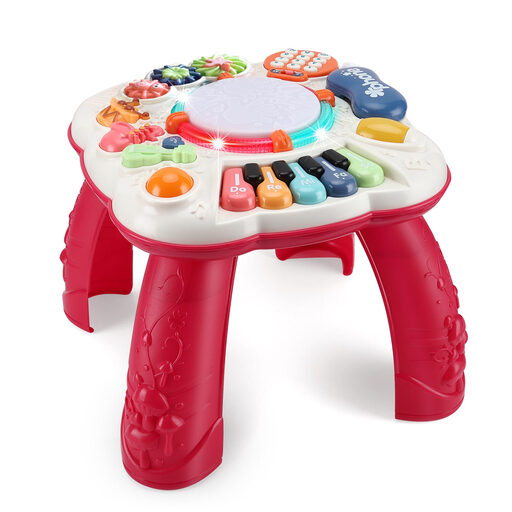
Why This Fits Their Persona: A compact option for families wanting several activities in one toy rather than buying separate early learning toys for 1-3 year olds.
It includes removable legs, allowing use as a floor-play panel before transitioning to a standing table. The listed features also include volume control.
Six play zones include piano keys, a drum, gears, a pretend telephone and instrument sound buttons. Batteries are not included.
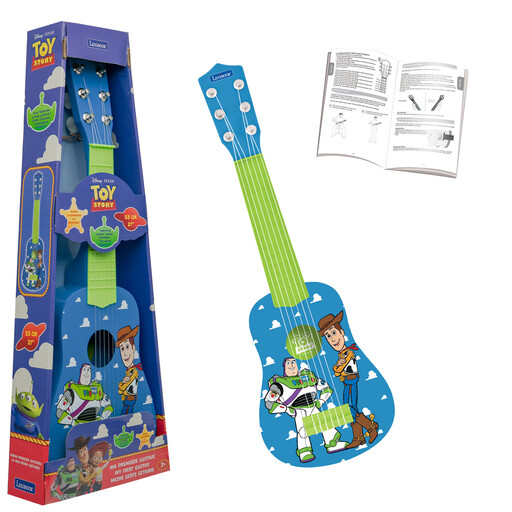
Why This Fits Their Persona: Suitable for families seeking a more focused, character-led instrument for a child aged three or above.
Its purpose is clear: introductory strumming rather than a collection of unrelated electronic effects. The age warning helps prevent unsuitable gifting.
It has six nylon cords, a 21-inch length, a tunable design and an included playing guide. A tuner is not provided.
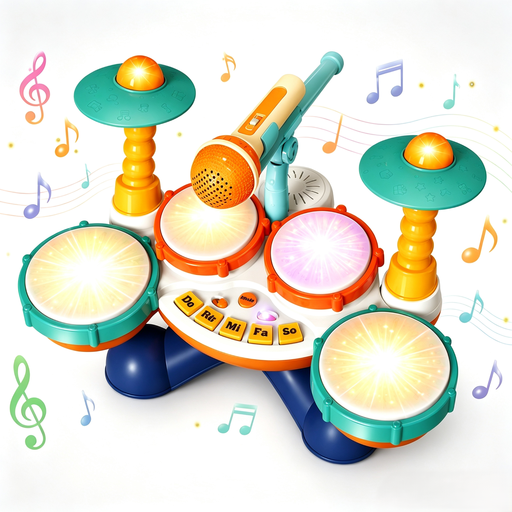
Why This Fits Their Persona: Designed for children who enjoy active, repeated play and families prepared to manage sound levels during indoor performances.
The adjustable volume dial addresses the noise issue, while the listing specifies a wide four-point anti-slip base and rounded edges.
It combines four light-up drum pads, two cymbals, three play modes, ten melodies, animal sounds and a working microphone. Batteries are not included.
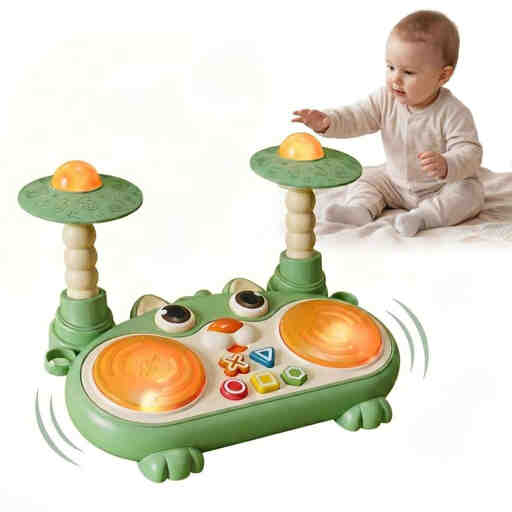
Why This Fits Their Persona: A practical choice for relatives shopping for a baby shower, first birthday or early sensory play gift.
Its stated 6-36-month range is paired with floor-friendly sensory activities, rather than relying on advanced instrument handling.
It offers light-up drum pads, animal sounds, shape and colour sorting and an anti-slip base. Batteries are not included.
We have compiled a complete, real-time list of products that fully satisfy these strict selection criteria and UK safety regulations.
They can be, provided the toy has adjustable volume or a quiet setting. Place it on a soft play mat to reduce impact noise, keep the speaker away from the child’s ears and set household rules for when louder play is appropriate.
Lifespan depends on construction, frequency of use, battery condition and storage. Check for secure battery compartments, wipe-clean surfaces and sturdy bases. Remove batteries if the toy will be stored for a long period and inspect it regularly for cracks or loose components.
They can support exploratory play, turn-taking and simple cause-and-effect understanding when used appropriately. Pressing keys, tapping pads or strumming strings may also encourage hand coordination and rhythm awareness. These benefits are not a substitute for adult interaction, so singing and playing together can make the toy more meaningful.