
24/7 Customer Support

Free returns

Same-day & Next-day Delivery

Quality Guaranteed

Unlock Your Welcome Offers: FREE Delivery | Up to 80% OFF | Free 30-day JoyPlus trial
Download the APP
Choosing musical toys for toddlers can seem straightforward until you compare flashing activity centres, baby musical toys, toddler musical instruments and character-themed guitars. Some products offer plenty of buttons but little variety, while others create more noise than useful play. The right choice depends on your child’s age, available space, supervision routine and tolerance for sound at home.
This guide explains the common buying traps, the specifications worth checking and our top recommendations for different types of families and gift buyers.
A product listing may advertise dozens of songs, phrases or sound effects. That does not necessarily mean a child will have more ways to play. Check whether the toy offers different actions, such as pressing, turning, tapping, strumming and pretend play. A cube or activity table with several play zones may hold attention more effectively than a single-button sound toy.
Electronic interactive music toys can be difficult to use in flats, during quiet time or around sleeping siblings if the volume cannot be adjusted. A volume dial or mute function gives adults more control. It is still sensible to keep the toy at a comfortable level, avoid placing speakers close to a child’s ears and supervise use.
A toy designed for children aged 1 to 3 is not automatically suitable for a younger baby. Likewise, a 53cm guitar may be intended for children aged 3 and above because of small parts or the way it is played. Always read the manufacturer’s age guidance and warnings, particularly where the packaging states choking hazard or requires direct adult supervision.
For babies aged around 6 to 12 months, look for large, easy-to-activate features, stable bases and floor-play options. Suitable educational toys for babies may include light-up drums, simple sound buttons and shape-sorter elements.
For toddlers aged 1 to 3, consider a baby activity cube, musical activity table or compact drum set. These can provide varied actions while supporting early cause-and-effect exploration. For children aged 3 to 8, a toy guitar for children can introduce strumming, basic chords and musical vocabulary.
Look for clearly stated materials, smooth edges and a stable construction. Several products in this guide list ABS plastic, BPA-free materials and rounded edges. These details are useful, but they do not remove the need for regular checks. Inspect toys for cracks, loose components or damaged strings, and remove all packaging before use.
A CE mark indicates that the manufacturer declares conformity with applicable European requirements; it is not an independent ranking of quality or durability. Product listings may also reference EN71 requirements. UK buyers should check the product information, warnings and seller details before purchase, particularly when ordering for a child under three.
Measure the intended play area before choosing a drum set or table. Check whether batteries are included, the battery type and whether the toy has an automatic shut-off. Acoustic-style guitars need no batteries, while electronic drums, plush toys and activity tables may require regular replacements.
For families who travel by car, visit grandparents or have limited storage, a cube or removable-leg activity table may be easier to manage than a larger stand-mounted instrument.
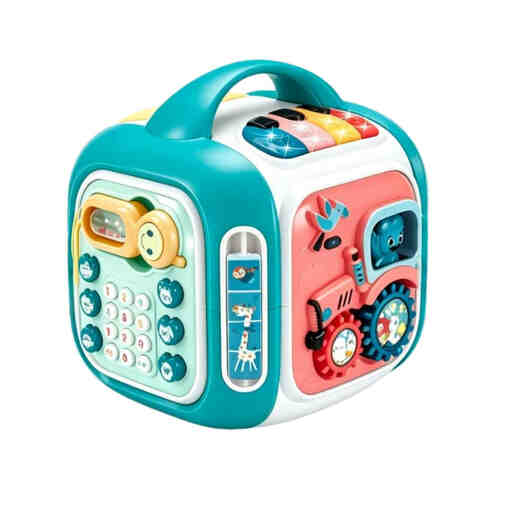
Why This Fits Their Persona: A compact option for families wanting several play functions without filling a small lounge or playroom. It is listed for ages 1 to 3 and measures 23 x 23 x 24cm.
Eight play modes provide more than one type of interaction, including piano, guitar, gears and pretend phone play.
Portable carry handle, ABS construction and rounded edges listed in the product details.
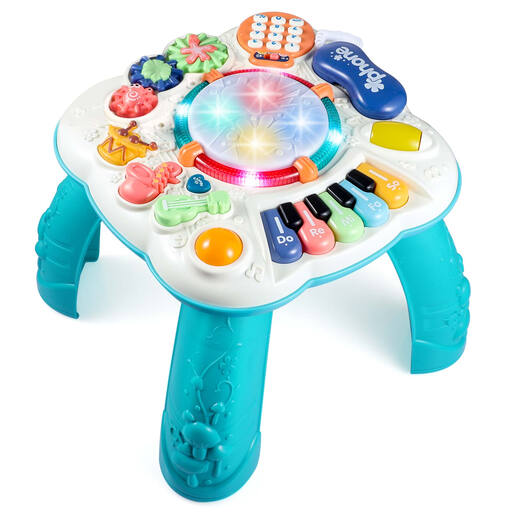
Why This Fits Their Persona: A multi-stage choice for households seeking a more substantial play centre from tummy-time play through standing activity.
It includes six play zones and a volume control dial, rather than relying on one repetitive sound feature.
Removable legs allow floor or standing use; the listing states ABS, BPA-free materials and rounded edges.
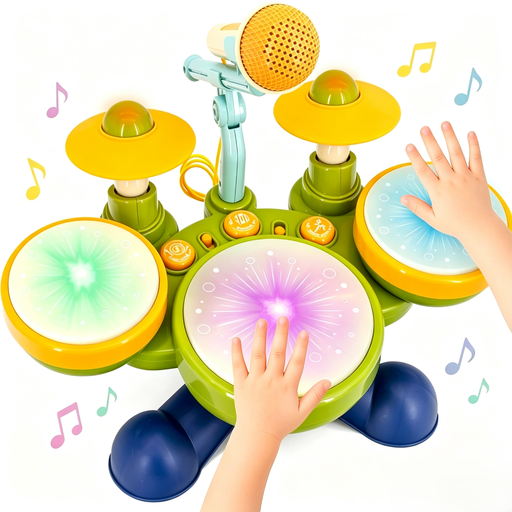
Why This Fits Their Persona: Suitable for energetic toddlers who enjoy singing, tapping and repeated active play, particularly where adults need control over household noise.
The adjustable volume dial addresses the common problem of electronic instruments being too loud for indoor play.
Includes light-up drum pads, cymbals, a working microphone and a removable stand; batteries are not included.
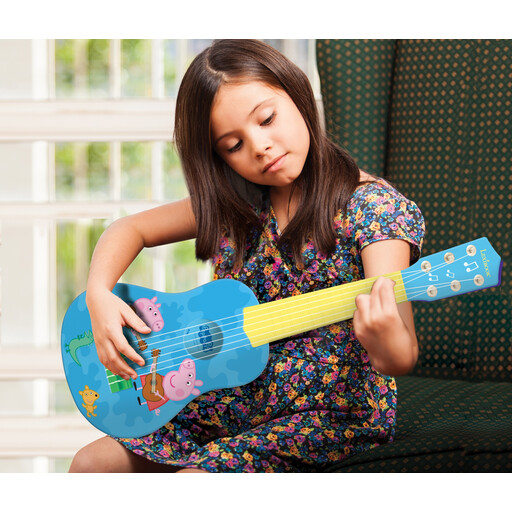
Why This Fits Their Persona: A suitable birthday gift for a child aged 3 to 8 who is interested in pretend performance and learning a recognisable string instrument.
The product information clearly states the 3+ age guidance and small-parts warning, helping buyers avoid giving it to a younger child.
Six soft nylon strings, a beginner’s guide and manual tuning knobs; no batteries are required.
We have compiled a complete, real-time list of products that fully satisfy these strict selection criteria and UK safety regulations.
Some are designed for babies from 6 months, including simple light-up drums and floor-play activity centres. Check the exact age range, keep small accessories away from young children and supervise play. A toy intended for toddlers aged 1 to 3 should not automatically be used by a younger baby.
Lifespan depends on construction, frequency of use, battery condition and storage. Choose products with sturdy bases, protected controls and replaceable batteries where applicable. Inspect frequently for cracks, loose pieces and worn cables or strings. Store electronic toys away from moisture and remove batteries before long-term storage if the instructions recommend it.
Not always. Acoustic-style first guitars, including several character guitars, use no batteries. Activity cubes, musical tables, baby musical toys and drum sets commonly require batteries, which may not be supplied. Check the listing before purchase and confirm whether volume control or mute functions are available.