What to check before choosing
Start with readiness and supervision, then compare the amount you would serve with the salt and allergen information on the current pack. Treat “medium sliced” as a preparation choice, not as a reason to skip those checks.
| Priority |
What to check |
Your needs |
| Readiness and supervision |
The NHS lists steady sitting and head control, picking up food and swallowing among readiness signs. Supervise eating throughout; a mini naan or sliced portion does not remove choking considerations. |
Is my baby ready to handle solid food, and can an adult stay with them throughout the meal? |
| Portion and salt |
Check whether salt is stated per 100 g, per mini naan, per half naan or per whole naan. Asda lists 0.45 g per mini plain naan, while Tesco lists 0.48 g per half plain naan (65 g); the portions differ. |
I want to compare the amount actually served, not assume that “mini” means less salt for every portion. |
| Ingredients and allergens |
Read the exact pack for declared allergens and may-contain statements. Asda’s standard plain naan declares wheat and may contain oats, rye and barley; its Free From plain naan is labelled gluten-free but lists 0.96 g salt per naan. |
If gluten must be avoided, I need to check that the whole ingredient and allergen panel meets the child’s requirements. For nursery or school food, I also need to check the setting’s allergen policy. |
| Pack format |
A mini naan provides a separate smaller unit; a standard naan can be divided before serving. Check the size and texture of the piece against the child’s current eating skills, rather than relying on a pack-size description. |
A smaller unit may be convenient, but I may already have a standard plain naan that I can portion for the meal. |
Relevant brand references
These retailer label examples show why format and serving basis matter; check the current pack before using any figure or allergen declaration.
Asda
Asda labels provide examples of standard, mini and Free From plain naan.
- Asda lists 0.95 g salt per standard plain naan and 0.45 g per mini plain naan.
- The standard plain naan declares wheat and may contain oats, rye and barley. The Free From plain naan is labelled gluten-free but lists 0.96 g salt per naan.
Tesco
Tesco’s plain naan label states nutrition for half a naan.
- The stated half naan is 65 g and contains 0.48 g salt, giving a defined portion basis for reading the label.
- Half a naan is a label portion, not an automatic serving size for a baby. Check the ingredients in bold for allergens.
Waitrose
Waitrose’s plain naan is labelled as a pack of two flame-baked naans.
- Nutrition is stated per naan, including 0.95 g salt.
- A per-naan figure describes the full product, not the amount that must be served to a baby. Check the pack’s allergen declaration.
M&S
M&S provides ingredient, nutrition and storage information for its plain naan.
- The listed ingredients include wheat flour and wheat gluten.
- Marks & Spencer advises that product information can change, so check the current label before serving.
A plain naan option on Joybuy
This plain naan is an option if you plan to divide a standard naan before serving. Its pack format alone does not settle the portion, salt or allergen checks involved in baby-led weaning.
 No image available
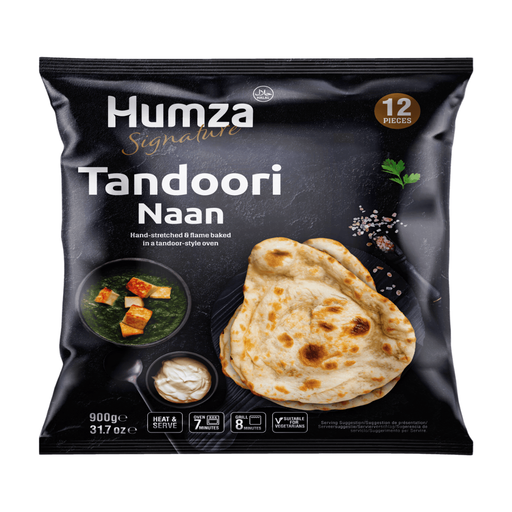
Humza Plain Tandoori Naan 300g, 4 pieces
For a meal using plain naan in smaller amounts, this four-piece pack can be divided before serving. Check the current pack’s salt and allergen information and supervise eating throughout.
View on Joybuy
Questions about naan and baby-led weaning
When can a baby start having a food such as naan?
The NHS advises starting solid foods when a baby is developmentally ready, usually at around six months alongside breast milk or infant formula. Readiness signs include sitting with steady head control, picking food up and bringing it to the mouth, and swallowing rather than pushing food back out.
Does a mini naan make baby-led weaning safer?
No: a mini naan may make the quantity easier to manage, but it does not replace readiness checks or adult supervision. Consider the piece offered and the child’s current eating skills; the NHS notes that choking can be quiet.
Is plain naan necessarily lower in salt?
No. Compare the current labels using the amount you intend to serve. Asda lists 0.45 g salt per mini plain naan and 0.95 g per whole standard plain naan; Tesco lists 0.48 g per half plain naan (65 g). Those figures use different portion sizes.
Does regular naan contain gluten?
The examined standard and mini plain naan products declare wheat or cereals containing gluten, but check the exact pack rather than assuming every recipe is identical. The NHS advises introducing foods that can trigger allergies one at a time and seeking GP or health-visitor advice first if a baby has an allergy or eczema, or there is a relevant family history.


