Studios handing over completed projects
You need to retain deliverables, keep ownership of folders clear and recover files if something goes wrong. Frequent editing directly from the NAS may not be part of the job.


For completed animation projects that will mainly be stored and handed over, start with a multi-bay NAS, compatible drives and a separate backup plan rather than paying for editing-focused network features. Consider faster networking and SSD storage if people will repeatedly access or edit large files from the NAS; the computers and network between them must support that setup too. If client folders contain personal information, include access controls and appropriate security measures in the decision.
You need to retain deliverables, keep ownership of folders clear and recover files if something goes wrong. Frequent editing directly from the NAS may not be part of the job.
You regularly open or move large media and project files. Network connections and workstation compatibility matter alongside storage capacity.
You need to control who can access each project, remove access after delivery and protect retained copies. If folders contain personal information, assess the security measures appropriate to that data.
Decide whether the NAS will hold completed projects or serve as a working location. Then plan usable capacity, recovery and client access around the handover itself.
| Concern | What to check | Who this matters to |
|---|---|---|
| Recovery | Check the separate backup destination and how you would restore a project folder; RAID alone is not a backup. | If a delivered folder is changed or the NAS is lost, I need a recoverable copy. Around 36% of consumers put recovery first. |
| Usable capacity | Allow for current projects, revisions and the retention period, then compare usable capacity under the intended drive-protection layout. | I need room to retain this handover and later projects without relying on a drive’s headline capacity. Capacity is the primary concern for around 29% of consumers. |
| Working speed | For repeated transfers or direct project access, check the NAS ports and the corresponding workstation, switch and cabling connections. | If several of us work with large files from shared storage, waiting for repeated access matters more than archive space alone. Around 21% of consumers prioritise working speed. |
| Controlled access | Check folder permissions, sharing controls and how access is removed after delivery; assess encryption where personal information is stored. | I need the client to reach the right files without leaving other project folders open. Controlled access comes first for around 14% of consumers. |
Drive redundancy cannot recover every deleted, altered or compromised project folder. The National Cyber Security Centre advises regular backups for recovery from destructive ransomware and notes that backups are not ransomware-resistant by default.
Set up a separate backup destination and test restoring a representative folder before relying on the NAS for handovers.
Allow for backup capacity and time to test restores.
Recording technology matters to the intended workload. Western Digital distinguishes its SMR WD Red drives for lighter, idle-heavy use from the CMR WD Red Plus and Red Pro lines it identifies for ZFS systems.
Check the complete drive model, recording technology and the enclosure maker’s compatibility list before buying disks.
A faster NAS port does not make an existing workstation connection faster. Synology, QNAP and ASUSTOR present high-speed networking as part of a wider media-storage setup.
Check the computer port or adapter, switch, cabling and NAS port together before choosing a faster-network model.
Adapters, suitable switching and cabling may also be needed.
Old accounts or sharing links can leave project folders accessible beyond the handover. For stored personal information, the Information Commissioner’s Office identifies encryption as one way to help protect against unauthorised access.
Plan who receives access, when it will be reviewed or removed, and whether encryption is appropriate for the files and physical setup.
NAS options for shared project storage, file access and versioning.
NAS models covering compact storage and higher-I/O media workflows, depending on configuration.
Creator-oriented NAS models with networking and SSD options that vary by model.
NAS hard-drive line to consider when populating a compatible multi-bay enclosure.
Western Digital CMR NAS-drive lines for compatible enclosures.
These NAS enclosures cover different bay counts and potential roles, from retained handover folders to shared project access. Choose the drive configuration, backup destination and network setup to match how your team will use the files.
 No image available
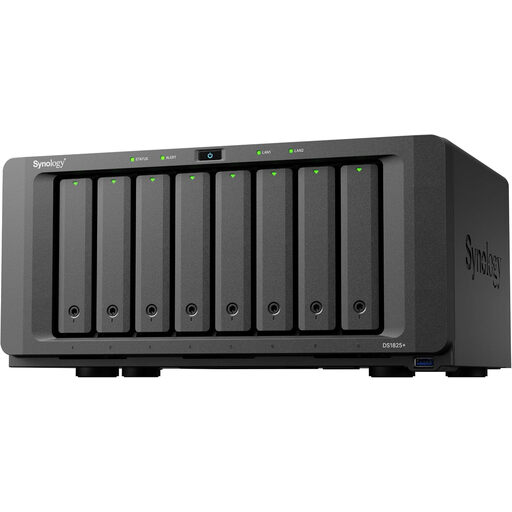
Consider the eight-bay layout if completed projects need room for a growing archive. This is a diskless NAS: check compatible drives, usable capacity under your chosen protection layout and a separate backup destination. For active work, confirm the exact network configuration before planning faster connections.
 No image available
The four-bay DS425+ is a choice to assess for shared client-project folders. Confirm the drives supplied or required, usable capacity, and the particular permissions and sharing controls needed for your handover; plan a separate backup as well.
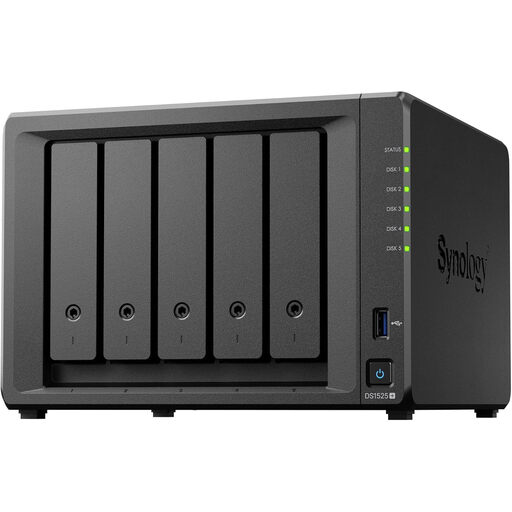 No image available
Assess this five-bay model if the NAS will hold projects that several people access repeatedly, not just completed handovers. It is diskless, so select compatible drives and check usable capacity. Confirm its network configuration against your workstations and switch, and provide a separate backup.
 No image available
The four-bay DS925+ is worth assessing when project storage may need to grow or files are transferred frequently. Confirm the compatible expansion unit before planning extra bays, as the product descriptions give conflicting unit names. Also check drive inclusion, usable capacity and your separate backup plan.
 No image available
Consider this two-bay model for a more limited project-storage and sharing requirement. It is diskless: check approved drives, usable capacity and whether its client-access controls fit the handover. Set up and test a separate backup rather than relying on drive redundancy alone.
No. RAID can help a NAS remain available after a drive failure, but it cannot replace a separate backup that you can restore. The National Cyber Security Centre advises regular backups for recovery from destructive ransomware and cautions that backups need appropriate protection too.
Not for occasional copying and retention alone. Consider faster networking if several people repeatedly transfer large files or work directly from the NAS, and check that their computers, adapters, switch and cabling support the intended connection.
Start with the enclosure maker’s drive-compatibility list and check each disk’s full model number and recording technology. Western Digital identifies Red Plus and Red Pro as CMR drives for ZFS systems, while Seagate describes IronWolf Pro as CMR storage for RAID and NAS use; those product-line descriptions do not replace a model-specific compatibility check.
Consider encryption as part of the security plan when folders contain personal information, alongside access controls and backups. The Information Commissioner’s Office identifies encryption as a way to help protect stored personal information from unauthorised access; choose measures appropriate to the files and how the NAS and drives are kept.
Review who still needs access, remove obsolete accounts or sharing links, and confirm which version you will retain and for how long. Check that the retained project can be restored from its separate backup.