What matters when choosing?
Set the recovery plan and capacity target before deciding whether active shared editing justifies faster networking. A NAS used chiefly for scheduled backups presents a different network question from one serving several editors throughout the day.
| Concern |
What to check when buying |
Who this matters to |
| Recovery beyond RAID |
Check scheduled, versioned backups, a separate destination and how the studio will test a restore. Synology warns that RAID failures can still cause data loss. |
If losing the primary NAS would leave my studio without its footage, I need recoverable versions elsewhere; around 31% of consumers put this recovery need first. |
| Shared-workstation bandwidth |
Count simultaneous transfers and check NAS ports, switch connections and active clients together. QNAP says a complete 10GbE setup needs compatible equipment at each point. |
When several editors move large assets at once, I want to assess the whole network path rather than the NAS port alone; roughly 25% of consumers prioritise shared-workstation bandwidth. |
| Archive growth |
Estimate footage growth and retention needs, then calculate usable capacity with the intended drives and RAID layout. Check the enclosure’s bays, expansion support and drive compatibility. |
I keep camera originals and finished projects, so I need room to expand without planning around raw drive capacity alone; about 25% of consumers place archive growth first. |
| Controlled access |
Plan individual accounts and project-folder permissions. If footage contains personal data, assess security and recovery measures appropriate to the risks, as the UK Information Commissioner’s Office advises. |
Freelancers or clients may need access to particular projects, not the entire library; approximately 19% of consumers put controlled access and protection first. |
Relevant brands to consider
These brands offer different enclosure, drive or workflow options; compare the exact model and its compatibility requirements rather than assuming every product in a brand’s range has the same features.
Synology
A route to consider when versioned recovery and room for a growing archive are central to the plan.
- Synology documents snapshots and backups to other destinations; its DS1825+ has eight bays and supports expansion to 18 drives.
- Check DS1825+ drive and network-card compatibility. Published throughput reflects Synology’s test conditions, not a guaranteed result for a studio.
QNAP
A range to examine when shared video workflows and the choice of network connection are important.
- QNAP describes video-production workflows and NAS options with different connection types.
- For a complete 10GbE setup, QNAP says the switch and clients must be compatible as well as the NAS; check software and model suitability for the studio’s workflow.
ASUSTOR
An option for studios considering a larger enclosure with built-in high-speed network ports.
- ASUSTOR lists ten HDD bays, four PCIe 4.0 M.2 slots, dual 10GbE and dual 5GbE ports for the Lockerstor 10 Gen3.
- ASUSTOR’s published SMB Multichannel results come from optimised laboratory conditions and may not be reproduced by ordinary clients.
TerraMaster
A compact-enclosure route for a studio whose retention needs fit a four-bay plan.
- TerraMaster specifies dual 10GbE ports for the F4-424 Max and describes snapshot and backup functions.
- Four bays leave less drive-count headroom than an eight- or ten-bay enclosure; calculate the required usable capacity before choosing it.
Seagate
A drive brand to assess separately from the NAS enclosure.
- Seagate positions IronWolf Pro CMR drives for multi-user RAID and NAS storage.
- Check the NAS maker’s compatibility list for the exact drive. Confirm any rescue-service coverage for the specific drive and seller rather than assuming it applies.
A Joybuy NAS for a growing archive
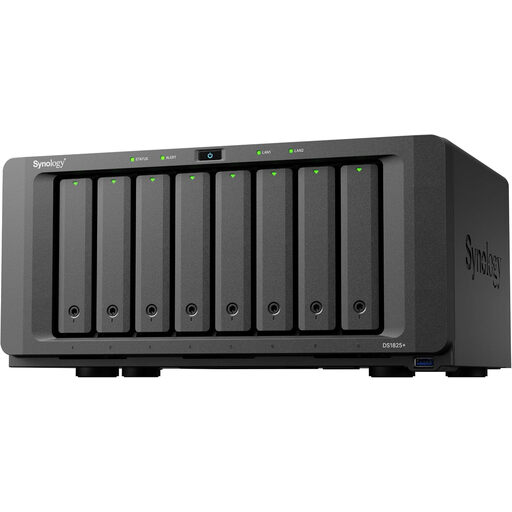
This eight-bay model is relevant if the studio is planning space for an expanding video archive and wants the option to upgrade its network later. Establish the backup destination and check the complete configuration before treating it as a shared-studio storage plan.
 No image available
Synology DS1825+ eight-bay diskless NAS
Consider this model for a growing archive where drive-bay headroom matters. Synology specifies eight bays, expansion support for up to 18 drives, two built-in 2.5GbE ports and an optional 10/25GbE upgrade for the DS1825+.
Calculate usable capacity for the chosen drives and RAID layout, and check Synology’s drive and network-card compatibility lists. Confirm the versioned-backup arrangement and separate destination the studio needs; faster shared transfers also require compatible switching and client connections.
View on Joybuy
Frequently asked questions
Does RAID mean the video library is backed up?
No. Synology warns that RAID failures and drive failures can still cause data loss. Plan versioned recovery and a backup at a separate destination so recovery does not depend on the primary NAS alone.
Does a shared-studio backup NAS need 10GbE?
Not necessarily: the case for 10GbE depends on whether the NAS mainly receives backups or regularly serves large files to several active workstations. If the studio chooses 10GbE, QNAP advises checking the NAS, switch and client connections together.
Should footage containing personal data be encrypted?
Assess encryption against the risks to that footage rather than assuming every file has the same requirement. The UK Information Commissioner’s Office says UK GDPR does not specifically require all personal information to be encrypted, but encryption can be an appropriate security measure; consider access, physical storage, transfers and key management.
What should the studio test after setting up backups?
Test whether an authorised person can restore a file, folder or project version within a timeframe the studio can accept. The UK Information Commissioner’s Office advises organisations to be able to restore access to personal data after an incident and to test the effectiveness of their security measures.
How can I check whether drives and network cards will work with a NAS?
Check the compatibility list for the exact NAS model and the specific drive or card before buying. Synology directs DS1825+ buyers to check drive and network-card compatibility, while Seagate advises checking the NAS maker’s approved-drive list for IronWolf Pro.


