Freelance live-recording engineer
You need to retain an organised original while delivering selected sessions or stems. A repeatable copy-checking and backup routine matters more than a headline network speed.


Choose a NAS around a handover workflow that retains the original recordings, keeps a separate backup and checks the delivered copy. A two-bay Gigabit model can suit one-person archiving; consider 2.5GbE or faster for repeated large transfers only when the workstation, switch and other parts of the transfer path can use it. Mirrored disks alone do not verify a client copy or replace a separate backup.
You need to retain an organised original while delivering selected sessions or stems. A repeatable copy-checking and backup routine matters more than a headline network speed.
Several people may need access to project files while client copies are prepared. Faster networking is relevant when the workstation, switch and transfer method can use it.
You need to clarify ownership and permissions before delivery, then control access to recordings where the project calls for it. NAS settings cannot settle what the client is entitled to receive or use.
Start with the copy and recovery workflow, then choose network capability for the equipment you use; treat access and permissions as part of the handover plan.
Consider it when: You usually archive completed projects from one computer and your network is Gigabit-only.
Trade-off: The Gigabit connection can limit transfers of large sessions, particularly when quick, repeated handovers matter.
Consider it when: You copy large projects regularly and the connected workstation and network can use 2.5GbE.
Trade-off: A faster NAS port cannot overcome a slower connection elsewhere in the path.
Consider it when: Multiple people access projects or your established workflow can use higher-speed networking and direct USB transfers.
Trade-off: The wider equipment setup matters: ASUSTOR cautions that its optimised RAID 1 transfer results may not be reproduced by ordinary computers.
| Concern | What to check | Who this matters to |
|---|---|---|
| Complete, recoverable copies | Plan a separate backup and a post-copy content or hash check where supported. Check any checksum or snapshot prerequisites before setting up folders. | I need to know the client received the complete session while I retain a recoverable original. Around 40% of consumers put verified retention first. |
| Repeat transfer speed | Match the Ethernet ports to the workstation, switch and cabling; check the USB specification if external media is part of delivery. | Large sessions pass through my workflow often, so time spent copying can affect the handover. For around 40% of consumers, transfer turnaround is the primary concern. |
| Controlled, authorised delivery | Check individual access and suitable security options, then confirm the contract and permissions for the recordings being transferred. | Before giving a client access, I need to control who can receive the files and establish the permitted use. Rights and access come first for around 20% of consumers. |
A faster port does not establish a faster end-to-end copy path. Manufacturer transfer figures also depend on equipment and configuration.
Check the recording computer, switch, cabling and delivery method before choosing 2.5GbE or 5GbE for speed.
Using the faster connection may require compatible adapters, switch ports or cabling.
Mirroring does not establish that every delivery file copied correctly, and a mirror is not a separate backup. QNAP notes that content checks use system resources.
Retain the source, keep a backup elsewhere and check the delivered files before overwriting the originals.
A separate backup needs another storage destination, and a thorough content check takes time.
The UK Intellectual Property Office says the record producer is normally the first owner of sound-recording copyright; commissioning does not automatically transfer ownership. Permissions concerning performers and the underlying work can also matter.
Clarify ownership, permitted client use, delivery and retention in writing, and check the relevant permissions for the project.
For Synology file self-healing, the Synology Knowledge Center specifies a checksum-enabled Btrfs shared folder and a supported multi-drive RAID or SHR arrangement. The shared folder’s checksum setting cannot be changed later.
Confirm support on the exact model and storage layout, then configure the intended checked folder before loading client projects.
The two-bay DS725+ is relevant if built-in 2.5GbE and DSM backup and sharing tools fit your handover workflow.
The two-bay TS-233 offers a Gigabit route, while the TS-264 provides two 2.5GbE ports for a compatible faster network.
The Lockerstor 2 Gen2+ AS6702T v2 is a two-bay option for a studio able to use its dual 5GbE ports and direct USB transfers.
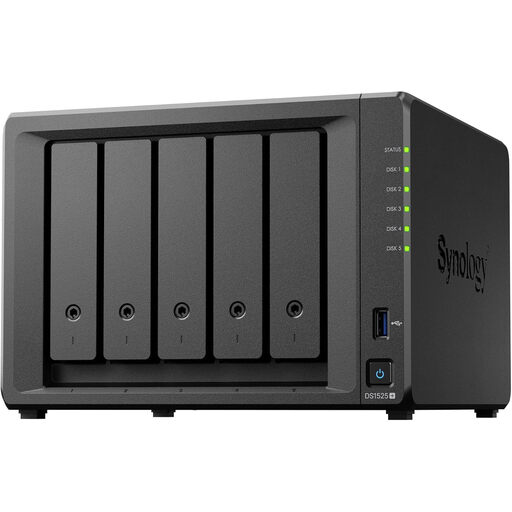
This five-bay diskless NAS is a consideration when a shared recording library calls for more than a two-bay unit. Check its network fit, drive bundle and handover workflow against your project before choosing it.
 No image available
Consider this five-bay model if you are planning shared storage for concert projects rather than a smaller two-bay setup.
The listing title identifies it as diskless; confirm the drive bundle and usable capacity for your chosen configuration. Check the network connection, separate-backup options and copy-verification workflow before relying on it for a client handover.
Gigabit can suit copies from one computer when that transfer time is acceptable. Consider 2.5GbE for repeated large projects only if the workstation, switch and cabling can use it; a faster NAS port alone will not remove a slower link elsewhere.
No. Keep another copy on a separate storage destination so that the NAS is not your only place to recover the recordings; mirrored disks do not establish that the client’s copy is complete.
Keep the original until the delivered files have been checked. Compare the expected files and, where your workflow supports it, run a content or hash check and retain its result with the project. QNAP notes that thorough content checks can take additional system resources.
Do not assume commissioning alone establishes permission to transfer or use every part of the recording. The UK Intellectual Property Office says the record producer is normally the first owner of sound-recording copyright and commissioning does not automatically transfer ownership; the British Copyright Council also identifies permissions concerning performers and the work performed. Check the agreement and the permissions relevant to that concert.
Assess encryption alongside access controls and secure transfer, particularly if the recordings contain personal information. The Information Commissioner’s Office identifies encryption as a measure whose suitability depends on the nature and risks of the processing; it does not replace managing who can access the files and keys.