What matters when choosing a NAS?
Start with the archive’s expected size and growth, decide how a separate backup will work, then check who needs access. Assess faster networking against the group’s actual file transfers rather than treating port speed as a substitute for those decisions.
| Concern |
What to check |
Who this matters to |
| Recovery and preservation |
Check drive compatibility and the intended two-disk layout. Arrange a separate offline or off-site copy and test restoring a recording with its catalogue information. |
If I am responsible for the original recordings, I need a way to recover them after more than a single drive failure; around 37% of consumers put preservation and recovery first. |
| Controlled sharing |
Check separate accounts, folder permissions and how access can be removed when volunteer roles change. |
When several organisers use the library, I want people to find files without giving everyone permission to change or delete them; controlled sharing comes first for around 27% of consumers. |
| Large-file transfers |
Consider 2.5GbE ports if transfers are a recurring bottleneck, and check the switch, computer adapters and other parts of the local network. |
After a concert, I may need to move large audio or video masters repeatedly; around 18% of consumers make transfer speed their primary concern. |
| Privacy and permissions |
Plan restricted access to source and release files, and keep the relevant recording and distribution permissions with the project records. |
If recordings are restricted or identify people, I need to know who can access and circulate each file; privacy and rights are the first concern for around 18% of consumers. |
A two-bay system can provide a two-disk layout, but its usable capacity depends on the drives and configuration selected. The National Cyber Security Centre describes a backup approach with at least three copies on two devices and one off-site. Before choosing drive sizes or a larger enclosure, estimate how much source audio and video the group keeps and how quickly that archive grows.
Relevant NAS and drive brands
Compare the particular enclosure or drive range against the archive’s needs; a brand name alone does not establish drive compatibility, included equipment or a suitable backup arrangement.
Synology
Synology positions the two-bay DiskStation DS224+ for central file management in small organisations and teams.
- Synology describes tools for managing and sharing files, while its Hyper Backup package supports multiple destinations and backup versions.
- A two-bay enclosure leaves limited room for additional internal drives, and backup tools still need a separate destination.
QNAP
The TS-264 is a two-bay option to examine when the group has a use for faster local networking or expansion.
- QNAP specifies two 3.5-inch SATA bays, two 2.5GbE ports, two M.2 slots and PCIe expansion for the TS-264.
- QNAP states that the TS-264 ships without HDDs; select compatible drives separately.
ASUSTOR
Lockerstor 2 Gen2 (AS6702T) is a two-bay route for groups assessing 2.5GbE networking and M.2 options.
- ASUSTOR lists dual 2.5GbE ports, four M.2 slots and a PCIe slot for the model.
- ASUSTOR states that 10GbE is not supported by the AS6702T or AS6702T v2; do not plan a 10GbE upgrade around this model.
Seagate
IronWolf is a hard-drive range to consider for NAS storage, not a NAS enclosure.
- Seagate identifies IronWolf as a CMR drive range designed for multi-bay NAS systems.
- Check the exact drive against the enclosure manufacturer’s compatibility guidance before choosing it.
Western Digital
WD Red variants warrant model-by-model checking when selecting drives for the archive.
- Western Digital identifies WD Red Plus and WD Red Pro as CMR drives.
- Some WD Red drives use SMR instead, so check the exact variant and the NAS manufacturer’s recommended drives.
Joybuy NAS options for a community archive
These enclosures cover a compact two-bay library and larger archives that may need more drive bays. Decide how many drives and how much growth the group needs before comparing them; none removes the need for a separate backup and appropriate access permissions.
 No image available
Synology DS225+ two-bay diskless NAS
Consider this format if a compact central library meets the group’s expected archive size. The enclosure is described as diskless, so select compatible internal drives separately. Check that its account and folder controls meet the group’s access plan, and arrange a separate backup.
View on Joybuy
 No image available
Synology DiskStation DS925+ four-bay NAS
The four-bay format is worth assessing if the recording archive is expected to grow beyond a compact two-bay setup. Check the exact drive requirements and whether drives are included in the selected bundle; the product information specifies Synology-branded drive compatibility. Plan a separate backup even if using multiple internal disks.
View on Joybuy
 No image available
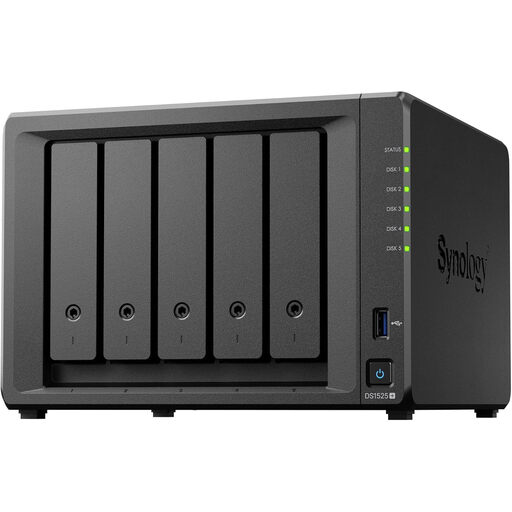
Synology DS1525+ five-bay diskless NAS
Consider five bays if the group expects a larger retained library and has a plan for using the additional drive positions. This model is described as diskless, so check compatible drives and the exact bundle. Confirm the access controls required for volunteers and provide a separate recovery copy.
View on Joybuy
Questions about storage, access and permissions
Can our group copy or upload recordings of its concerts?
Not automatically: holding a recording does not by itself establish permission to distribute it. UK Intellectual Property Office guidance explains that performers’ rights can restrict recording, copying and public availability of protected performances, while permission can allow those activities. Check the relevant rights and agreements for the performers, repertoire and intended audience before sharing.
Is a two-disk NAS enough to protect original recordings?
No, not as the group’s only copy. A suitable two-disk arrangement can help with a disk failure, but the National Cyber Security Centre advises keeping multiple copies on separate devices, including one off-site. Include a restore test in the group’s backup routine.
Will 2.5GbE ports make copying recordings faster?
They are worth considering when large local transfers are a recurring bottleneck and the network path supports 2.5GbE. QNAP lists dual 2.5GbE ports for the TS-264 and ASUSTOR lists them for Lockerstor 2 Gen2, but computers, network equipment and the storage workload also affect transfer speed.
Are hard drives included with a NAS enclosure?
Check the exact model and bundle rather than assuming they are included. QNAP says the TS-264 ships without HDDs, and the Joybuy DS225+ and DS1525+ titles identify those enclosures as diskless. Verify drive compatibility before ordering drives for any enclosure.
How should volunteers get access to the recording library?
Give volunteers individual accounts and only the folder permissions their roles require, then remove access when roles change. For systems holding personal information, the Information Commissioner’s Office recommends strong passwords and multi-factor authentication where possible; keep restricted masters separate from files approved for wider sharing.


