People preparing a client handover
You need to organise a master archive, check that files can be restored and transfer the photographs without leaving the only recoverable copy on one device.


For a modest family-photo archive and a one-off client handover, start by considering a two-bay NAS with compatible NAS-rated CMR hard drives, mirrored storage and a separate backup you can restore from. Consider more bays if the archive will keep growing, or faster networking if repeated large transfers and the rest of your network can use it. Mirroring and snapshots do not replace an independent backup.
You need to organise a master archive, check that files can be restored and transfer the photographs without leaving the only recoverable copy on one device.
You expect to retain photographs after the handover and need to decide whether two bays provide enough usable capacity or whether a larger enclosure gives you more room to plan for growth.
You need to control access to family photographs or client files and consider how to protect copies stored on the NAS and on removable or remote backup media.
Consider it when: The archive is modest, one person will mainly manage it and mirrored storage meets your capacity plan.
Trade-off: Mirroring leaves less usable capacity than the drives’ combined raw capacity, and two bays limit later drive-layout choices.
Consider it when: You will keep adding photographs or retain several collections and want more flexibility in planning capacity.
Trade-off: A larger enclosure calls for more drive, space and configuration planning; calculate usable capacity for the layout you intend to use.
| Concern | What to check | Who this matters to |
|---|---|---|
| Recovery beyond RAID | Check for an independent backup destination, earlier file versions and a restore process you can test before handover. | If photographs are deleted or the NAS fails, I need to recover a usable earlier copy. Around 29% of consumers put recoverability first. |
| Confidentiality and transfer | Check account permissions, secure sharing and whether encryption suits both the NAS and its separate backup. | When identifiable photographs or client files change hands, I need to limit who can access them. For around 29% of consumers, protecting that access is the primary concern. |
| Usable capacity | Allow for archive growth, the intended RAID layout and backup versions; check exact drive compatibility before choosing a capacity. | If I will keep the archive after handover, today’s folder size will not settle my storage decision. Keeping enough usable room is the leading need for around 24% of consumers. |
| Transfer and administration | Check the NAS and computer ports, the network path and whether your workflow needs repeated large transfers. | When I need to hand over large batches of files, I want a transfer process I can manage without unnecessary delays. Around 18% of consumers make that workflow their first priority. |
Both drives remain in one NAS, so mirroring does not provide a separate recovery destination. Synology cautions that RAID crashes and drive failure can still cause data loss.
Configure an independent backup with earlier versions where appropriate, then restore a sample file before handing over the archive.
The total printed on the drives is not the same as usable capacity under a mirrored layout. Retained backup versions also need space.
Size the current archive and expected additions, then calculate capacity for your chosen drives, layout and separate backup.
An undersized setup may require moving the archive to a different storage layout sooner than planned.
A faster NAS port alone cannot determine transfer speed; the connected computer, network equipment and source storage also matter.
Check the ports and adapters at both ends, along with the switch or router and cabling, before choosing networking features for large transfers.
Identifiable photographs or client files may be exposed if access is too broad or a removable copy is lost. The Information Commissioner's Office says security measures for personal data should be appropriate to the risk.
Give people appropriate individual access where practical, protect credentials and assess whether encryption is suitable for stored and removable copies.
A NAS range to examine if scheduled backup, file sharing and recovery workflows are central to the handover. Synology documents separate backup destinations and multi-version backup in its DSM guidance.
A NAS range to consider when the handover workflow could use additional local connections or storage options.
A NAS range to examine if networking and M.2 storage options matter to a more demanding local workflow.
An internal hard-drive range to check when fitting a compatible multi-bay NAS for the photo archive.
An internal hard-drive range specified by Western Digital for RAID-oriented NAS use.
These two-, four- and five-bay Synology enclosures offer starting points for a modest handover or an archive expected to grow. Whichever layout you choose, plan compatible drives, a separate backup and a test restore.
 No image available
Consider this four-bay enclosure if the family-photo archive will continue growing after handover.
Check whether drives are included and which exact models are compatible. Plan an independent backup and a restore test rather than relying on the NAS layout alone.
 No image available
This two-bay model is a starting point for a straightforward photo archive with a separately planned backup.
It is listed as diskless, so select compatible drives and calculate usable capacity for your intended layout. Confirm the backup and restore workflow before handover.
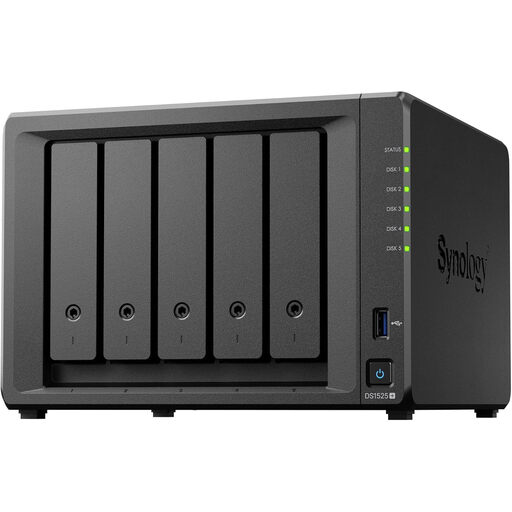 No image available
Consider five bays if retaining and expanding the archive calls for more capacity-planning options than a modest handover needs.
This model is listed as diskless. Check drive compatibility and the backup, restore and access arrangements required for client material.
 No image available
This four-bay enclosure is relevant if you expect the photo archive to grow beyond a simple mirrored two-drive plan.
Check whether drives are included and confirm exact drive compatibility, including any brand restrictions. If later expansion matters, confirm the compatible expansion unit before planning around it; arrange a separate backup for the handover.
No. Mirroring can help keep a NAS available after a drive problem, but it is not an independent copy. Synology warns that RAID crashes and drive failure can still cause data loss; the Northern Ireland Cyber Security Centre advises keeping copies on different devices, including one offline in another location.
A two-bay NAS is a sensible starting point for a modest archive if its usable capacity meets your plan and you keep a separate backup. Consider four bays when you expect to retain growing collections or want more flexibility in planning drive capacity.
Encryption is a risk-based decision, not a universal NAS-specific rule. The Information Commissioner's Office says UK GDPR security measures for personal data must be appropriate to the circumstances and explains that encryption can protect stored information against unauthorised access. If you handle personal data for a client, assess your controller or processor role, the storage and sharing arrangements, and the protection needed for both the NAS and backup copies.
Check compatibility before choosing a drive. Seagate and NAS manufacturers direct buyers to model-specific compatibility information, so confirm the exact drive model and capacity against the enclosure’s current list.