Collaborative design-file groups
Members opening, transferring and organising large project files from several computers need to consider network compatibility and who can manage shared folders.


Choose a NAS around the group’s main constraint: room for a growing archive, a network that can handle large transfers, or manageable access and recovery. Four- and five-bay models offer different expansion and connectivity options, but faster NAS ports depend on compatible network equipment and computers. Plan a separate backup destination whichever model you choose; RAID and snapshots do not replace one.
Members opening, transferring and organising large project files from several computers need to consider network compatibility and who can manage shared folders.
Groups keeping completed projects, source assets and older versions need to plan usable capacity, expansion and a separate backup as their archive grows.
If design folders also contain names, contact details or contributor agreements, access rights, updates and risk-appropriate encryption matter alongside storage space.
Start with the space the archive needs after the chosen drive arrangement, then check the network used by active members and who will maintain access and backups.
| Concern | What to check | Who this matters to |
|---|---|---|
| Usable capacity and growth | Estimate the current archive and its growth. Check usable space under the intended drive arrangement, bay count and compatible expansion options. | If completed projects and source files must stay accessible, I need enough usable space without losing sight of recovery. Around 29% of consumers put capacity and retention first. |
| Network speed | Check the NAS ports, switch and main computers against the planned transfer workflow; an optional 10GbE upgrade is not built-in connectivity. | When several members move large files, I want to know whether our existing network will hold up. Roughly 24% of consumers prioritise transfer and shared-workflow needs. |
| Protection and access | Check individual permissions, updates, versioning and a separate backup destination. Assess encryption against the risks if folders contain personal information. | If members’ details sit beside design assets, I need controlled access and a way to recover important files. Around 29% of consumers make protection and governance their primary concern. |
| Ongoing administration | Assign administrators and check how they will manage changing membership, updates and restore tests. | When volunteers change, I need the next administrator to understand the accounts and recovery process. About 18% of consumers put manageable upkeep first. |
A diskless enclosure has no usable file space until suitable drives are installed. QNAP states that drives and SSDs for the TS-464 are sold separately, and an internal drive arrangement does not provide an independent backup.
Check drive compatibility, the capacity available under your chosen arrangement and what will hold the separate backup before selecting an enclosure.
RAID can help a system remain available through certain drive failures, but it cannot cover every loss affecting the NAS or its files. Synology warns that RAID failures can still cause data loss; the National Cyber Security Centre advises regular backups for recovery from destructive ransomware.
Keep versioned copies at a distinct destination, limit routine write access to backups where practical and test a restore.
Multi-gigabit ports alone cannot make a slower switch or computer connection faster. ASUSTOR cautions that its optimised lab transfer results may not be reproduced on ordinary computers.
Trace the connection from each main computer through the switch to the NAS before deciding whether 2.5GbE, 5GbE or an optional 10GbE upgrade fits the workflow.
A faster connection may also require compatible switch ports and workstation adapters.
Changing membership can leave access in place after it is needed. The Information Commissioner’s Office advises appropriate access rights for personal information, while the National Cyber Security Centre recommends keeping devices up to date.
Give members individual accounts, restrict administrator access and assign responsibility for removing old permissions and applying updates.
Its documented DS923+ and DS1525+ configurations give groups different starting points for bays and built-in network connections.
The four-bay TS-464 is a route to consider where the group has, or plans to install, compatible 2.5GbE networking.
The four-bay Lockerstor 4 Gen2+ offers a configuration to examine when the group can support multi-gigabit connections and wants several M.2 slots.
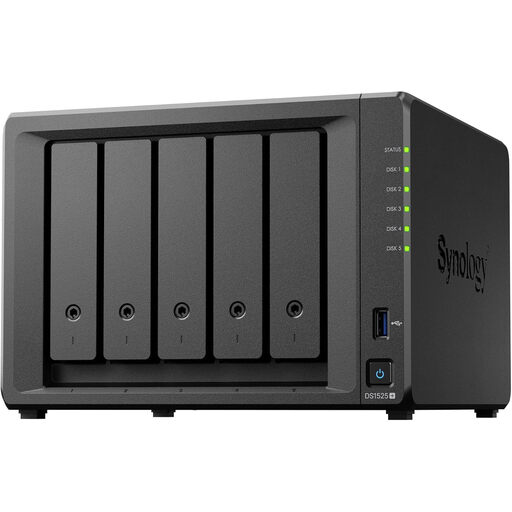
This five-bay choice suits a group considering more internal drive space and a built-in 2.5GbE connection for shared design files. Check the drives, network equipment and separate backup needed for the complete setup.
 No image available
A choice for members sharing design files when archive growth makes additional drive bays useful.
Synology specifies five drive bays, two built-in 2.5GbE ports and expansion support for up to 15 drives for the DS1525+. Its 10GbE connection requires an optional module.
This listing is for a diskless model, so confirm compatible drives and arrange a separate backup destination. Check the applicable warranty terms with the seller.
No. RAID can help with certain drive failures, but Synology warns that RAID failures can still lead to data loss. Keep a separately protected backup and test that the group can restore a folder; the National Cyber Security Centre also recommends regular backups for recovery after destructive ransomware.
Not necessarily. Check the NAS, switch and main computers against the way members transfer or work on files before choosing a network speed. An optional 10GbE NAS connection will not remove a slower connection elsewhere in that path.
Check the exact listing before ordering. QNAP explicitly sells the TS-464’s drives and SSDs separately, and the Joybuy Synology DS1525+ choice shown here is labelled diskless. Confirm drive compatibility and the usable capacity of your planned drive arrangement.
Set access rights and security measures appropriate to the information and how the group uses it. For personal information covered by UK GDPR, the Information Commissioner’s Office describes appropriate technical and organisational measures, including consideration of encryption according to risk; it also advises assigning access rights that fit users’ roles.
Assign named people to manage accounts, updates and backup checks, with a handover process when volunteers change. The National Cyber Security Centre recommends keeping devices up to date; the group should also practise restoring a representative folder so the recovery process is understood.