Choose a network-attached storage device (NAS) by how you will recover your family records and how much the archive may grow, rather than by network speed alone. Two bays can suit a modest household collection, while four bays offer more room to plan for growth; either way, keep an independent copy separate from the NAS. RAID and snapshots can help with particular failures or changes, but neither replaces that copy.
Who a NAS archive may suit
Keeper of irreplaceable family originals
If you are digitising photographs, letters or certificates, you need files you can identify and recover, not just space to store them. The US National Archives and Records Administration advises keeping multiple copies, including one off-site.
Growing home genealogy archivist
Recurring scanning projects and contributions from several computers or family members make capacity planning and a repeatable backup routine important. Compare the bays and backup features of the specific NAS models you are considering.
First-time NAS owner
If you want central storage without building a server, look for backup or versioning tools you can set up and maintain. Check compatible drives and plan a separate destination for a recoverable copy.
What to prioritise
Two-bay NAS
Consider it when: One household has a modest collection and wants a compact local archive alongside a separate backup.
Trade-off: A two-drive mirrored arrangement uses both bays, leaving no free internal bay for growth.
Four-bay NAS
Consider it when: Continued scanning, larger image files or backups from several computers make flexible capacity planning important.
Trade-off: More bays bring more drive and configuration decisions; they do not create a separate backup.
For either bay count, establish how you will restore files from a separate copy before deciding how much internal capacity you need.
| Concern |
What to check |
Who this matters to |
| Independent recovery |
Plan a backup to a separate drive, another NAS or an off-site destination, and test a restore. RAID is not that separate copy. |
When family photographs or records cannot be replaced, I need a way to recover them even if the NAS is lost. Around 36% of consumers put independent recovery first. |
| Capacity for future scans |
Compare usable space under your intended drive arrangement, then check drive compatibility for the exact NAS model. |
My archive grows with each scanning project, so I need room for future files rather than just today’s folders. Capacity growth is the primary concern for around 29% of consumers. |
| Access across devices |
Check account controls, network connections and whether backup tools cover the computers and operating systems you use. |
If several people contribute records from different computers, I want one organised place they can use without leaving files on a single device. Around 21% of consumers prioritise shared access. |
| Manageable setup |
Read the setup guidance and check how you would schedule backups and restore a test folder. |
For my first NAS, I need a routine I can keep running and check myself. Straightforward setup comes first for around 14% of consumers. |
Mistakes to avoid
-
Treating mirrored drives as the only backup
RAID can help a NAS continue operating after a drive failure, but Seagate states that RAID does not protect against every hardware failure. It cannot replace a copy kept away from the NAS.
Keep another copy on separate media or at another location, and periodically restore a sample folder to check it.
-
Assuming the enclosure is the complete archive setup
A NAS needs a suitable drive arrangement, while an independent backup needs its own destination. The QNAP UK Store describes the TS-464-8G as a diskless enclosure.
Check what is included with the exact model, which drives it supports and where its separate backup will be kept.
Maintaining a separate drive or off-site copy also adds a task to your archive routine.
-
Planning around raw drive capacity
The combined capacities printed on drives are not the usable archive space in every protection arrangement. A two-drive mirror, for example, does not provide their combined capacity for files.
Calculate usable space for the configuration you intend to use, allowing room for later scanning projects and file versions.
-
Assuming scanning alone preserves the record
Files can remain intact yet be difficult to identify later. The National Archives describes digital preservation as maintaining information’s long-term accessibility as well as its integrity.
Keep physical originals where possible, name files consistently and record who, what, where and when in metadata or a catalogue.
Recording that context takes time during each scanning project, but is harder to reconstruct later.
Relevant brands to consider
Synology
Synology’s DS225+ is a two-bay model for a compact archive; the DS425+ provides four bays for a collection needing more internal drive options.
- The DS225+ datasheet describes backup and versioning tools, alongside a 2.5GbE network port.
- Synology advises checking the DS425+ drive compatibility list before choosing disks. Bay count and raw capacity alone do not establish usable space.
QNAP
QNAP’s two-bay TS-233 and four-bay TS-464-8G offer different starting points for a household archive and one expected to grow.
- The QNAP UK Store lists snapshot and account-security functions for the TS-233, and dual 2.5GbE ports, M.2 slots and PCIe expansion for the TS-464-8G.
- Those features require appropriate setup; neither model makes a family archive automatically secure. Enable remote access only if you need it and can maintain it.
ASUSTOR
The DRIVESTOR 2 Pro Gen2 (AS3302T v2) is a two-bay option for an archive planned around RAID 1 and Btrfs snapshots.
- ASUSTOR lists support for two 3.5-inch or 2.5-inch SATA drives, RAID 1 and a 2.5GbE connection.
- Its listed 2GB DDR4 memory is not expandable. Assess the model against your intended tasks rather than assuming a later memory upgrade.
Joybuy NAS choices
These models range from a two-bay local archive to four- and five-bay choices for collections expected to grow. Whichever layout you choose, plan a separate backup destination for irreplaceable genealogy files.
 No image available
Synology DS225+ two-bay diskless NAS
Consider this two-bay model for a modest household archive kept alongside an independent backup.
Synology’s DS225+ datasheet describes backup and versioning tools and a 2.5GbE port. The unit is listed as diskless: check compatible drives and set up a separate recoverable copy.
View on Joybuy
 No image available
Synology DS425+ four-bay NAS
Four bays give a growing family archive more internal drive-planning options than a two-bay layout.
Synology advises consulting the DS425+ drive compatibility list. Check the bundle contents, backup destinations and restore steps before relying on it in your archive routine.
View on Joybuy
 No image available
Synology DiskStation DS925+ four-bay NAS
This four-bay model is relevant if your genealogy files and scanning projects are expected to grow.
If future expansion affects your choice, confirm the compatible expansion unit and configuration for the DS925+. Check supported drive models, bundle contents and your separate backup plan.
View on Joybuy
 No image available
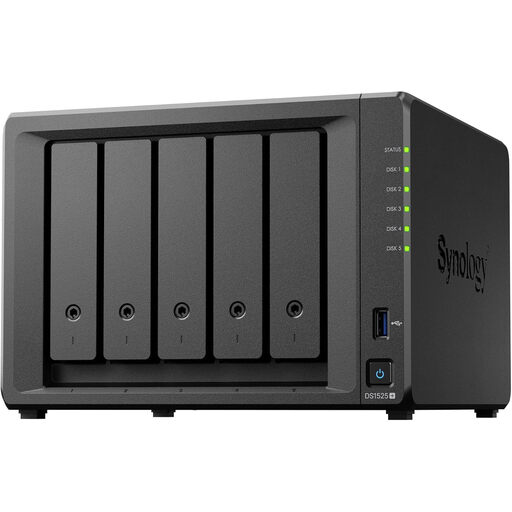
Synology DS1525+ five-bay diskless NAS
Consider a five-bay enclosure only if your planned archive and drive arrangement call for more internal bays than the smaller models offer.
This model is listed as diskless. Confirm its bay configuration, compatible drives, backup destinations and restore procedure before using it for family records.
View on Joybuy
Questions about genealogy archives
Is RAID 1 enough protection for genealogy records?
No. RAID 1 can help keep a NAS operating after a drive failure, but, as Seagate notes, RAID is not a complete backup. Keep another copy on separate media or in a separate location and test that you can restore it.
Should I choose a two-bay or four-bay NAS?
Two bays can suit a modest household archive if their usable capacity meets your plans and you maintain a separate backup. Four bays offer more flexibility for continuing scan projects or several computers, but require more drive-planning and management decisions.
What should I keep alongside scanned family photographs and papers?
Keep physical originals where possible and record identifying details alongside the digital files. Consistent names and information about who, what, where and when help preserve the context that storage alone cannot supply.
Does a private family NAS archive require a UK data-protection fee?
The Information Commissioner's Office says processing personal information only for personal, family or household affairs is exempt from the data-protection fee. If your activity goes beyond that scope, check the ICO guidance that applies to it; the fee exemption does not settle other data-protection obligations.


