Home-movie archivists
You want one household location for original family videos, with a recovery plan that goes beyond keeping them on the NAS alone.


For a growing household movie library, consider a two-bay disk-based NAS if you want central storage and the option of drive redundancy, but check whether compatible drives are included. Choose HDMI output or stated transcoding support only if your playback setup needs those features; faster networking and flash storage are more relevant when you move large video files frequently. Keep a separate copy of irreplaceable films, because drive redundancy is not a complete backup.
You want one household location for original family videos, with a recovery plan that goes beyond keeping them on the NAS alone.
You want to browse and play a shared library on household devices. Direct HDMI output or stated transcoding support may matter, depending on how you plan to watch.
You regularly move large files between a computer and the NAS, so network connections and storage type may affect your choice more than playback features.
Plan an independent copy for irreplaceable films, then choose storage and a playback route that fit your household. Give faster networking particular attention if large-file transfers are part of your routine.
| Concern | What to check when buying | Who this matters to |
|---|---|---|
| Protecting irreplaceable films | Check whether the NAS can back up to a separate destination and how you would restore files. Plan a copy that is not continuously connected. | If family footage cannot be replaced, I need a way to recover it after deletion or damage to the NAS. Around 36% of consumers put independent recovery first. |
| A growing shared library | Check drive-bay count, compatible drives, what the listing includes and usable capacity under your chosen drive arrangement. | When videos are spread across household devices, I want one accessible library with room to grow. For around 29% of consumers, central storage is the primary need. |
| TV playback | Decide whether you need direct HDMI or network playback, then check the exact NAS and playback device for the features your video formats require. | I want to watch the library on the television without finding that my intended connection or player cannot handle the files. Playback is the leading concern for around 21% of consumers. |
| Moving large video files | Check the NAS port, computer and network equipment together; if considering flash storage, check the required drive type. | Frequent importing or editing makes file-transfer capability central to my decision. Around 14% of consumers prioritise this workflow. |
Two drives in a redundancy arrangement remain part of one connected system. The National Cyber Security Centre warns that connected storage can be affected during ransomware incidents.
Keep a separate copy of irreplaceable movies and periodically check that you can restore files from it.
A separate external, remote or cloud destination may be needed.
Some NAS enclosures are sold without storage drives. QNAP states that the TS-262 ships without HDDs.
Check the exact listing, the manufacturer's drive-compatibility information and the usable capacity under your intended drive arrangement.
Compatible HDDs or SSDs may need to be obtained separately.
HDMI output and hardware transcoding are model-specific features. Neither is automatically required when a compatible TV app or media player plays the stored files over the network.
Decide whether the NAS will connect directly to the TV or serve a separate playback device, then check that setup against your video formats.
QNAP lists 2.5GbE for the TS-262, while ASUSTOR lists 10GbE for the FLASHSTOR 12 Pro FS6712X. Those port specifications alone do not establish the speed of a complete connection.
Check the computer connection and network equipment alongside the NAS before choosing multi-gig networking.
A compatible computer port, switch or router may also be needed.
The DiskStation DS224+ is a two-bay example for a conventional home archive, while Synology's Hyper Backup software offers a range of backup destinations.
The TS-262 is a two-bay multimedia NAS to consider when direct HDMI output or stated hardware-accelerated transcoding is relevant to your setup.
The FLASHSTOR 12 Pro FS6712X represents a flash-based route for people working regularly with large video files.
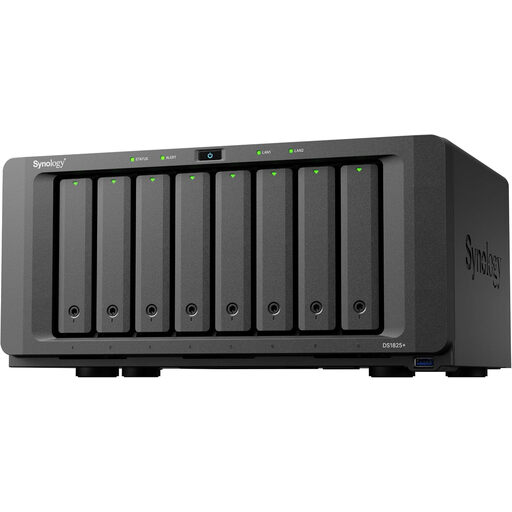
This eight-bay model is presented for enterprise video production and may be relevant if your home-movie work involves a large archive. Check that its setup and playback options suit your household before choosing it for home use.
 No image available
Consider this enterprise-focused model if you regularly work with a large video archive; check the household playback setup you intend to use.
Eight-bay, diskless enclosure: select compatible drives separately and check the usable capacity of your planned arrangement.
The listing title states 25GbE; check the connection available on the chosen configuration and whether your computer and network equipment can use it.
Plan a separate backup destination for irreplaceable films rather than relying on the NAS alone.
No. A two-drive redundancy arrangement may help after a single-drive failure, but it is still one connected system. The National Cyber Security Centre advises keeping at least three copies on two devices, with one copy off-site, and warns that connected storage can be affected during ransomware incidents.
Not necessarily: QNAP states that the TS-262 ships without HDDs. Check what the exact listing includes and consult the manufacturer's compatibility information before selecting drives.
You need NAS HDMI output only if your intended setup connects the NAS directly to the television. Network playback through a TV app or separate player is another route, but you should check that the device and your video formats work together. QNAP lists HDMI 2.1 output for the TS-262; do not assume it is a feature of every NAS.
Check the marking and documentation for the specific product and where it will be supplied. Department for Business and Trade guidance for Great Britain says UKCA and CE markings indicate that the manufacturer believes the product meets relevant requirements; its guidance on the applicable marking routes concerns England, Scotland and Wales. Northern Ireland follows different processes, so confirm the applicable route with the seller or manufacturer if buying there.