What matters when buying?
Set the recovery plan and access rules first, then size the archive for growth; choose network capability around the file transfers your studio actually makes. Synology and QNAP document two- and four-bay options, while ASUSTOR and TerraMaster document higher-bandwidth models, but port specifications alone cannot establish transfer speeds in your studio.
| Concern |
What to check |
Who this matters to |
| Recovering drafts |
Check how to retrieve previous versions and restore a whole folder. Arrange a separate, isolated backup and test both restores. |
If a draft is deleted or changed unexpectedly, I need to recover the right version rather than rely on the live NAS alone. Around 33% of consumers would put recovery first. |
| Controlled access |
Check individual or group folder permissions and how access will be removed when a collaborator leaves. |
When projects have different contributors, I need each person to reach the right folders without sharing unrestricted credentials. Roughly 27% of consumers would make access control their primary concern. |
| Archive growth |
Estimate current storage, growth and retention; calculate usable capacity for the intended drives and disk layout, and check drive compatibility. |
If we retain drafts for years, I need room for the archive to grow without planning around raw drive capacity alone. Around 20% of consumers would prioritise capacity and retention. |
| Large-file transfers |
Compare NAS ports with the switches, cabling and workstation connections on the full network path. |
If several of us regularly move large project folders, I need the network to keep up with that work. About 20% of consumers would put transfer capability first. |
Relevant brands to consider
These manufacturer-documented examples help distinguish enclosure, networking and drive choices; check the exact model and configuration rather than applying a feature to every product from a brand.
Synology
The four-bay DS425+ is one route for a growing shared archive, alongside Synology’s documented Hyper Backup recovery functions.
- Synology lists four bays and built-in 2.5GbE for the DS425+. Its Hyper Backup documentation describes multi-version restore, integrity checks and multiple backup destinations.
- Usable capacity depends on the drives and RAID configuration, and Hyper Backup’s backup format has restoration-tool requirements. A separate backup still needs an isolation plan.
QNAP
The TS-216G is a compact two-bay example for a studio comparing shared-folder controls and a smaller enclosure.
- QNAP lists two drive bays and one 2.5GbE port for the TS-216G, and documents user- and group-level shared-folder permissions.
- Two drive positions give fewer later layout choices than a four-bay enclosure; plan growth before committing to this format.
ASUSTOR
The Lockerstor 4 Gen3 is a higher-bandwidth four-bay option to examine when large-file movement is a regular part of studio work.
- ASUSTOR lists dual 10GbE and dual 5GbE connections for the Lockerstor 4 Gen3.
- ASUSTOR’s published RAID 5 transfer figures come from an optimised laboratory environment. Check the studio’s switches and workstations rather than treating those figures as expected results.
TerraMaster
The F4-424 Pro is a four-bay option for comparing multi-gig connections and drive-layout choices.
- TerraMaster lists dual 2.5GbE ports, two M.2 NVMe cache slots and several RAID and single-disk layout options for the F4-424 Pro.
- Its published performance claims should not be taken as transfer results for a particular studio. Check network compatibility and the support terms that apply to the purchase.
WD Red Plus
This Western Digital NAS HDD line is relevant when selecting internal drives for an enclosure that will hold the shared archive.
- Western Digital positions WD Red Plus for RAID-optimised NAS systems of up to eight bays and specifies continuous operation for the line.
- Choose the exact drive model against the enclosure maker’s compatibility guidance. A NAS-rated drive does not replace an isolated, tested backup.
Joybuy NAS choices
These enclosures cover modest two-bay storage through larger multi-bay archives. Choose the drive layout, access controls and separate backup arrangement for your studio; the number of bays by itself does not settle those decisions.
 No image available
Synology DS425+ four-bay NAS
Consider this model when a growing shared archive calls for four drive positions. Synology documents built-in 2.5GbE for the DS425+ and multi-version recovery through Hyper Backup; check the drives and bundle contents, then plan a separate isolated backup whose restores you can test.
View on Joybuy
 No image available
Synology DiskStation DS925+ four-bay NAS
This four-bay enclosure is a candidate if the archive needs room for a planned drive layout. Check the exact supported drives, including the listing’s Synology-branded-drive restriction, and confirm bundle contents. Establish the permissions, version recovery and isolated backup workflow before relying on it for shared drafts.
View on Joybuy
 No image available
Synology DS225+ two-bay diskless NAS
The two-bay format may suit a modest archive if its usable capacity will cover the intended retention period. This listing identifies the enclosure as diskless, so select compatible drives separately. Check the folder permissions your collaborators need and arrange an isolated backup rather than relying on the NAS alone.
View on Joybuy
 No image available
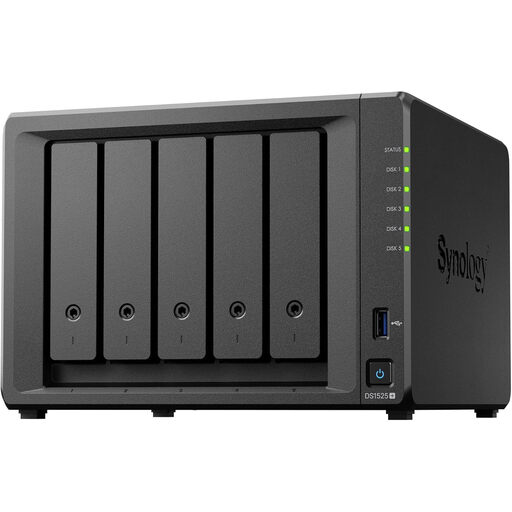
Synology DS1525+ five-bay diskless NAS
Five drive positions make this a model to assess for a larger archive alongside active studio projects. It is listed as diskless: check compatible drives and calculate usable capacity for your chosen layout. Verify that the network path, file-version recovery and separate backup process meet the studio’s needs.
View on Joybuy
 No image available
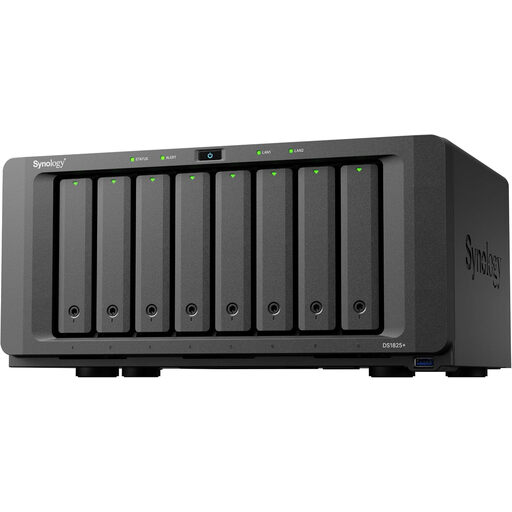
Synology DS1825+ eight-bay diskless NAS
Consider this eight-bay enclosure only against a substantial, planned archive requirement rather than assuming more bays are necessary for every studio. The listing identifies it as diskless. Confirm drive compatibility, usable capacity and the full network path, and set up an isolated backup with a tested restore procedure.
View on Joybuy
Common questions
Is RAID enough to protect archived design drafts?
No: a resilient disk layout does not replace a separate recovery copy. The National Cyber Security Centre recommends up-to-date, isolated offline backups of important data and warns that connected storage can be affected by malware. Keep a separate copy and test that you can restore both files and project folders.
Should each designer have a separate NAS login?
Use named accounts or defined groups when collaborators need different folder access. QNAP documents read-only, read/write and deny permissions for shared folders; assign access by project and remove it when someone leaves.
Does a small studio need 10GbE?
Not unless its file-transfer work and surrounding network justify it. Check how often large folders move and whether the workstations, switches and cabling can use the connection. ASUSTOR notes that its published high-speed results come from an optimised laboratory setup, not an ordinary studio network.
Must a UK studio encrypt a NAS holding personal data?
Assess whether encryption is appropriate to the data and risks rather than assuming the same setup suits every archive. The Information Commissioner’s Office says UK GDPR requires appropriate technical and organisational security measures. If drafts contain personal data, document the assessment alongside access controls and recovery arrangements.
What needs attention after the NAS is installed?
Assign someone to review accounts, maintain supported security updates, check backups and periodically test restores. Keep the isolated backup separate from the live archive so that recovery does not depend on the NAS remaining available.


