Small design teams sharing active projects
Several people need to open, save and organise large files in one place. Network fit and permissions for each user matter as much as the enclosure’s drive-bay count.


A four-bay NAS can suit a small studio sharing active design files, while a team expecting substantial archive growth should consider more starting bays or a confirmed expansion path. Match the NAS connection to the studio’s switch and workstations, and keep an independently protected, tested backup rather than relying on RAID or snapshots alone.
Several people need to open, save and organise large files in one place. Network fit and permissions for each user matter as much as the enclosure’s drive-bay count.
Growing project archives make the number of bays, supported expansion hardware and usable capacity under the chosen drive layout important early decisions.
Shared files may include personal or commercially sensitive information. These teams need controlled access and a recovery plan alongside storage capacity; the Information Commissioner’s Office advises assigning access rights according to roles.
For large files shared across a studio, establish the main constraint before choosing bay count or network ports: day-to-day access, room to grow, recovery or the work of running the system.
| Concern | Buying checks | Who this matters to |
|---|---|---|
| Access to active files | Check NAS ports against switch and workstation speeds. Confirm how the intended multi-port arrangement works; two ports do not guarantee twice the speed for one workstation. | When several colleagues work on large files, I want shared access without choosing faster NAS ports that the rest of our network cannot use. Around 31% of consumers put access to active files first. |
| Usable capacity and growth | Compare starting bays and supported expansion, then calculate usable space for the intended drives and redundancy layout rather than relying on raw capacity. | As our project archive grows, I need enough usable space without an early change of enclosure. Capacity growth is the primary concern for around 25% of consumers. |
| Recovery and access control | Check permissions and available restoration features. Plan an independently protected backup and test restoring a project; RAID and snapshots are not substitutes for that copy. | If client files are deleted or an account is compromised, I need a way to recover work and limit who can reach it. Around 25% of consumers prioritise recovery and controlled access. |
| Ongoing administration | Decide who will manage accounts, updates, drive monitoring and restore tests. Confirm the required sharing protocols and compatibility of the exact drive models. | With a small team, I need a system someone can maintain consistently after setup. Manageable administration comes first for around 19% of consumers. |
An empty enclosure has no installed HDD capacity. QNAP specifies that the TS-464 ships without HDDs, while other bundles need checking individually.
Confirm what the listing includes, then choose compatible drives and calculate usable space for the intended RAID layout.
The completed setup may also need SSDs, expansion hardware or changes to studio network equipment.
Western Digital distinguishes SMR WD Red models intended for lighter use with idle time from its CMR WD Red Plus and WD Red Pro lines for more demanding conditions, including ZFS-related use.
Check the exact drive model, recording technology and enclosure compatibility list when planning sustained multi-user activity or rebuilds.
A workstation’s connection and the network path can still limit its transfers, regardless of the NAS’s combined port capability.
Trace the connection from NAS to switch to workstation, and confirm support for the intended network configuration.
Using faster ports may require a compatible switch, workstation adapters and configuration time.
Neither provides an independently protected copy if normal access to the storage or its administration is compromised. The National Cyber Security Centre recommends backups that can be isolated and restored from an earlier version.
Keep a separately protected backup and test recovery with a representative studio project.
A separate backup destination, restore tests and ongoing administration remain part of the setup.
Desktop NAS enclosures with different starting bay counts and expansion routes, including the DS923+ and DS1522+.
The four-bay TS-464 offers a route for studios considering built-in dual 2.5GbE connections.
The Lockerstor 4 Gen2 AS6704T is a four-bay enclosure with dual 2.5GbE and four M.2 slots, according to ASUSTOR.
A drive supplier to consider when selecting HDDs for a separate NAS enclosure.
Its WD Red drive family contains lines with different recording technologies and intended usage patterns.
These enclosures span four-, five- and eight-bay starting points for shared studio files. Compare each listing’s included drives, supported storage configuration and network fit before choosing a size; none replaces a separate recovery copy.
 No image available
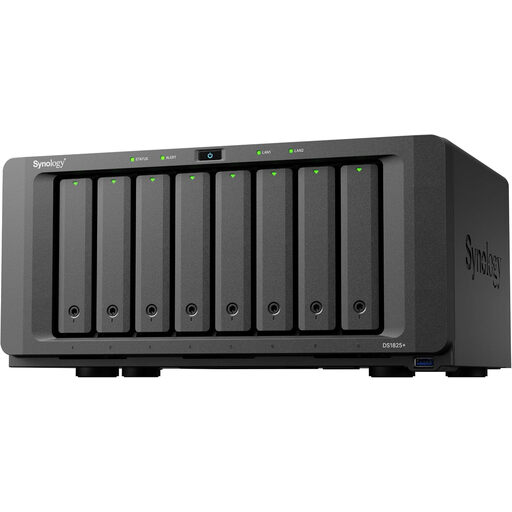
Consider the eight-bay starting point if the studio expects a substantial working archive. The enclosure is described as diskless; check supported drives, usable capacity and the exact network configuration against the studio’s equipment.
 No image available
A four-bay option for a small team planning central file storage. Confirm whether drives are included and check the listing’s Synology-branded-drive restriction against the exact models you intend to use; also check the expansion hardware and full network path.
 No image available
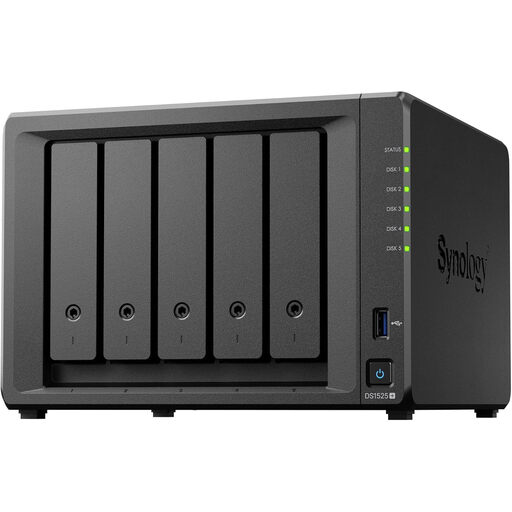
The five-bay starting point may suit a studio planning space for growing projects. Because this is a diskless enclosure, confirm supported drives and usable capacity under your chosen layout; check what network hardware its intended setup requires.
 No image available
A four-bay enclosure to assess for a small team’s shared files. Check the drive bundle, supported drives and network ports against your workload, and arrange an independent backup rather than relying on enclosure features alone.
No. RAID can help keep storage available after a drive failure, but it is not an independent copy for recovering from deletion, corruption or a compromised account. The National Cyber Security Centre advises making backups isolatable and restoring an earlier version when later versions become corrupted.
Not automatically: consider 10GbE when the network is a constraint on the studio’s work and the switch and workstations can use the intended connection. A NAS with 2.5GbE ports is another option to assess, but multiple NAS ports do not guarantee a combined transfer rate to one workstation.
Choose by exact model, recording technology and enclosure compatibility, particularly if sustained shared access or ZFS use is planned. Seagate describes IronWolf as CMR for multi-user NAS use; Western Digital identifies WD Red Plus and WD Red Pro as CMR, while some WD Red models use SMR and are intended for lighter patterns with idle time.
The studio should choose security and recovery measures appropriate to the risks of processing that personal data. The Information Commissioner’s Office advises protecting confidentiality, integrity and availability, enabling timely restoration after an incident, and assigning and reviewing access rights according to roles. The particular controls depend on the data and the studio’s risk assessment.