For a small lecture archive, start by planning access, usable capacity and recovery: a two-bay NAS with compatible NAS drives can provide central storage, but it still needs a separate, recoverable backup. If several people will use the archive, check whether the network and access controls suit their workflow; if recordings identify people, confirm your institution’s approved storage and retention arrangements before moving them.
Who needs a lecture archive?
Lecturers keeping a recoverable archive
If recordings need to remain retrievable after leaving the computer used to capture them, central storage can help organise access. Keep a separate backup as well: the National Cyber Security Centre advises maintaining a recent offline backup of important data, and Synology cautions that RAID failures can still cause data loss.
Course teams sharing recordings internally
A shared archive needs access controls and a retention schedule, not just space for files. The Information Commissioner’s Office says personal data must not be kept longer than necessary; the team should establish who can retrieve recordings and when they should be reviewed or removed.
IT staff handling sensitive recorded teaching
Check approved storage, permissions, encryption and backup arrangements before deploying a self-managed NAS. Jisc notes that data protection applies to identifiable students and lecturers in recordings, while the Information Commissioner’s Office identifies encryption as a protection for stored personal information.
What should you check before buying?
Set the retention period and recovery plan before choosing drive capacity. Then decide whether straightforward access is enough or whether the people and equipment using the archive call for a faster local network.
| Concern |
What to check |
Who this matters to |
| Recovering recordings |
Plan a separate backup destination, suitable file versions and a way to test restoration; snapshots alone are not a separate backup. |
If a recording is deleted or the NAS fails, I need a copy I can actually restore. Around 33% of consumers put recoverability first. |
| Capacity and retention |
Size the archive from representative files and the agreed retention period, allowing for the chosen drive layout and versions. |
I need enough usable space for recordings I am authorised to keep, without planning around indefinite retention. For around 25% of consumers, capacity and retention are the primary concern. |
| Everyday access |
Check supported ways to access files, user permissions, the number of bays and whether drives must be obtained separately. |
My priority is finding and sharing recordings without depending on one lecturer’s computer. That makes straightforward access the main concern for around 25% of consumers. |
| Shared-workflow speed |
Check the NAS ports alongside switches and client adapters; link aggregation requires compatible equipment. |
When several colleagues move large recordings, I want to know whether our network can use a faster NAS connection. Around 17% of consumers put shared-workflow speed first. |
Mistakes to avoid
-
Using RAID or snapshots as the only backup
A local NAS can still be affected by enclosure failure, theft or ransomware. Synology warns that RAID problems can cause data loss, while the National Cyber Security Centre advises keeping a recent offline backup of important data.
Maintain a separate backup destination, keep earlier versions where appropriate and test a restore before relying on the archive.
Allow for a second backup destination and the time needed to test recovery.
-
Choosing drive capacity before setting retention
Recording sizes and the period for which files are kept both affect usable-capacity needs. For recordings containing personal data, the Information Commissioner’s Office says organisations must not retain that data longer than necessary.
Measure representative recordings, agree a retention schedule and account for redundancy and versions before selecting drives.
An unsuitable capacity choice can mean replacing drives or migrating the archive earlier than planned.
-
Assuming encryption makes institutional storage acceptable
Encryption is one security control, not a decision about who may record, store or access identifiable people’s contributions. Jisc identifies data protection and rights considerations for recorded lectures.
Confirm your institution’s approved-storage, permissions, recording and retention requirements before moving files to a self-managed NAS.
-
Choosing faster network ports without checking the network
ASUSTOR states that link aggregation requires compatible equipment; its published throughput figures reflect laboratory conditions.
Check the switch, client adapters and other parts of the network path before treating faster NAS ports as a reason to choose a model.
Using those connections may also require compatible network equipment and cabling.
Relevant brands to consider
Synology
Synology positions the DS223j and DS224+ as compact NAS options for central storage and small-team workflows.
- Synology describes file-protection and backup tools on the cited models.
- These tools do not replace an independent backup or establish that self-managed storage is approved by an institution.
QNAP
QNAP positions the TS-233 for people starting with centralised NAS storage, sharing and synchronisation.
- QNAP specifies hardware-accelerated encryption for TS-233 volumes and shared folders.
- Encryption still needs appropriate configuration, permissions and an organisational decision about where recordings may be kept.
ASUSTOR
The two-bay Lockerstor 2 (AS6602T) is an option to assess when faster local networking matters to a shared workflow.
- ASUSTOR specifies dual 2.5GbE ports and M.2 NVMe slots for this model.
- ASUSTOR says link aggregation requires compatible equipment, and laboratory throughput may differ from everyday results.
Seagate
Seagate positions its IronWolf range as hard drives for NAS systems.
- Seagate specifies conventional magnetic recording (CMR) and NAS-oriented use for the cited IronWolf line.
- Check the exact drive model and capacity against the chosen NAS, rather than assuming compatibility from the range name.
Western Digital
Western Digital positions WD Red Plus drives for RAID-oriented NAS systems.
- Western Digital specifies CMR models in the cited WD Red Plus range.
- Confirm the exact capacity and model against the enclosure’s supported-drive information.
Joybuy NAS choices for shared archives
These four- and five-bay Synology enclosures are choices to assess for a growing or shared recording archive. Work out the required usable capacity and backup arrangement separately before choosing an enclosure.
 No image available
Synology DiskStation DS925+ 4-bay NAS
Consider this four-bay enclosure if the recording archive is expected to grow. Check the exact supported drive models before purchase; the product description calls for Synology-branded drives. Confirm the backup and security features your archive requires, and check the compatible expansion unit before planning an expansion.
View on Joybuy
 No image available
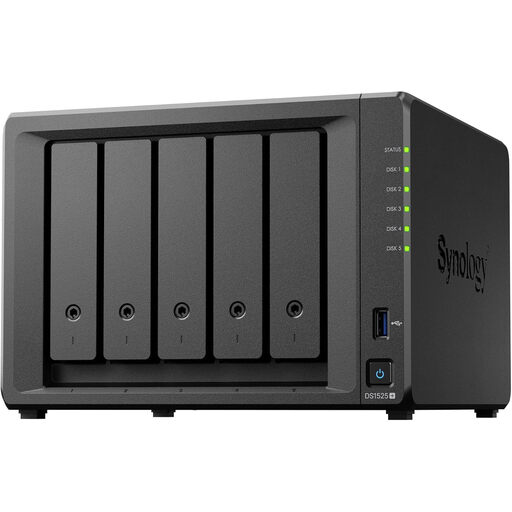
Synology DS1525+ 5-bay diskless NAS
Consider this five-bay model if several people need access to a shared media archive. It is sold as a diskless NAS, so choose compatible drives separately. Check the recovery and security features needed for the recordings; a stated library-capacity figure does not establish usable space with your chosen drive layout.
View on Joybuy
Frequently asked questions
Is RAID 1 enough to protect archived lecture recordings?
No: RAID 1 does not provide an independent backup if the NAS or its accessible files are affected. Keep a separate, recoverable copy and test restoration. The National Cyber Security Centre advises a recent offline backup for important data, and Synology warns that RAID failures can still result in data loss.
Should lecture recordings on a NAS be encrypted?
If recordings contain personal information, assess encryption as part of the storage security plan. The Information Commissioner’s Office identifies encryption as protection against unauthorised or unlawful processing of stored personal information; it does not replace access controls or approval for the storage arrangement.
Can a university keep lecture recordings indefinitely on a NAS?
Not by default when the recordings contain personal data. The Information Commissioner’s Office says personal data must not be kept longer than necessary, so the institution needs a justified retention period and a way to review and remove recordings when appropriate. Jisc also identifies rights considerations for recorded lectures.
Which drives should go into a diskless NAS?
Choose drives compatible with the exact enclosure and intended drive layout, checking the manufacturer’s supported-model information. Seagate specifies its cited IronWolf line and Western Digital its cited WD Red Plus range as CMR NAS drives, but the exact model and capacity still matter.
Will a 2.5GbE NAS automatically speed up video transfers?
No: the rest of the network must be able to use the faster connection. Check the switch, client adapters and connection method; ASUSTOR says link aggregation requires compatible equipment and that its published performance results were obtained under laboratory conditions.


