For a household photo library, start with a two-bay NAS and mirrored drives if a straightforward local setup is the priority; consider four bays if the library is likely to grow and you want more room to expand. Mirroring and recovery points serve different purposes, and neither replaces a separately stored local copy that you can restore from.
Who each setup suits
Households wanting simple photo recovery
A two-bay NAS with mirrored drives is a starting point if you want to keep household photos locally and remain able to access them after one drive fails. Plan versioned backups or snapshots for unwanted file changes, and practise restoring photos rather than relying on the mirror alone.
Owners of growing RAW-photo libraries
If you retain camera originals, video or several family members’ libraries, consider four bays for greater flexibility in arranging future storage. Estimate usable capacity under your chosen drive layout before deciding how much room you need.
Photo editors using several devices
If large files move regularly between the NAS and multiple computers, models with 2.5GbE networking may be relevant. Check the connections through the switch or router and each computer: a faster NAS port cannot remove a slower link elsewhere.
What to check before buying
Choose the storage layout around your library and expected growth, then plan how you will recover a photo or an entire folder without relying on the NAS as your only copy.
| Concern |
What to check |
Who this matters to |
| Recovering earlier photos |
Check how to restore individual files or folders from retained versions, and plan a separately stored local copy that you can test. |
If a photo is deleted or altered, I need an earlier copy I can actually retrieve. Around 31% of consumers would put recoverability first. |
| Simple mirrored storage |
Confirm the bay count, RAID 1 support, drive compatibility and usable capacity with two drives mirrored. |
I want a manageable household setup that can remain accessible if one drive fails. Roughly 31% of consumers would make that straightforward drive-failure protection their main concern. |
| Room for library growth |
Estimate the space needed for RAW files and video, then compare usable capacity and available bays under the intended storage layout. |
Keeping originals and new shoots means I do not want to replace my storage arrangement too soon. For about 23% of consumers, capacity growth would come first. |
| Transfers between devices |
Check the NAS Ethernet ports and the compatible connection through your switch or router to each computer. |
When I move large photo collections between computers, the network path matters to my workflow. Around 15% of consumers would prioritise faster multi-device access. |
Mistakes that affect recovery
-
Treating a mirror as the only backup
Mirroring addresses a drive failure, not every event that can affect the NAS and its files. The National Cyber Security Centre advises keeping backups that can be isolated and checking that restoration works.
Keep another local copy separately from the NAS, disconnect or isolate it when appropriate, and try restoring both a folder and an individual photo.
-
Choosing an enclosure without planning the drives
A NAS enclosure is not necessarily supplied with storage drives: QNAP specifies that its TS-264 ships without HDDs. The drives and the separate backup destination both affect whether the setup is ready for your photos.
Check what is included, which drives are compatible and how much usable space your chosen layout provides.
-
Choosing multi-gig ports without a compatible network
A 2.5GbE port on the NAS cannot by itself remove a slower connection between the NAS and a computer.
Check the switch or router, computer adapters and cabling along the intended path before choosing a model for faster transfers.
Using the faster connection may also require changes to other network equipment.
-
Keeping snapshots without a restore plan
A snapshot can provide a point-in-time recovery option, but one stored on the NAS is not an independent off-device copy. ASUSTOR also warns that restoring a snapshot can overwrite current data.
Decide how long to retain recovery points, check the scope of a restore and preserve a separate copy before a broad rollback.
Relevant brands for reference
Synology
Synology is relevant if photo management and versioned backup software matter alongside the NAS enclosure.
- Synology describes browsing, albums, uploads and search in Synology Photos, and multi-version restoration in Hyper Backup.
- Those functions still need a planned backup destination; copies held only on the NAS do not replace a separately stored one.
QNAP
QNAP is relevant when comparing RAID arrangements, snapshots and two-bay hardware with faster network connections.
- QNAP documents RAID and snapshot options; its TS-264 is a two-bay model.
- QNAP specifies that the TS-264 ships without HDDs. Confirm the drives and separate backup destination required for your setup.
ASUSTOR
ASUSTOR is relevant if scheduled snapshots and multi-gig networking are part of the intended local workflow.
- ASUSTOR documents snapshot scheduling and restoration; its AS5402T has dual 2.5GbE ports and four M.2 slots.
- ASUSTOR warns that snapshot restoration can overwrite current data. Faster networking also depends on the rest of the connection.
Joybuy NAS choices
These NAS enclosures cover a two-bay household starting point and larger bay counts for growing photo libraries. Choose the storage and recovery arrangement you need, then check each model’s local backup destinations, drive requirements and restore options before buying.
 No image available
Synology DS225+ Two-Bay Diskless NAS
Consider this two-bay enclosure for a household photo library if a mirrored-drive arrangement suits your capacity needs.
It is sold as diskless, so choose compatible drives. Check how to set up your intended local backup destination and restore individual photos.
Joybuy
 No image available
Synology DS425+ Four-Bay NAS
Consider four bays if you expect your photo library to grow and want more storage-layout flexibility.
Check the supplied contents and the listing’s Synology-branded drive compatibility requirement. Confirm that the backup destination and restore process suit an entirely local workflow.
Joybuy
 No image available
Synology DiskStation DS925+ Four-Bay NAS
This four-bay model is another option when accommodating a growing photo library matters more than keeping to two bays.
Check which drives are compatible and included, and whether its backup destinations, retained versions and restore options meet your local-only plan.
Joybuy
 No image available
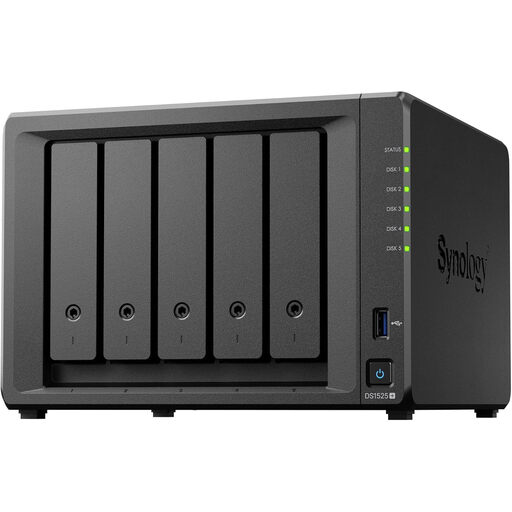
Synology DS1525+ Five-Bay Diskless NAS
Consider this larger enclosure only if your photo archive or production workflow calls for five bays; it is a less direct fit for a simple household backup.
It is diskless, so drives are required. Confirm the local backup destination and photo-restoration workflow before choosing it.
Joybuy
Questions about local photo backups
Is RAID 1 a backup for my photos?
No. A RAID 1 mirror can help keep photos accessible after one drive fails, but it is not an independent copy if files are deleted or the NAS itself is lost or compromised. Retain recovery points for unwanted changes and keep another local copy separately.
Can I back up photos without using cloud storage?
Yes, provided you configure the source devices, NAS and additional backup destination for a local workflow. A separately stored external drive or second NAS avoids making the main NAS your only copy; consider whether keeping all copies in one location meets your recovery needs.
Should I choose a two-bay or four-bay NAS?
Choose two bays if a mirrored household setup provides enough usable capacity for your expected photo library. Four bays offer more room to plan storage layouts as a RAW-photo or video collection grows; compare usable space under the chosen layout rather than bay count alone.
Do I need 2.5GbE for photo backups?
Not necessarily: decide based on the size and frequency of transfers between your devices. For 2.5GbE to matter to a computer’s connection, the network equipment and computer adapter along that path must also support a compatible faster link.


