Choose a two-bay NAS if its usable capacity suits your local project library and you want a configuration that can tolerate one drive failure. Consider more bays if the archive is likely to grow beyond two drives, or 2.5GbE and SSD options if active projects need faster wired access and the rest of your network can support it. Whichever route you take, keep a separate backup that you can restore without relying on cloud storage: RAID alone is not a backup.
Who needs a local project NAS?
Local-only project archivists
If recordings, stems, masters and sample packs need a central home or studio library, a NAS offers a place to organise them without depending on cloud storage. A suitable two-drive RAID configuration can tolerate one drive failure, but a separate backup destination is still needed. Synology distinguishes RAID redundancy from backup in its storage guidance.
Producers working with active sessions
If you regularly move substantial project folders or access large sample libraries from a workstation, check the complete wired path before choosing faster NAS ports or SSD options. QNAP and ASUSTOR offer models with 2.5GbE and M.2 slots, but those features alone do not establish how a particular session will perform.
Small studio collaborators
When several authorised people or devices need the same local project files, consider shared access alongside permissions and recovery. The National Cyber Security Centre advises protecting backups from attackers who may also reach primary storage; a separate copy should not simply remain exposed with the working library.
What matters when choosing?
Work out how much project storage you need and how you will back it up, then decide whether daily transfers, future growth or a simpler setup changes the enclosure you should choose.
| Concern | What to check | Who this matters to |
|---|
| Capacity and drive resilience |
Compare usable capacity under your intended drive layout with the space your projects need; check the exact drives against the NAS maker’s compatibility list. |
If my archive keeps growing, I need room for recordings and exports without mistaking one-drive RAID redundancy for a backup. Around 33% of consumers put project capacity and drive resilience first. |
| Active-project transfers |
Check NAS Ethernet ports against the workstation and network equipment; consider M.2 options only where they fit your intended workflow. |
When I move large session folders between my workstation and shared storage, a slow wired connection gets in the way. For around 27% of consumers, transfer access is the primary concern. |
| Cloud-free recovery |
Plan a separate, versioned backup destination and a way to disconnect or otherwise isolate it; check that you can restore a project. |
I want earlier project versions recoverable even if the working NAS is damaged or compromised, without sending copies to a cloud service. Keeping that independent recovery route comes first for around 27% of consumers. |
| Manageable setup |
Check whether drives are included and confirm exact drive compatibility before settling on an enclosure. |
If I need a modest local library, I would rather establish a workable drive-and-backup setup than choose expansion I cannot yet use. Around 13% of consumers prioritise setup simplicity. |
Mistakes to avoid
-
Treating RAID as a backup
Redundancy within one enclosure does not create an independent recovery copy. Synology warns that RAID crashes and drive failures can still cause data loss, while the National Cyber Security Centre notes that attackers may target backup infrastructure too.
Keep versioned project copies on a separate destination, such as an external drive or another NAS that can be isolated, and periodically test a restore.
-
Planning for the enclosure alone
Some NAS enclosures arrive without disks: QNAP specifies that the TS-264 ships without HDDs. Faster NAS ports also depend on a compatible wired path to the workstation.
Before choosing an enclosure, account for compatible drives, separate backup storage and any network equipment your intended setup requires.
-
Choosing drives by capacity alone
Drive-family names do not establish compatibility with every enclosure or variant. QNAP directs buyers to its model-specific compatibility list, and Seagate likewise advises checking with the NAS maker.
Cross-check the exact enclosure and HDD or SSD model before ordering, including the drive configuration you intend to use.
-
Expecting a headline transfer figure in every studio
QNAP’s stated figure of up to 589 MB/s for the TS-264 depends on port trunking with both built-in 2.5GbE ports; it is not a result to expect from every computer or network arrangement.
Check the workstation adapter, switch or router, cabling and NAS storage layout against the conditions behind any published figure.
Brands to consider for a local NAS setup
Synology
Synology presents the two-bay DiskStation DS224+ as storage for small-to-moderate teams, with a configuration that can provide one-drive RAID redundancy.
- Synology describes backup destinations including external devices and secondary Synology systems.
- Synology warns that RAID can still suffer data loss; plan an independent copy of music projects.
QNAP
The two-bay TS-264 is a QNAP option for buyers considering dual 2.5GbE ports, two M.2 slots and a PCIe expansion slot.
- The port and slot options give buyers specific wired-network and SSD configurations to assess.
- QNAP says the TS-264 ships without HDDs; its advertised maximum transfer figure depends on port trunking with both 2.5GbE ports.
ASUSTOR
ASUSTOR’s two-bay Lockerstor 2 Gen2 (AS6702T) combines dual 2.5GbE connectivity with four M.2 slots for buyers assessing SSD configurations.
- ASUSTOR describes M.2 use for caching, storage or a mixture of both.
- ASUSTOR states that the two-bay AS6702T does not support 10GbE; check the exact model if that upgrade matters.
Seagate
Seagate IronWolf is a NAS-drive range to consider when selecting disks for an enclosure, rather than an alternative NAS enclosure.
- Seagate describes IronWolf drives as intended for NAS use and specifies CMR technology for the range.
- A range name does not confirm that a particular capacity or drive revision suits your NAS; Seagate advises consulting the enclosure maker’s compatibility list.
NAS options on Joybuy
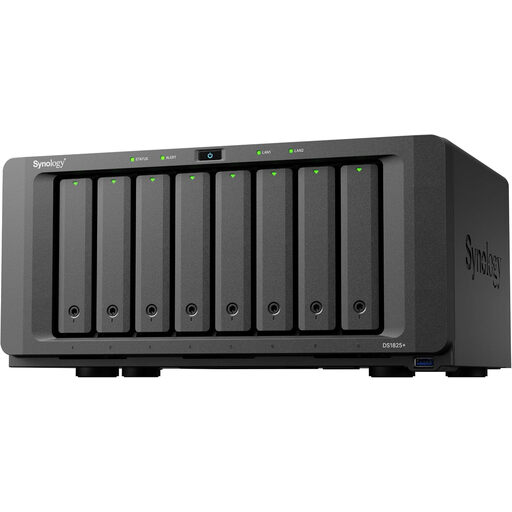
These two-, four- and eight-bay enclosures offer different starting points for a local project library. Choose the number of bays around your storage plans, then confirm compatible drives and arrange a separate cloud-free backup.
 No image available
Synology DS1825+ 8-Bay Diskless NAS
Consider this enclosure if a shared production archive calls for more drive bays than a small two-bay setup.
Eight bays; diskless configuration. Select compatible drives separately, and plan an independent backup for project recovery.
View on Joybuy
 No image available
Synology DS425+ 4-Bay NAS
A four-bay enclosure is worth considering when a local project library needs room for more installed drives than a two-bay model.
Check the included drive configuration, exact drive compatibility and wired-network fit before choosing it for active sessions.
View on Joybuy
 No image available
Synology DiskStation DS925+ 4-Bay NAS
This four-bay model is another route to a shared local library when you want more drive positions than a two-bay enclosure.
Confirm the exact compatible drives and whether disks are included; establish a separate recovery copy rather than relying on the NAS alone.
View on Joybuy
 No image available
Synology DS225+ 2-Bay Diskless NAS
A two-bay enclosure may suit a compact central library if its eventual usable capacity fits your music projects.
Diskless configuration: choose compatible drives separately. Check its network fit for active transfers and keep a backup outside the enclosure.
View on Joybuy
Frequently asked questions
Is RAID enough to protect music projects on a NAS?
No: RAID can help a suitable configuration tolerate a drive failure, but it does not replace an independent backup. Synology warns that RAID failures can still cause data loss and recommends keeping separate copies; test that you can restore the projects you need.
How can I back up a NAS without cloud storage?
Keep a versioned copy on a separate physical destination, such as an external drive or another NAS, and check that you can restore it. The National Cyber Security Centre advises that disconnecting on-premises backup media and storing it separately can make those copies harder for an attacker to reach.
Do I need to check the exact NAS drive model?
Yes: check the enclosure maker’s compatibility list for both the exact NAS and drive model. QNAP cautions that compatibility can differ within a drive lineup, while Seagate also directs buyers to the NAS maker’s list.
Are hard drives included with a NAS enclosure?
Not necessarily: QNAP specifies that its TS-264 ships without HDDs. Check the included-drive configuration for each enclosure you are considering, then select compatible disks for your intended storage layout.


