Move-week project protectors
If active sessions would be difficult to recreate, prepare a recoverable copy before the NAS and studio equipment are packed. Synology recommends keeping a backup off-site as part of its backup guidance.


Choose a two-bay NAS with a suitable redundant-drive configuration if you want one organised local archive that remains available after a single drive fails. Before moving it, create and test a separately stored backup: drive redundancy does not protect the only copy from loss or damage to the NAS. Let your capacity needs and post-move transfer workflow determine which enclosure to consider.
If active sessions would be difficult to recreate, prepare a recoverable copy before the NAS and studio equipment are packed. Synology recommends keeping a backup off-site as part of its backup guidance.
If sessions, stems, sample libraries and exports are scattered across drives, a NAS can provide a central place to organise and access them after the move. Plan its usable capacity and a separate backup together.
If you will copy substantial project folders repeatedly after moving, consider faster wired networking only when the computer and the rest of the network can support it.
For music projects travelling with your studio equipment, settle the recovery plan before choosing capacity, setup features or network speed.
| Concern | What to check | Who this matters to |
|---|---|---|
| Independent recovery | Check for a separately stored backup destination and versioned backups; restore a project folder before packing. | If my NAS is lost or damaged in the move, I still need to open my sessions from another copy. Around 33% of consumers may put independent recovery first. |
| Usable capacity | Size compatible drives for your archive and expected growth using the usable capacity of your chosen storage layout. | With sessions, stems and samples to consolidate, I need space for upcoming projects without assuming two drives give me their combined raw capacity. Usable capacity may be the primary concern for around 27% of consumers. |
| Setup and handling | Review the model's setup and shutdown instructions, and finish a backup before disconnecting it. | I need to pack the equipment safely and get back to my files after reconnecting it, without a complicated move-week setup. Around 20% of consumers may place this need first. |
| Post-move access | Check file-sharing needs and the Ethernet capability of the computer and network equipment before choosing 2.5GbE. | If I regularly move large project folders after settling in, access and copying are central to my workflow. This may be the leading concern for around 20% of consumers. |
A redundant-drive layout can keep a NAS available after one drive fails, but it does not provide another copy if the enclosure is lost or damaged. Synology recommends an off-site copy in its backup guidance.
Before the move, make a separate backup to an external drive, remote NAS or cloud destination, then restore a representative project folder to check that it opens.
The enclosure, drives and storage layout all affect how much space will be usable. A redundant layout can provide less usable capacity than the drives' combined raw capacity.
Check the retailer's bundle, the model's compatible drives and your chosen layout; allow for a separate backup destination and future projects.
A 2.5GbE port on the NAS does not make a Gigabit-limited computer or network path faster.
Check the computer, switch or router, and cabling before making faster networking a deciding factor.
A compatible Ethernet adapter or other network equipment may also be needed.
Changing enclosures is not necessarily a direct drive swap. QNAP's migration guidance requires a compatibility check and shutdown for its documented migration process.
Power down and disconnect equipment before internal handling. If moving drives between enclosures, follow the instructions for both exact models and preserve drive order where required.
A NAS platform to consider when your priority is an organised local archive with a planned backup to another destination.
Its TS-233 is presented by QNAP as a two-bay option for beginner and home NAS users seeking file access, sharing and syncing.
Its two-bay Drivestor 2 Gen2 (AS1202T) is an option to examine if faster wired transfers are important after the move.
These four- and five-bay Synology models are options for a central music-project archive after the move. Check their drive requirements and arrange a separate, tested backup before packing.
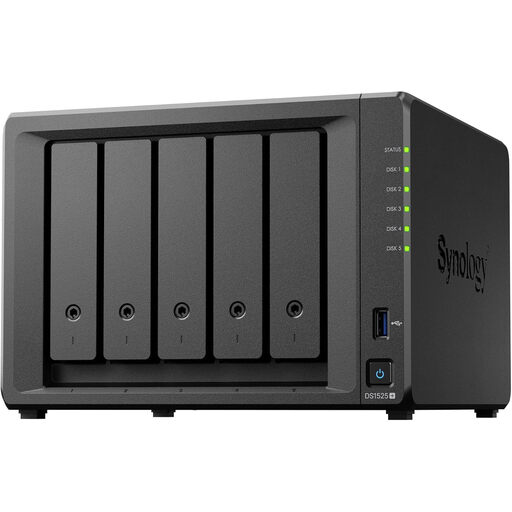 No image available
Consider this model if your music-project archive needs central storage and you plan to choose the drives separately.
It has five drive bays and is described as diskless. Check compatible drives, usable capacity for your intended layout and the model's backup options before moving.
 No image available
Consider this model for a central project archive if its supported drives and storage layout suit the capacity you need.
It has four drive bays. Check the model-specific drive compatibility list, what the retailer bundle includes and how you will keep a separate backup before the move.
No. A redundant-drive configuration can help if one drive fails, but it is not an independent copy if the NAS is lost or damaged. Make a separately stored backup and test a project-folder restore before packing.
Complete and test the backup before fully powering off the NAS and attached peripherals. Disconnect the equipment from the electrical outlet, then follow the exact model's hardware instructions before handling internal components.
Check the migration instructions for the exact source and destination models before attempting it. QNAP's documented migration path requires a compatibility check and both systems to be powered off; do not assume drives can be moved between arbitrary models or brands.
Encryption is a decision to assess against the data and the risk of loss, not a blanket requirement for every home archive. For organisations processing personal data, the Information Commissioner's Office says UK GDPR requires appropriate security measures and identifies encryption as a measure that may be appropriate depending on the processing risks.