For a growing music-project library, a four-bay NAS gives you room to plan storage and backups, but choose its network capability around your workstation and switch rather than a headline transfer figure. Built-in 2.5GbE suits a setup that can use it; consider 10GbE when the whole network path supports it. Keep a separate, tested backup rather than relying on the NAS as your only copy.
Who is this setup for?
Active project editors
If you regularly move multitrack sessions, samples and exports between a workstation and shared storage, consider the network path as well as the NAS. Built-in 2.5GbE is useful only when the workstation and connecting equipment can use it; the same condition matters even more for 10GbE.
Growing project-library keepers
If finished sessions, stems and raw recordings keep accumulating, choose enough drive bays for your intended capacity and disk layout. A four-bay enclosure offers more layout options than a single external drive, though you still need to plan the disks separately when the enclosure is diskless.
Backup-first home producers
If losing a session would be difficult to recover from, plan a separate backup that is not continuously reachable from the workstation. The Cybersecurity and Infrastructure Security Agency advises keeping offline backups and testing them regularly.
What matters when choosing a NAS?
Decide how you will use the projects, how much room the archive needs and how you will restore files; then check the equipment connecting the NAS to your workstation.
| Concern |
What to check |
Who this matters to |
| Local transfers |
Check the NAS ports and the workstation adapter, switch and cabling. A faster NAS port alone does not make the whole connection faster. |
When I move active sessions and recorded takes, I want transfers that do not interrupt editing; around 45% of consumers put local project access first. |
| Archive growth |
Choose a bay count and disk layout for the archive you expect to keep, and confirm which drives suit the exact NAS model. |
My finished sessions and stems keep accumulating, so I need room to organise and retain them; roughly 33% of consumers prioritise capacity and disk layout. |
| Recoverability |
Plan a separate backup and test that you can restore a session from it. The Cybersecurity and Infrastructure Security Agency advises offline, regularly tested backups. |
If a project is deleted or reachable storage is compromised, I need a manageable way to get it back; about 22% of consumers make recoverability their primary concern. |
Mistakes to avoid
-
Assuming an enclosure includes storage drives
QNAP specifies that the TS-464 ships without HDDs. A diskless enclosure cannot hold your projects until compatible drives are fitted.
Check the contents of the exact listing and plan the drives and any SSDs or network equipment needed for your setup.
A diskless setup requires separate drives before it can be used for storage.
-
Treating the NAS as the whole backup plan
A backup that remains reachable can also be affected by ransomware. The Cybersecurity and Infrastructure Security Agency advises maintaining offline backups and testing them regularly.
Keep a separate offline or off-site copy of sessions you cannot recreate, and practise restoring files from it.
-
Choosing 10GbE without checking the network
ASUSTOR says its published throughput results come from optimised lab conditions and may differ on ordinary computers. A workstation or switch on a slower link can limit the connection.
Check the workstation adapter, switch and cabling before choosing a faster network tier.
-
Assuming expansion parts are compatible
Synology says support may be limited for issues caused by drives outside its published compatibility list. QNAP warns that unsupported memory modules can cause errors or prevent startup.
Check the current compatibility guidance for the exact NAS model, drives, firmware and expansion components you intend to use.
Brands to consider for this setup
Synology
The DiskStation DS923+ is a four-bay route for buyers who prefer to add faster networking later rather than require it from the outset.
- Synology lists optional 10GbE networking and M.2 NVMe options for caching or all-flash storage pools on the DS923+.
- Its drive compatibility guidance matters when selecting disks: Synology says support may be limited for issues caused by drives outside the published list.
QNAP
The TS-464 is a four-bay option when built-in 2.5GbE ports and a later networking upgrade suit the workstation setup.
- QNAP lists four SATA bays, two 2.5GbE ports, two M.2 slots and optional faster networking through PCIe for the TS-464.
- QNAP says the TS-464 ships without HDDs and warns that unsupported memory modules can cause errors or prevent startup.
ASUSTOR
The Lockerstor 4 Gen3 (AS6804T) is worth considering when the workstation and network can use its built-in multi-gigabit connections.
- ASUSTOR lists dual 10GbE, dual 5GbE, four NVMe slots and ECC memory for this model.
- ASUSTOR says its published performance results were obtained under optimised lab conditions and may differ in other environments.
Joybuy product choices
These Synology NAS choices range from a two-bay diskless enclosure to four-bay models and a five-bay diskless model. Choose the bay count for your archive, then check the exact drive configuration and network connection before ordering.
 No image available
Synology DiskStation DS925+ 4-Bay NAS
A four-bay choice if you want to plan a growing project archive across multiple drives.
Before choosing drives or an expansion unit, check compatibility for the exact DS925+ model. Confirm the supplied drive configuration and whether its network connection suits your workstation and switch.
View on Joybuy
 No image available
Synology DS425+ 4-Bay NAS
Consider this four-bay model if you want a central place to organise an expanding project library.
Check its network ports against your workstation connection and confirm whether the supplied configuration includes drives.
View on Joybuy
 No image available
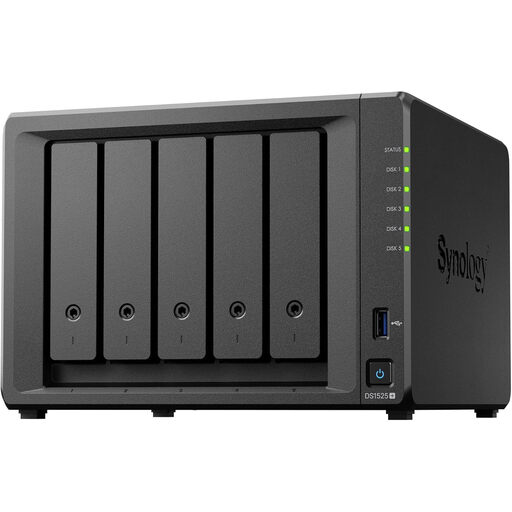
Synology DS1525+ 5-Bay Diskless NAS
The five-bay format may suit a larger project archive if you expect to use the additional drive space.
This is a diskless configuration, so drives are needed separately. Check what network hardware is required before planning around 10GbE; the connection also depends on the workstation, switch and cabling.
View on Joybuy
 No image available
Synology DS225+ 2-Bay Diskless NAS
A two-bay option to consider when a smaller project archive meets your storage-layout needs.
This is a diskless configuration, so drives are needed separately. Two bays leave fewer disk-layout options than four; check its network ports before relying on it for faster workstation transfers.
View on Joybuy
Frequently asked questions
Should I choose a two-bay or four-bay NAS for music projects?
Choose four bays if your archive is likely to grow and you want more options for arranging drives; two bays may be enough when your planned storage layout fits within them. Bay count alone does not establish transfer speed, so check the network connection separately.
Do I need 10GbE for a home music workstation?
Not necessarily: choose 10GbE when your transfer workflow warrants it and the workstation, switch and cabling can support the intended connection. A NAS with built-in 2.5GbE may be a more proportionate starting point when that is the network you can use; manufacturer lab throughput figures are not guaranteed home-workstation speeds.
Does a NAS replace a separate backup?
No. Keep a separate backup that is not continuously reachable and test that you can restore files from it. The Cybersecurity and Infrastructure Security Agency warns that ransomware can target accessible backups and advises maintaining offline, encrypted backups.
Will a NAS enclosure come with hard drives?
Check the exact configuration rather than assuming drives are included. QNAP specifies that its TS-464 ships without HDDs, and a listing described as diskless needs separately obtained drives before it can store projects.


