What to consider when buying
For a local music-recording archive, settle the backup plan and required usable space before deciding whether faster networking or more bays would change your workflow.
| Concern |
What to check |
Who this matters to |
| Protecting recordings |
Check two-drive RAID 1 support and plan an independent local backup. Synology describes RAID 1 as writing identical data to the drives; QNAP advises backing up NAS data before replacing a faulty disk. |
If a drive fails while unfinished takes are stored locally, I want access to the project without treating the NAS as its only copy. Around 33% of consumers put protection against a single-drive failure first. |
| Usable archive space |
Size a two-drive RAID 1 archive around the smaller drive, not the sum of both. For a larger array, check the required bay count and RAID options; QNAP lists at least three disks for RAID 5. |
As alternate takes and mixes accumulate, I need room to keep them without immediately replacing the enclosure. Roughly 27% of consumers prioritise usable space for future recordings. |
| Local transfer speed |
Check the NAS port, computer adapter and switch or router together before choosing 2.5GbE. QNAP specifies two 2.5GbE ports on the TS-264, while ASUSTOR specifies 2.5GbE on the Drivestor 2 Pro Gen2. |
Moving large sessions between studio devices regularly makes transfer time important to my workflow. Around 20% of consumers put local transfer speed first. |
| A manageable local setup |
Confirm whether drives are included, which drives are compatible and where the separate backup will live. QNAP states that the TS-264 ships without hard drives. |
I want to keep recordings locally without overlooking the equipment needed to run and back up the NAS. Approximately 20% of consumers prioritise a straightforward local-only setup. |
Joybuy NAS choices
These enclosures cover a two-bay starting point and larger-bay options for a growing local recording archive. Check each model's drive compatibility, RAID options and separate-backup arrangement before choosing a complete setup.
 Image unavailable
Synology DS225+ two-bay diskless NAS
For a local music archive built around two drives, this diskless enclosure lets you select compatible internal drives separately. Confirm its RAID options and how you will make an independent local backup before buying.
View on Joybuy
 Image unavailable
Synology DiskStation DS925+ four-bay NAS
For an archive that may need more than two drive positions, this model has four bays. Check compatible drive models, whether drives are included, the RAID configuration you intend to use and your separate local-backup plan. Confirm the supported expansion unit before relying on later expansion.
View on Joybuy
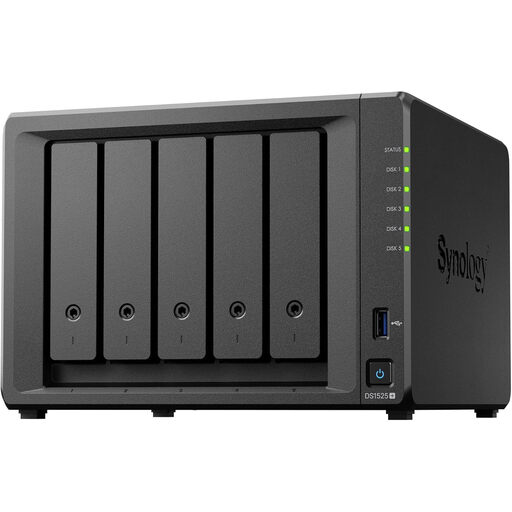 Image unavailable
Synology DS1525+ five-bay diskless NAS
For a larger local archive, this diskless model provides five drive bays. Plan for compatible internal drives, and check the supported RAID options and local-backup arrangements before choosing it for recordings.
View on Joybuy
Frequently asked questions
Can I store music recordings on a NAS without using cloud storage?
Yes. The NAS can hold recordings on local drives, while an external drive or another local NAS can hold a separate backup. Synology describes external-device backup as an option alongside other backup destinations.
Does RAID 1 remove the need for a backup?
No. RAID 1 mirrors data across drives but does not create an independent copy outside the NAS. QNAP advises backing up NAS data before replacing a faulty disk.
How much usable space do two drives provide in RAID 1?
Plan around the capacity of the smaller drive, not the sum of both. Synology's RAID guidance lists the smallest drive size as RAID 1 storage capacity.
How should I choose hard drives for the NAS?
Start with the enclosure maker's compatibility information for the exact drive model and capacity. Western Digital positions WD Red Plus for RAID-optimised NAS systems, and Seagate positions IronWolf for NAS use; a drive range's intended use does not establish compatibility with every enclosure.
What should I do with an old NAS enclosure in the UK?
Check an appropriate electrical-equipment collection or recycling route when replacing it. UK government guidance covers waste electrical and electronic equipment under the WEEE regulations; check the available route for the enclosure and its drives.


