Recording archivists focused on recovery
You mainly need somewhere to keep finished sessions, stems and masters, with a plan for restoring files rather than the fastest possible access to live projects.


For recordings stored from one home workstation, a two-bay NAS is a sensible starting point if you want the option of protection against one drive failing. Choose 2.5GbE for frequent large transfers only if the workstation and network path can use it; consider more expansion when your storage or shared-workload needs are likely to grow. Keep a separate, recoverable backup copy whichever enclosure you choose, because RAID is not a backup.
You mainly need somewhere to keep finished sessions, stems and masters, with a plan for restoring files rather than the fastest possible access to live projects.
You regularly transfer large projects between the workstation and NAS. Faster networking matters only if the workstation and the rest of the connection can support it.
You expect your archive or shared workload to grow and want to assess extra drive bays, M.2 slots, memory or network ports before choosing an enclosure.
Decide how you will recover recordings first, then check whether your transfer routine, listening library or expected growth justifies additional features.
| Concern | What to check | Who this matters to |
|---|---|---|
| Recording recovery | Check the drive configuration, compatible disks and where a separate, restorable backup copy will live. | If a finished take would be difficult to recreate, I need to know how I would recover its files after a problem. Around 36% of consumers put recording recovery first. |
| Project transfers | Check the NAS and workstation Ethernet ports, intervening network equipment and cabling. | When I move large sessions regularly, waiting for each transfer can interrupt my workflow; around 29% of consumers prioritise transfer speed. |
| Library access | Check the available library software and whether your file formats work with the playback devices you intend to use. | I want to find and listen to stored recordings without hunting through folders. For around 21% of consumers, convenient library access is the primary need. |
| Room to grow | Check drive bays and model-specific options for M.2 storage, memory or network expansion. | If more projects or people will use the archive, I want room to adapt the setup later; around 14% of consumers make expansion their first priority. |
A redundant drive configuration can help with a drive failure, but it does not give you a separate copy to restore after other kinds of loss.
Choose another backup destination and check how you would restore a recording folder or an earlier file version. Synology describes separate destinations and versioning in its Hyper Backup tools.
A separate backup destination also needs storage and an ongoing routine for checking that restores work.
A faster NAS port cannot remove a 1GbE limit elsewhere between the workstation and the enclosure.
Check the workstation adapter and every active network port on the transfer path before choosing 2.5GbE. QNAP says existing Cat5e cabling can be used for its 2.5GbE solution, but the connected equipment still matters.
Western Digital distinguishes SMR WD Red drives from CMR WD Red Plus and Red Pro drives. A family name alone does not establish the recording technology or enclosure compatibility of an exact model.
Check the drive model and capacity against its data sheet and the NAS maker’s compatibility list.
A NAS connected to your home network needs an update plan as well as storage planning. The National Cyber Security Centre advises against choosing connected devices whose manufacturer support is ending soon.
Check the stated security-support period, use a unique password, enable two-step verification if offered and apply updates.
Consider its desktop NAS range if file management, backups and a browsable music library matter alongside storage.
The TS-262 is worth examining when frequent transfers and hardware expansion are part of the plan.
Its desktop range includes different combinations of archive, networking and expansion features.
A hard-drive line to examine when selecting disks separately for a multi-bay NAS.
A drive line to examine if you are specifying CMR disks for a compatible enclosure.
These enclosures offer two-, four- and five-bay routes for storing recordings. Choose by the number of drives your plan calls for, then confirm drive compatibility, backup arrangements and the network connection for your workstation.
 No image available
A two-bay option to consider for a home recording archive when you plan to select drives and arrange a separate backup.
Check compatible drives, the redundancy configuration and the network port against your workstation setup.
 No image available
Consider four bays if your recording archive or shared storage plan calls for more drive positions than a two-bay enclosure provides.
Confirm compatible drive models and the correct expansion unit before relying on an expansion plan; check the full network path for your intended transfer speed.
 No image available
This four-bay enclosure is another route to consider if you want to plan recording storage across more drive positions.
Confirm whether drives are included, which models are compatible and whether its network port suits your workstation.
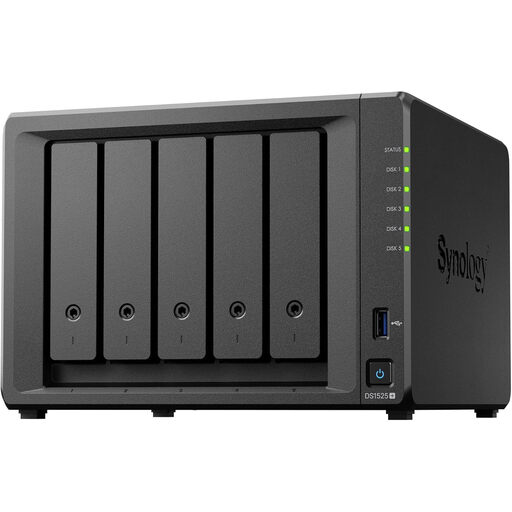 No image available
A five-bay option to assess if your recording archive genuinely needs additional drive positions or a broader shared-storage setup.
Select compatible drives separately and confirm the network configuration before planning how it will connect to the workstation.
It can suit a single-workstation archive if its capacity meets your needs and you keep a separate backup copy. With two compatible drives in an appropriate RAID configuration, the Synology DS224+, for example, is described by Synology as providing one drive of redundancy; check the configuration of the model you actually choose.
No particular transfer gain is guaranteed. QNAP describes 2.5GbE as having 2.5 times the connection speed of standard 1GbE, but the workstation, network equipment and storage can each limit a real file transfer.
Start with the enclosure maker’s compatibility list and check the exact drive model and capacity. Seagate markets IronWolf for multi-bay NAS use, while Western Digital distinguishes CMR WD Red Plus and Red Pro drives from SMR WD Red models; a drive-family name alone is not a compatibility check.
Check the manufacturer’s security-support period and plan to install updates, use a unique password and enable two-step verification where available. The National Cyber Security Centre advises avoiding connected devices whose support is ending soon.