What matters when choosing
For a portfolio kept locally, settle the recovery plan and usable drive capacity before deciding whether faster connections or additional access features matter to your workflow.
| Concern |
What to check |
Who this matters to |
| Independent recovery |
Check how the NAS backs up to a separate drive, whether you can disconnect that drive, and how you would restore files. |
If I delete a shoot or the NAS is damaged, I need another copy I can recover. Around 36% of consumers would put independent recovery first. |
| Usable capacity |
Calculate capacity for the intended RAID layout and check the number of bays and compatible drives. |
My RAW archive is growing, so the space left after mirroring or parity matters more than the capacity printed on each drive; around 29% of consumers would make usable capacity their primary concern. |
| Copying speed |
Compare NAS ports with your computer, switch or router, cabling and external-drive connections. |
When I regularly copy large shoots, waiting for transfers disrupts my workflow. Faster copying would come first for around 21% of consumers. |
| Manageable local access |
Check computer compatibility, folder permissions, updates and whether you need remote access. |
I need to find portfolio files on my devices without giving everyone access to client material; around 14% of consumers would prioritise straightforward, controlled access. |
Joybuy NAS choices
These Synology NAS models range from a two-bay destination for a local photo library to multi-bay storage aimed at larger shared archives. Check drive requirements, usable capacity and your separate backup plan for the model you choose.
 No image available
Synology DS225+ two-bay diskless NAS
Consider this for a local photo collection if the usable capacity of a two-drive layout will meet your needs.
It is a two-bay diskless model, so select compatible drives separately. Keep an independent backup rather than relying on RAID or snapshots alone.
Joybuy
 No image available
Synology DiskStation DS925+ four-bay NAS
Consider four bays if your local image archive calls for more drive-layout choices as it grows.
The listing describes dual 2.5GbE ports; using them requires compatible network equipment and a computer connection. Confirm included drives, compatible drive models and the exact expansion unit before planning the storage layout.
Joybuy
 No image available
Synology DS425+ four-bay NAS
This four-bay model is worth examining if portfolio files need central access across computers or controlled access for a small team.
The listing describes file sharing, access controls, backups and snapshots. Confirm included and compatible drives, calculate usable capacity, and keep a backup outside the live NAS.
Joybuy
 No image available
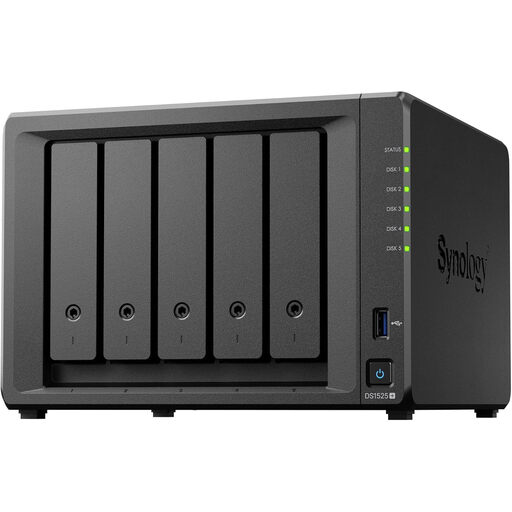
Synology DS1525+ five-bay diskless NAS
Consider this model for a larger shared photo and media archive rather than assuming a single portfolio needs a production-oriented setup.
The listing identifies five bays, diskless supply and 10-Gigabit networking. Choose compatible drives, calculate usable capacity and check whether your computers and network can use the connection.
Joybuy
 No image available
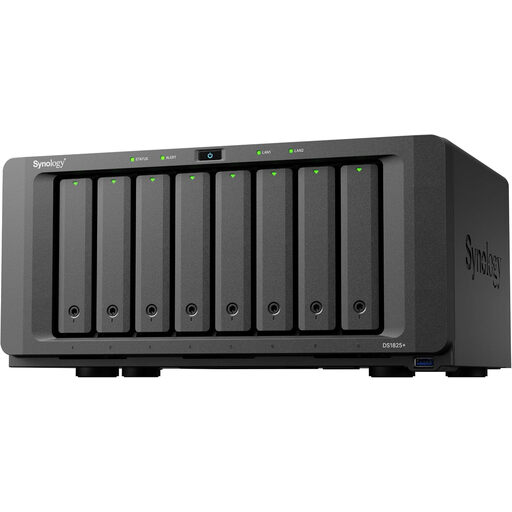
Synology DS1825+ eight-bay diskless NAS
This eight-bay model is oriented towards a larger, multi-user media archive; assess whether that scope matches your portfolio workflow.
It is listed as diskless, with 10GbE or 25GbE networking described. Confirm compatible drives and the intended network configuration, calculate usable capacity and plan an independent backup.
Joybuy
Common questions
Can a NAS replace cloud storage for my photo portfolio?
A NAS can be the local destination for copying and accessing portfolio images without cloud storage in the primary workflow. It does not automatically give you a separate backup elsewhere, so plan an independent copy; a disconnected external drive is one local option.
Is RAID 1 enough to protect portfolio images?
No: RAID 1 can help if one installed drive fails, but it is not a separate copy of your images. Keep another backup and test that you can restore files; the National Cyber Security Centre advises separating backup media from the live system to reduce its exposure to attacks.
Should I choose a two-bay or four-bay NAS for RAW photos?
Choose by the usable capacity and drive layout your archive needs, not by bay count alone. Two bays may suffice if a mirrored layout leaves room for growth; four bays offer more layout choices. QNAP states that RAID 5 needs at least three drives and RAID 6 at least four.
Will 2.5GbE make copying my images faster?
A 2.5GbE NAS port can help with transfers only when the computer and network path also support it. Check adapters, switch or router ports, cabling and the storage setup before choosing a model for faster connectivity; the port alone does not establish your copying speed.
What if my local portfolio contains identifiable people or confidential client files?
Local storage does not remove the need to control access to those files. For professional or organisational processing of personal data, the Information Commissioner's Office says security measures under UK GDPR should be appropriate to the circumstances and risk; assess permissions, updates, backups and whether encryption is appropriate for your work.


