Creators working to handover deadlines
You regularly copy large image folders for clients. The NAS, computer connection and network equipment all matter when you assess how promptly those copies can be completed.


A two-bay NAS can serve a solo portfolio-image handover workflow if its planned capacity is sufficient and you keep a separate backup; consider four bays when the archive or team grows. Copying speed depends on the complete network and storage path, while files containing personal information call for access controls and security measures suited to the risk.
You regularly copy large image folders for clients. The NAS, computer connection and network equipment all matter when you assess how promptly those copies can be completed.
You need room for active work and completed projects as well as a separate recovery copy, rather than a location used for one transfer and then cleared.
Your handovers may contain personal information or confidential material. Who can access the files and how you would recover them matter alongside copying speed.
Start with the need that matters most to your handovers: predictable copying, a recoverable and appropriately protected copy, or room for a growing shared archive. A compact two-bay setup and a four-bay setup answer different capacity needs; faster networking is a separate choice that must work across the whole transfer path.
| Concern | What to check | Who this matters to |
|---|---|---|
| Predictable copying | Check the NAS port, computer connection and switch together. Confirm the conditions behind any stated transfer rate. | When large image folders have to move before a handover deadline, I want to know which part of the connection could slow the copy. Around 42% of consumers might put predictable transfer times first. |
| Recovery and protection | Plan a separate backup and a way to test restoration. For personal information, assess permissions and whether encryption is appropriate to the risk. | If a client file is lost or accessed by the wrong person, I need a way to recover it and control who can open it. Recoverability and protection might come first for roughly 33% of consumers. |
| Archive growth and shared access | Estimate future storage needs and simultaneous users; check bay count, compatible drives and the exact expansion options. | As completed projects accumulate or colleagues need access, I do not want the enclosure to constrain the next project. About 25% of consumers might make archive growth and shared access their primary concern. |
Mirroring or RAID may help keep a NAS available after some drive failures, but it does not create an independent recovery copy. The National Cyber Security Centre advises keeping backups of essential business data.
Arrange a separate backup destination and test that you can restore the client files before relying on the NAS as your handover copy.
A faster port does not establish the speed of a complete transfer. Manufacturer figures can depend on a particular network and storage configuration.
Check the editing computer or adapter, switch, cabling and intended NAS configuration before choosing 2.5GbE or 10GbE capability.
QNAP specifies that the TS-264 ships without HDDs. A drive also needs to suit the exact enclosure and intended configuration, not just the required capacity.
Check what the selected enclosure includes and compare each proposed drive model with its compatibility guidance.
Synology warns that installing a data-bearing drive in a DS923+ formats and erases it.
Make and verify another copy before installation. Check the instructions for the exact NAS and drive setup you intend to use.
Relevant if you want to assess storage, backup software and an upgrade path together.
Relevant when a compact NAS with faster-port options is under consideration.
Relevant to a four-bay shared archive where network expansion is part of the plan.
Relevant when selecting internal NAS drives to go with an enclosure.
These four- and five-bay NAS enclosures are options to assess for a shared or growing portfolio-image archive. Choose the drive configuration, backup destination and network path to suit the handover workflow.
 No image available
Consider this four-bay enclosure if your client-image archive is growing. Check the exact compatible drives and expansion unit before planning a larger setup, and arrange a separate backup for handover files.
 No image available
This four-bay model is worth assessing for a small team sharing client-image files. Confirm its network-port configuration, compatible drives and what is included in the selected configuration before deciding whether it suits your transfer path.
 No image available
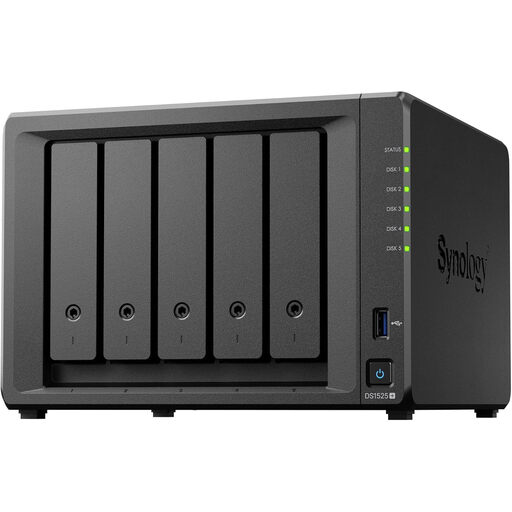
Consider this five-bay model if several people need shared creative-file storage rather than a location for occasional solo handovers. It is described as diskless, so select compatible drives separately; check the intended network configuration and arrange an independent backup.
A two-bay NAS can be enough for a mainly solo workflow if the planned drive capacity accommodates the files and you maintain a separate backup. Consider four bays or an expandable enclosure when the archive or number of users is expected to grow.
No. The computer connection, switch, cabling and storage configuration must also support the intended transfer path. QNAP’s higher stated figures for the TS-264 depend on its specified port-trunking configuration, so do not use a port rating alone to predict a handover time.
No. Mirroring does not give you an independent recovery copy. The National Cyber Security Centre advises backing up essential business data; keep a copy separate from the main NAS and test that you can restore the files.
Assess encryption alongside access permissions and other safeguards when the files contain personal information. The Information Commissioner’s Office describes encryption as a measure whose appropriateness depends on the nature and risks of the processing; the answer is not determined by the NAS model alone.
Make and verify another copy of its contents before installation. Synology’s DS923+ installation guidance warns that a drive containing data will be formatted and erased; check the instructions and drive compatibility guidance for your exact NAS.