What to check before buying
Work out how collaborators will copy and access files, then size the drives and recovery plan around the projects the studio needs to keep.
| Concern |
Buying check |
Who this matters to |
| Concurrent copying |
Compare the NAS ports with the switch and main workstations’ wired connections. Check the conditions behind any quoted transfer speed. |
When several collaborators copy folders at once, slow links elsewhere in the network could hold up the work; around 33% of consumers would put network throughput first. |
| Capacity and drive tolerance |
Estimate active and retained projects, then calculate usable capacity for the intended drives and RAID layout. Check drive compatibility. |
If completed projects must remain accessible as the archive grows, room for drives and a suitable layout become the priority; roughly 27% of consumers would focus primarily on capacity and drive-failure tolerance. |
| Controlled collaboration |
Plan named accounts and the access each role needs. If files identify people, assess proportionate security measures, including whether encryption is appropriate. |
When freelancers need only certain client folders, I want to limit their access without sharing an administrator login; around 20% of consumers would make controlled access their main concern. |
| Independent recovery |
Choose a separate backup destination, restrict who can alter it and test restoring a project folder. |
If an image folder is deleted or the primary NAS is affected by malware, I need a copy I can actually restore; independent recovery would come first for around 20% of consumers. |
Joybuy NAS choices
These Synology NAS models span two-, four- and eight-bay starting points for shared portfolio storage. Compare each one with the studio’s network, access requirements and backup plan rather than treating bay count alone as the decision.
 No image available
Synology DS425+ four-bay NAS
A four-bay option to assess when the studio wants a shared location for portfolio folders and room to plan beyond two drives.
Check the network connections, compatible drives and usable capacity for the intended setup. Arrange an independent backup rather than relying on NAS backup features alone.
View on Joybuy
 No image available
Synology DiskStation DS925+ four-bay NAS
Consider this model if retained portfolio projects call for four bays and a documented expansion path.
Synology specifies dual 2.5GbE ports and optional expansion to nine drives. Confirm drive compatibility, the intended RAID layout and whether the studio’s wired network can use the faster ports; keep a separate backup.
View on Joybuy
 No image available
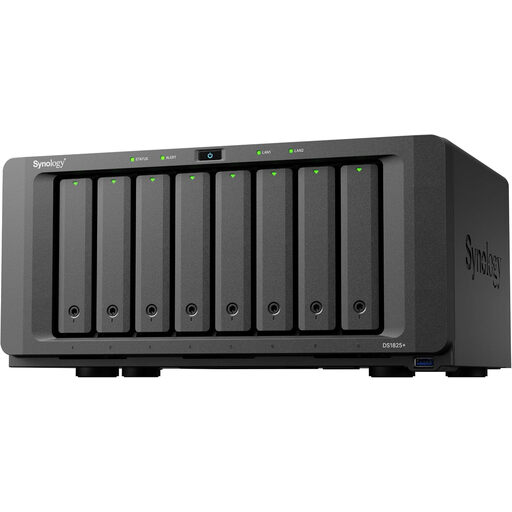
Synology DS1825+ eight-bay diskless NAS
Its eight-bay format is worth assessing if the studio expects a substantial retained archive or a larger production workgroup.
This is a diskless model, so plan for compatible drives. Confirm the exact network configuration, usable capacity and workstation connections before building a higher-throughput setup; maintain a separate backup.
View on Joybuy
 No image available
Synology DS225+ two-bay diskless NAS
A two-bay starting point to consider for centralising photo files if the studio can work within two-drive capacity limits.
This model is described as diskless, so plan for drives. Confirm its network connections, collaborator permissions and suitable drive configuration for the intended workflow, and arrange a separate recovery copy.
View on Joybuy
Questions about shared-studio NAS setups
Is a two-bay NAS enough for a shared photography studio?
A two-bay NAS can be enough for a small team centralising current projects, provided its capacity and access arrangements fit the work and the studio keeps a separate backup. For growing retained archives, four bays offer more RAID-layout choices: QNAP specifies at least three drives for RAID 5 and four for RAID 6.
Does RAID mean our portfolio images are backed up?
No. RAID can tolerate certain drive failures according to its layout, but it is not an independent recovery copy. The National Cyber Security Centre advises regular backups for recovery from destructive ransomware; protect the backup’s access and test a folder restore.
Must a UK studio encrypt its NAS?
The appropriate measures depend on the files and the risks, rather than on the NAS alone. The Information Commissioner’s Office says information relating to an identified or identifiable person can be personal data and identifies encryption as a measure that may be appropriate under UK GDPR. Assess the portfolio material and document the studio’s security choices.
What access should studio collaborators have?
Give collaborators named accounts with only the folder and action permissions their work requires, rather than a shared administrator login. The Information Commissioner’s Office advises role-based access profiles and regular reviews, including removing access that is no longer needed.
Will a multi-gig NAS automatically speed up image copying?
No. Faster NAS ports help only where the wired path and client computers can use them, and quoted speeds depend on test conditions. Check the NAS, switch and principal workstations together before choosing a 2.5GbE or higher-speed setup.


