A four-bay NAS is a sensible starting point if the group needs room for a growing RAW archive while retaining protection against a drive failure. Size the drives and network around the archive and the people using it, and keep a separate, tested backup: RAID alone cannot recover every kind of loss.
Who needs this setup?
Custodians of a growing RAW archive
If you organise long-term storage of event photographs, plan for archive growth, usable capacity and recovery after a drive failure. The four-bay configurations described by Synology and QNAP offer more capacity and redundancy choices than a two-bay starting point.
Groups with several uploaders or editors
When members regularly move large folders, consider the NAS connection alongside their computers, switch and shared-folder permissions. QNAP and ASUSTOR describe faster wired-network options, but the whole transfer path matters.
People responsible for recognisable photographs
The Information Commissioner’s Office says a photograph is usually personal data if someone can be recognised. Groups handling such files should decide who needs access, how accounts are removed when roles change and how backed-up files can be recovered.
What matters when choosing?
Start with the archive’s size and recovery plan, then check how members will transfer files and who should be able to access them.
| Concern | What to check | Who this matters to |
|---|
| Usable capacity and growth |
Estimate archive growth and retention needs; compare usable capacity after the chosen drive layout, and check drive and expansion compatibility. |
I need space for future events without replacing the whole setup too soon. Around 31% of consumers would put archive growth first. |
| Recovery from loss |
Choose a drive-failure arrangement, maintain a separate backup and test restores of RAW folders. Western Digital cautions that RAID is not a backup. |
If files are deleted or a drive fails, I need a way to get the photographs back. Roughly 31% of consumers would make recovery their primary concern. |
| Multi-user transfers |
Check concurrent users and the NAS, switch and computer connections; decide whether members edit local copies or access files over the network. |
Several of us move large shoots, and waiting for transfers interrupts our work. Around 23% of consumers would prioritise this workflow. |
| Access and privacy |
Check account and folder permissions, administrator roles, volunteer offboarding and whether encryption suits the group’s risks. |
I need to know who can view or change photographs of recognisable people. About 15% of consumers would put controlled access first. |
Mistakes to avoid
-
Treating RAID as the only backup
Western Digital warns that RAID does not protect against malicious attacks, file-system corruption or ransomware. The National Cyber Security Centre notes that physically disconnected backup media stored separately is harder for an attacker to access.
Keep a distinct backup copy, restrict its administration and test restores of representative RAW folders.
A separate destination and regular restore tests add storage and administrative work.
-
Buying faster NAS ports without checking the network
A 2.5GbE port or optional 10GbE upgrade cannot remove a bottleneck in a slower switch, client connection or Wi-Fi link. A port specification is not a promised transfer speed for every member.
Trace the wired path from the NAS to each computer that regularly moves RAW folders before choosing networking upgrades.
Using faster ports may also call for compatible switching, client adapters or cabling.
-
Choosing drives by capacity alone
Synology and QNAP provide model-specific compatibility guidance. A drive’s capacity does not, by itself, establish that it suits the selected NAS and storage configuration.
Check the exact NAS and drive model numbers against the manufacturer’s compatibility information before ordering.
-
Giving every volunteer administrator access
Broad permissions make it harder to control viewing, changes and access when responsibilities change. The Information Commissioner’s Office recommends assigning rights by role and having a process to amend or remove them.
Use individual accounts, limit administrator access and document who manages the archive and its backups.
Relevant brands to consider
These model lines illustrate different storage and networking choices; compare the exact configuration before committing the group’s archive.
Synology
The DiskStation DS923+ is relevant to groups considering four bays, data-management features and later expansion.
- Synology specifies four SATA bays, Btrfs integrity features and expansion to nine drives with a compatible DX517.
- Its built-in connections are two 1GbE ports; 10GbE requires an optional module. Check the DS923+ drive compatibility list.
QNAP
The TS-464 is relevant when several members use a suitable wired network for local file transfers.
- QNAP specifies four bays, dual 2.5GbE ports, two M.2 slots and a PCIe upgrade path.
- The network benefit depends on connected equipment and workload. Check compatible drives and SSDs for the exact model.
ASUSTOR
The LOCKERSTOR 4 Gen2 AS6704T is relevant to technically confident groups considering networking and expansion options.
- ASUSTOR specifies four bays, dual 2.5GbE, four M.2 slots and a PCIe slot.
- Confirm compatible drives, current firmware, support arrangements and the intended backup workflow before adopting it as the group archive.
Joybuy NAS options for a shared RAW archive
These NAS models offer four- or five-bay starting points for shared storage. Compare their exact drive, network and recovery configurations against the group’s archive plan rather than treating the bay count as a complete backup solution.
 No image available
Synology DS425+ 4-Bay NAS
Consider this four-bay model if members need a shared place to store and retrieve photo folders.
Before planning the archive, check compatible drives, usable capacity, supported RAID arrangements, network ports and whether drives are included.
View on Joybuy
 No image available
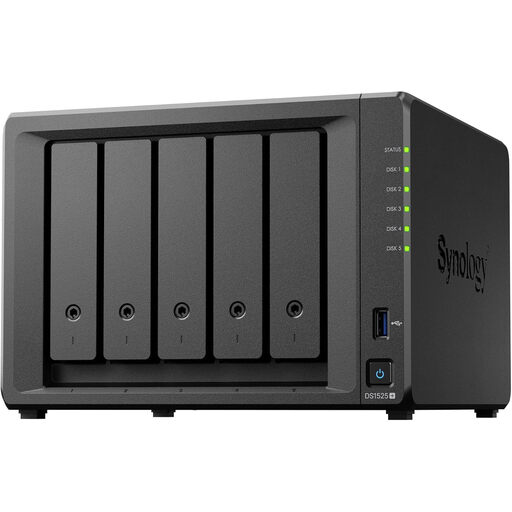
Synology DS1525+ 5-Bay Diskless NAS
The five-bay configuration is worth considering if the group’s capacity plan calls for another drive bay.
It is sold as diskless, so plan the drives separately. Check compatible drive models, usable capacity, RAID and backup recovery options, permissions and what equipment the advertised 10GbE readiness requires.
View on Joybuy
 No image available
Synology DiskStation DS925+ 4-Bay NAS
Consider this four-bay model if the group wants to assess faster wired transfers between the NAS and suitably equipped computers.
The listing specifies dual 2.5GbE ports; actual transfer speeds also depend on the network path. Check exact drive compatibility, the supported expansion unit, backup recovery options and user permissions before planning the archive around it.
View on Joybuy
Frequently asked questions
Should we use RAID 5 or RAID 6 for the RAW archive?
Choose between them using the group’s usable-capacity and drive-failure requirements. In a four-drive arrangement, RAID 5 uses the equivalent capacity of one drive for redundancy and tolerates one drive failure; RAID 6 uses two drives’ worth and tolerates two. Western Digital cautions that neither arrangement replaces a separate backup.
Do we need 2.5GbE or 10GbE?
Faster NAS networking is worth assessing when several members regularly move large RAW folders over a compatible wired network. Check the switch and computers as well as the NAS: a faster NAS port cannot overcome a slower link elsewhere in the path.
How should we handle photographs of recognisable people?
Control access according to who needs the files and assess safeguards appropriate to the group’s processing risks. The Information Commissioner’s Office says recognisable photographs are usually personal data and advises role-based access management; its guidance treats encryption as a measure to consider in light of the data and risks involved.
Can we move existing disks straight into a new NAS?
Back up important files before installing existing disks and follow the instructions for the exact NAS model. Synology’s DS923+ installation guidance, for example, warns that installing a drive containing data will format it and erase its contents; also check model-specific drive compatibility before purchase.


