For a defined handover archive with modest day-to-day access, a two-bay NAS is a reasonable starting point; consider faster networking or more bays if recordings will remain an active team workspace or continue to grow. Keep an independently recoverable copy outside the primary NAS, and agree access, retention and restoration arrangements before handing the recordings over.
Who needs this archive?
Client-handover archive custodians
If you are responsible for delivering a retrievable set of recordings, decide who may access it, when access ends and how to recover files if the primary NAS fails. The Information Commissioner’s Office advises that personal data should not be kept longer than needed and that security measures should reflect the processing risk; the National Cyber Security Centre advises planning for recoverable backups.
Teams still reviewing recordings
If colleagues will continue uploading, finding and transferring files during handover, assess the file-sharing workflow and the network connecting them to the NAS. A faster port is relevant only if the rest of that connection can use it.
Organisations building a longer-term repository
If further projects will add recordings, plan usable capacity and an expansion route before choosing an enclosure. Additional drive space does not determine how long recordings should be retained or replace an independent backup.
What matters when choosing a NAS?
Choose the enclosure for the archive’s expected access and growth, then plan recovery and handover controls separately: a mirrored disk layout does not create an independent copy.
Straightforward two-bay archive
Consider when: The recording set is defined and only modest concurrent access is expected.
Trade-off: Two bays leave less room to change the drive layout as the archive grows.
Active-workspace NAS
Consider when: Several people will continue transferring or reviewing recordings, or future storage expansion is a firm requirement.
Trade-off: Faster networking depends on compatible equipment throughout the connection; extra hardware does not replace a recovery plan.
| Concern | What to check | Who this matters to |
|---|
| Recoverability |
Arrange a separate, protected backup destination and restore a sample recording with its folder structure before handover. |
If the NAS is damaged or files are deleted, I need to retrieve the agreed archive. Around 31% of consumers put a recoverable copy and a tested restore path first. |
| Access and retention |
Agree authorised users, access removal and a retention review; assess whether encryption is appropriate for the recordings. |
When recordings include client information, I need to control who receives them and when they are removed. Roughly 31% of consumers give that governance need priority. |
| Usable capacity |
Allow for recordings added during handover and compare usable space under the intended drive layout, not just the drives’ combined labels. |
If the client must retrieve files throughout an agreed retention period, I need room for the archive to grow. Around 25% of consumers make capacity headroom their primary concern. |
| Active transfers |
Check whether frequent concurrent transfers justify 2.5GbE and whether switches and client devices can use it. |
While colleagues are still moving and reviewing large files, I need transfers to fit the workflow. About 13% of consumers prioritise active-transfer capability. |
Handover mistakes to avoid
-
Treating a disk mirror as the whole backup plan
A primary NAS can still be affected by deletion, account compromise or an incident affecting the enclosure. The National Cyber Security Centre advises checking that backups can be restored and protecting backup infrastructure from destructive access.
Keep an additional recoverable copy, restrict access to it and test restoration of representative recordings before responsibility transfers.
An additional backup destination needs a protected location and time set aside for restore tests.
-
Choosing an enclosure without planning its drives
A bay count or advertised raw capacity does not tell you the usable space under your chosen drive layout. QNAP describes the TS-264 as shipping without HDDs, illustrating why the exact enclosure configuration matters.
Confirm whether drives are included, choose compatible models and calculate usable capacity against the expected archive and retention period.
-
Keeping recordings simply because space is available
Where recordings contain personal data, the Information Commissioner’s Office says they must not be kept longer than needed for their purpose. Spare NAS capacity does not establish a retention period.
Agree the archive’s purpose, authorised handover recipient, review point and deletion or anonymisation process before loading files.
-
Choosing faster ports without checking the network
Manufacturer transfer figures can depend on the network and configuration. Faster NAS ports may make little difference to a completed archive accessed only occasionally.
Check the switches, client adapters and frequency of concurrent transfers before selecting a faster-networking model.
Using the faster connection may also require changes to switches, adapters or cabling.
Relevant brands to consider
Synology
The DS224+ is a compact two-bay route for centralised access and file-sharing workflows.
- Synology describes file versioning on the DS224+ that can roll back unwanted changes or deletion.
- Version rollback does not replace an independently recoverable backup; assess capacity and access needs for the intended handover.
QNAP
The two-bay TS-264 is worth considering when recordings remain an active workspace and compatible faster networking is planned.
- QNAP specifies two 2.5GbE ports, two M.2 slots and optional 10GbE expansion for the TS-264.
- QNAP’s quoted throughput depends on its stated network configuration and conditions; drives and SSDs are separate items.
ASUSTOR
The Lockerstor Gen2 range offers different bay counts for archives with differing growth plans.
- ASUSTOR specifies dual 2.5GbE ports for the Lockerstor 2 Gen2.
- Check expansion support for the exact model: ASUSTOR’s product material says the AS6702T and AS6702T v2 do not support 10GbE.
Seagate
IronWolf is a NAS HDD line to assess alongside a compatible enclosure rather than an archive appliance on its own.
- Seagate describes IronWolf as using conventional magnetic recording (CMR) for one- to eight-bay NAS systems.
- Check the exact drive model, capacity and enclosure compatibility. A NAS HDD alone does not provide a separate backup copy.
Joybuy NAS options
These multi-bay Synology enclosures are options to assess when archive growth or continuing file access matters. For a defined, mostly read-only handover, weigh their additional bays against the usable capacity and workflow you actually require.
 No image available
Synology DiskStation DS925+ 4-Bay NAS
Consider this four-bay enclosure if the recording archive needs room for a planned drive layout and continued central file access.
The listing specifies dual 2.5GbE ports. Check that your network can use them and confirm usable capacity under your chosen drive layout.
The listing restricts drive compatibility to Synology-branded drives. Confirm compatible drive models and the exact expansion unit before planning future growth.
View on Joybuy
 No image available
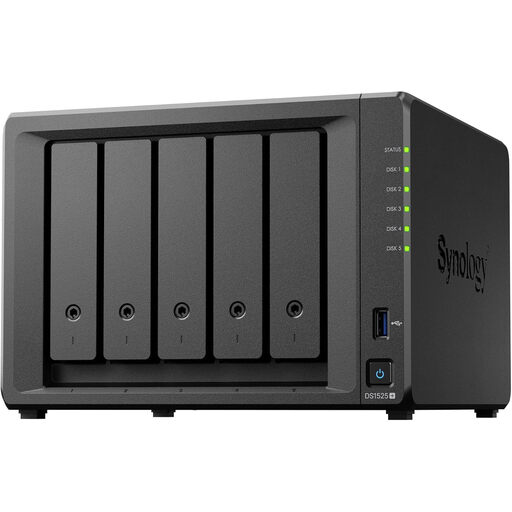
Synology DS1525+ 5-Bay Diskless NAS
Consider this five-bay enclosure if future recording growth or a continuing team workflow calls for a larger storage platform.
It is the diskless variant, so plan compatible drives separately. Confirm usable capacity for the intended drive configuration rather than treating stated expansion figures as available archive space.
Check drive and expansion compatibility for this model, and arrange an independent backup and restore test for the handover.
View on Joybuy
Frequently asked questions
Is a mirrored two-disk NAS enough backup for a client handover?
No: keep an independently recoverable copy as well as the NAS. The National Cyber Security Centre advises regular backups and checking that files can be restored; its organisational guidance also recommends isolating backup infrastructure and using separate credentials.
Do UK rules set one retention period for all client meeting recordings?
No single period applies to every recording containing personal data. The Information Commissioner’s Office says personal data must not be kept longer than needed for its purpose, so agree and document the handover archive’s purpose, review point and deletion responsibility.
Does every NAS recording archive need encryption?
Encryption is not automatically required in every case. The Information Commissioner’s Office describes it as an example of a security measure whose appropriateness depends on the nature and risks of the processing; if you use it, plan how keys and authorised access will be managed.
When does 2.5GbE matter for a recording archive?
Consider 2.5GbE when several people regularly transfer recordings and the connected network equipment can use it. QNAP specifies dual 2.5GbE for the TS-264, and ASUSTOR does so for the Lockerstor 2 Gen2, but port specifications alone do not establish the transfer speed of your setup.


