What matters when choosing?
Choose the enclosure around usable space and how the library will be accessed, then plan a separate recovery copy. Faster ports and extra bays are useful only when the project’s storage and wired-network needs call for them.
Two-bay NAS
Choose when: A defined library is backed up mainly from one computer and fits within the usable capacity of a mirrored pair.
Trade-off: RAID 1 tolerates one drive failure but limits usable space to roughly one matched drive and leaves less room to expand.
Four-bay NAS
Choose when: Footage is expected to grow beyond a mirrored pair or several project devices need storage.
Trade-off: More drives and setup are involved, and a layout that tolerates one failed drive still uses some capacity for redundancy.
Collaborative NAS
Choose when: Several active users regularly transfer large footage and the school has, or plans, a suitably fast wired network.
Trade-off: Higher-speed interfaces bring no matching transfer benefit if computers or other parts of the wired path remain slower.
| Concern |
What to check |
Who this matters to |
| Usable capacity and growth |
Measure footage, project files and exports; allow for additions, then calculate usable capacity for the intended drives and RAID layout. Check drive compatibility with the exact NAS model. |
If the archive keeps growing, I need room for the next shoots without mistaking raw drive capacity for protected space. Around 36% of consumers would put capacity and growth first. |
| Transfers and shared access |
Check the wired ports on the NAS, computers and switch, plus the cabling, before choosing 2.5GbE or a faster interface. |
When several editors need large files promptly, waiting for transfers could interrupt their work. Around 29% of consumers would make transfer speed and shared access their primary concern. |
| Recovery and secure handling |
Plan a separately protected copy and a test restore. For identifiable footage, agree access and storage arrangements with the school’s data-protection lead. |
If footage is deleted or contains identifiable people, I need a way to recover it and control who can open it. Recovery and secure handling would come first for around 21% of consumers. |
| Manageable setup |
Confirm the intended drive layout and who will manage alerts, updates and documented restore steps. |
Without a dedicated administrator, I need a setup someone can keep running throughout the project. Around 14% of consumers would prioritise manageable ownership. |
Joybuy NAS choices
These Synology enclosures span a two-bay backup setup, four-bay storage for a growing library and an eight-bay option to assess for a larger collaborative workflow. Choose by the project’s usable-capacity and access needs, and plan a separate recovery copy whichever model you consider.
 No image available
Synology DS425+ 4-Bay NAS
A four-bay choice to assess when the school video library is expected to grow or be shared. Synology lists built-in 2.5GbE for the DS425+; calculate usable capacity for the chosen drives and layout, and check the exact model’s drive compatibility. Keep a separate copy that you can restore.
View on Joybuy
 No image available
Synology DS225+ 2-Bay Diskless NAS
A two-bay option for a defined library backed up mainly from one computer, if a mirrored pair provides enough usable space. Diskless means drives are not included; check compatible drives and the network connection for the intended setup. Maintain and test a separate backup copy.
View on Joybuy
 No image available
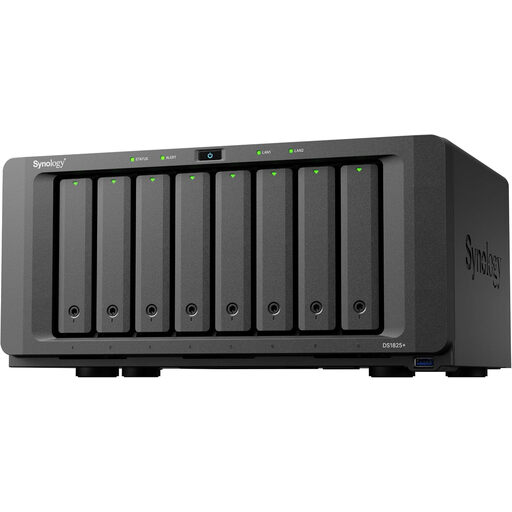
Synology DS1825+ 8-Bay Diskless NAS
An eight-bay option to assess only if the project has substantial storage growth or a genuinely collaborative workflow. The product title identifies a diskless enclosure, but its capacity descriptions should be checked against the actual drive configuration before purchase. Confirm that any intended faster networking is matched by the computers and wired network, and arrange a separate tested backup.
View on Joybuy
 No image available
Synology DiskStation DS925+ 4-Bay NAS
A four-bay model to consider when the archive may need more drive positions. Its listing describes dual 2.5GbE ports; check the exact DS925+ drive-compatibility list and confirm the compatible expansion unit before planning later growth. Calculate usable capacity for the intended configuration and keep a separate recovery copy.
View on Joybuy
Common questions
How much NAS capacity does a school video library need?
Start with the measured size of source footage, project files and exports, then allow for additions over the planned retention period. Calculate usable space for the chosen drives and RAID layout rather than adding up their headline capacities; Synology’s RAID guidance explains how the layout changes usable capacity.
Is RAID 1 or RAID 5 enough to back up the video library?
No: drive redundancy is not a separately protected recovery copy. Supported RAID layouts can tolerate certain drive failures, but the National Cyber Security Centre advises protecting backups from destructive actions and checking that files can be restored.
Does a school-project backup need 2.5GbE?
Not necessarily; decide according to how often large footage files must move and whether several people need access. To benefit from a 2.5GbE NAS connection, check that the computer, switch and cabling support the intended wired path as well as the NAS.
What if the footage identifies pupils or staff?
Agree where and how it will be stored before moving it to a NAS. Department for Education guidance addresses schools’ protection of personal data, while the Information Commissioner’s Office calls for security measures appropriate to the circumstances and risk; consult the school’s data-protection lead about access, retention and recovery.
What needs attention after the NAS is set up?
Assign someone to monitor drive-health and capacity alerts, manage updates and access, and test restoration from the separate backup. The National Cyber Security Centre specifically advises checking that important files can be restored, rather than relying on the existence of backup jobs alone.


