Studios building a growing central archive
Teams bringing layered artwork, scans, exports and project folders into one location need to plan for growth as well as the usable capacity left after their chosen RAID layout.


Choose a NAS enclosure and drives around the studio’s archive growth, shared access and recovery plan—not raw drive capacity alone. A four-bay setup offers more room to plan capacity and redundancy than a mirrored two-bay setup, but either needs compatible drives, appropriate access controls and a separate protected backup; RAID is not the archive’s only copy.
Teams bringing layered artwork, scans, exports and project folders into one location need to plan for growth as well as the usable capacity left after their chosen RAID layout.
When several people add and retrieve artwork, shared-folder permissions, the studio network and compatible drives all become part of the buying decision.
Teams that need to recover earlier or deleted files should consider version recovery, access controls and a backup copy protected separately from the NAS.
Choose the enclosure size for the archive’s likely growth, then check the drives, shared access and recovery arrangements that make that capacity usable.
Consider it when: The archive is growing and the studio wants more options for drive layout and later capacity changes.
Trade-off: More bays and drives take space and administration; the chosen RAID layout still determines usable capacity.
Consider it when: The archive is smaller and relatively stable, and the studio accepts limited expansion within the enclosure.
Trade-off: Mirroring reduces usable capacity compared with the drives’ combined raw capacity, and growth may mean replacing drives or the enclosure.
| Concern | What to check | Who this matters to |
|---|---|---|
| Recovery and backup | Check shared-folder version recovery where supported, and plan a separate backup destination that can be isolated from routine access. | If losing or overwriting client artwork would disrupt a project, I need an earlier copy I can restore. Recovery is the primary concern for around 36% of consumers. |
| Shared access | Check user and group permissions, the NAS network ports, the studio’s switch and workstation connections, and exact drive compatibility. | When several of us work from the archive, I need the right people to reach the right folders without sharing an administrator login. Around 36% of consumers put collaborative access first. |
| Usable capacity | Estimate archive growth and retained versions, then calculate usable capacity for the intended drives and RAID layout. | If our layered files and exports keep accumulating, I need space for the archive after redundancy and retained versions are accounted for. For around 28% of consumers, capacity and growth come first. |
Drive redundancy does not provide an independent copy if the NAS or its accessible files are damaged. The National Cyber Security Centre advises making backups isolatable as far as reasonably practical.
Keep a separate protected backup, limit who can administer it and test that files can be restored.
Western Digital distinguishes CMR WD Red Plus and Red Pro drives from some WD Red variants that use SMR. A family name also does not establish compatibility with a particular enclosure.
Check each drive’s full model number and recording method against the selected NAS maker’s compatibility guidance, especially for an active shared archive or ZFS setup.
Synology notes that usable capacity varies with the installed drives and RAID configuration. Retained versions also need space.
Calculate usable capacity for the intended layout and allow for archive growth before choosing drive sizes and bay count.
Broad administrator access weakens separation between everyday work and storage management. ASUSTOR warns that a forgotten encrypted-folder password can make its data unrecoverable.
Use named accounts and appropriate group permissions; if enabling folder encryption, establish a secure procedure for retaining its recovery credentials.
NAS enclosures for studios considering central storage, shared folders and recovery tools.
A NAS option to assess when storage management and recovery controls are central to the studio’s plans.
NAS systems to consider where shared-folder access rights are a priority.
Internal NAS drives to assess for an active, multi-bay artwork archive.
Internal NAS-drive families to compare when CMR recording is required.
These NAS enclosures offer four-bay or larger starting points for a central artwork archive. Choose drives and a separate backup arrangement to suit the studio’s intended configuration.
 No image available
Consider this enclosure for a shared archive that needs four bays and controlled access to central files.
Synology lists a built-in 2.5GbE port for the DS425+. Check whether drives are included, which models are compatible and how much usable space the intended RAID layout provides.
Plan a separate protected backup rather than relying on the NAS’s RAID or local recovery features alone.
 No image available
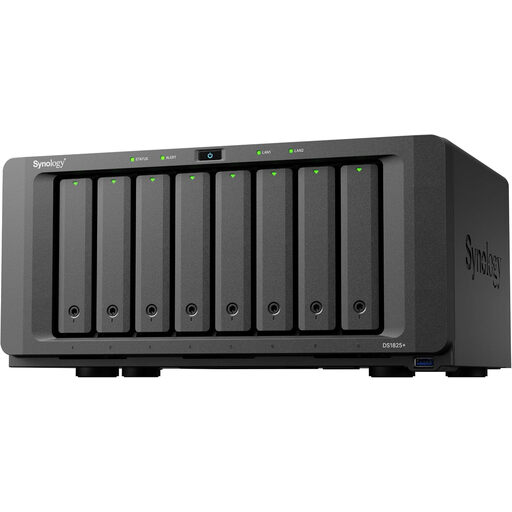
Consider this larger enclosure if the studio’s archive and shared workload justify eight drive bays.
It is listed as diskless, so choose compatible drives separately. Check the intended drive and RAID configuration for usable capacity, and match any network option to the studio’s equipment.
Arrange an independently protected backup for the artwork archive.
 No image available
Consider this four-bay enclosure if the studio wants to plan a shared archive with possible later expansion.
Confirm the exact compatible drives and expansion accessory before choosing either. Check whether drives are included and calculate usable capacity for the intended RAID layout.
Plan a separate protected backup alongside the central archive.
No: RAID can provide drive redundancy, but it is not a separate backup of the archive. Synology advises keeping additional copies on different storage media, including an off-site copy.
A compatible CMR NAS drive is a sensible choice to assess for sustained shared writes, RAID rebuilds or a ZFS setup. Western Digital identifies Red Plus and Red Pro as CMR and says they should be used with ZFS; check the exact drive model against the NAS maker’s compatibility guidance.
No: where the chosen NAS supports them, snapshots can provide earlier file versions, but they do not replace an independently protected copy. The National Cyber Security Centre warns that backups are not ransomware-resistant by default and recommends making them isolatable as far as reasonably practical.
Include access controls in the NAS plan, particularly if the studio will allow remote access. The UK Information Commissioner’s Office advises multi-factor authentication or equivalently strong controls for internet-facing remote-access services; check its current guidance when setting up the system.