Small studios sharing active projects
Several people need to open, save and organise current files in one place. Consider shared-folder permissions and the network used by those workstations, not just storage capacity.


Choose a two-bay network-attached storage (NAS) enclosure if protected capacity needs are modest; consider four bays if growing project archives call for more room to plan capacity and redundancy. Check the network path from the NAS to each workstation, select compatible drives for the intended storage layout, and keep an independent backup: RAID alone is not a backup.
Several people need to open, save and organise current files in one place. Consider shared-folder permissions and the network used by those workstations, not just storage capacity.
Moving projects from separate computers and external disks makes protected usable capacity, archive growth and a separate backup destination important planning decisions.
A shared location is useful only if someone can manage access, maintain backups and practise recovery. The National Cyber Security Centre advises keeping backups that can be isolated from a compromised network.
Work out the capacity your chosen redundancy layout will leave available and how you will recover files, then check the full network path for everyday shared work.
| Concern | What to check | Who this matters to |
|---|---|---|
| Active-project access | Compare NAS, switch and workstation port speeds; consider how many people transfer files at once. | When several of us use current project files, I want to avoid a slow network connection holding up transfers. Around 27% of consumers put active-work access first. |
| Independent recovery | Plan a separate backup destination that can be isolated, and test restoring representative folders. | If client work is deleted or a device is compromised, I need a recoverable copy beyond the working NAS. Roughly 33% of consumers prioritise independent recovery. |
| Protected capacity | Calculate usable space under the planned redundancy layout, allowing for retained projects and growth. | As completed projects accumulate, I need room for archives without choosing bays solely by today's raw capacity. About 20% of consumers make capacity growth their primary concern. |
| Ongoing administration | Check drive compatibility, folder permissions and who will handle updates, alerts and restore tests. | If nobody has much time to administer storage, I need a setup the studio can maintain consistently. Around 20% of consumers put manageable operation first. |
The NAS needs suitable drives to hold files. Faster networking also depends on compatible switches and workstation connections; a faster NAS port cannot remove a slower link elsewhere.
Check the exact model's drive compatibility, the disks needed for your storage layout, the network equipment and a separate backup destination before choosing an enclosure.
The setup may also call for network adapters, suitable cabling or additional storage for backups.
RAID is a way to configure storage, not an independent copy of studio work. The National Cyber Security Centre warns that backups are not ransomware-resistant by default.
Keep a separate backup destination, restrict administrator access and test whether you can restore representative project folders. Plan how backup access can be isolated if a studio device is compromised.
QNAP's quoted throughput for the TS-264 depends on its stated dual-port configuration. It should not be taken as the speed of a single workstation connected at 1GbE.
Map the NAS ports, switch, workstation connections and expected number of simultaneous transfers before deciding whether 2.5GbE or a later network upgrade is useful.
Redundancy changes usable capacity, while retained project archives continue to take space. A two-bay enclosure leaves fewer bay-level options for growth than a four-bay enclosure.
List current files, likely growth and archive-retention needs, then calculate capacity under the intended layout using drives compatible with the exact NAS model.
If archives outgrow the available bays, changing the storage setup may involve replacing the enclosure or adding compatible expansion hardware.
The four-bay DS923+ is a reference point for a studio planning centralised files and future network options.
The two-bay TS-264 offers a compact route for a studio whose protected capacity needs fit a smaller enclosure.
The four-bay Lockerstor 4 Gen2 (AS6704T) is another route for studios considering SSD slots and later network expansion.
These enclosures offer four or five drive bays for studios planning shared storage and growing project libraries. Decide on usable capacity, compatible drives and a separate backup before relying on any one model for live work.
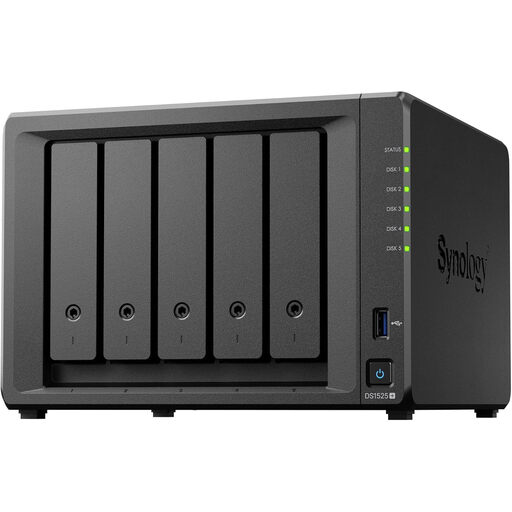 No image available
Consider this five-bay enclosure if the studio is planning space for a growing project library.
The title identifies it as diskless; confirm the exact bundle and compatible drives before planning usable capacity. Check the supplied network configuration against the studio's switch and workstations, and maintain a separate backup.
 No image available
This four-bay model is worth considering when a studio wants to plan shared storage around more than two drive bays.
Confirm the included bundle, compatible drives and network ports before choosing a storage layout or expecting faster workstation transfers. Keep an independent backup of important files.
 No image available
Consider this four-bay model if the studio wants to plan for a growing shared archive.
Check the exact supported-drive list and bundle contents. Confirm the compatible expansion unit with Synology before planning extra capacity, and check the complete network path for shared work.
A two-bay NAS can suit a studio with modest protected capacity needs. Calculate usable space after the chosen redundancy layout, include retained projects and growth, and check that the network meets the team's needs. QNAP's TS-264 is a two-bay example; four-bay models offer more bay-level flexibility for a growing archive.
No. RAID can help maintain access after certain drive failures, but it is not an independent copy against deletion or a compromised system. The National Cyber Security Centre identifies regular backups as a key recovery measure against destructive ransomware and cautions that backups are not resistant by default. Use a separate destination and test a restore.
Not necessarily: check whether the current bottleneck is the network and whether the switch and workstations can use faster connections. A NAS with 2.5GbE ports is an option when the rest of that path supports 2.5GbE; consider a 10GbE upgrade path if future project and network requirements justify it. Port specifications alone do not establish transfer speed for a particular workflow.
Check the exact enclosure's drive-compatibility guidance and the drives required for your planned storage layout. Copy any existing data off a drive before installing it: Synology's DS923+ hardware instructions warn that a drive containing data will be formatted and its contents erased during installation.