Studio backup owner
The person responsible for recovering teaching files after deletion, drive failure or an attack, and for deciding who can change backup settings.


Choose a NAS around the studio’s main task: recovering teaching files, controlling shared access or moving large media files across a compatible network. A NAS can serve as a local backup destination, but a drive mirror or snapshots on that NAS cannot replace a separate recovery copy; the National Cyber Security Centre and Department for Education recommend keeping backups protected and separated. Check permissions, administrator accounts, usable capacity and restore procedures before prioritising network speed.
The person responsible for recovering teaching files after deletion, drive failure or an attack, and for deciding who can change backup settings.
A teacher, technician or studio manager who needs staff to find and update common materials without giving everyone administrative access.
A team moving substantial image, audio or video resources that needs to assess the whole wired network before choosing a faster NAS port.
For shared-studio backups, settle the recovery plan first; then decide whether everyday file sharing or large transfers place additional demands on the NAS.
Consider when: Backups are mainly scheduled and shared access is light on a Gigabit network.
Accept: The QNAP TS-233 has one Gigabit Ethernet port and 2 GB of non-expandable memory; plan for another backup destination.
Consider when: Several staff need controlled access to a common resource library as well as backup and version recovery. Synology describes these tools for its two-bay DS224+.
Accept: Shared storage and file rollback on the NAS still need a separate, tested recovery copy.
Consider when: Staff regularly move large teaching-media files and the relevant workstations and switch have a 2.5GbE wired path. ASUSTOR lists 2.5GbE for the Drivestor 2 Pro Gen2; TerraMaster lists two 2.5GbE ports for the F2-424.
Accept: A Gigabit-only link restricts that faster path, while network capability does not replace separated backups.
For consumers choosing a NAS for teaching resources in a shared studio, these concerns describe the primary need that drives each purchasing decision.
| Concern | What to check | Who this matters to |
|---|---|---|
| Recovering teaching files | Plan versioned backups to a separate destination and test restoring representative folders. | When a NAS fails or files are changed unexpectedly, I need a usable copy elsewhere. Around 36% of consumers put that recovery need first. |
| Shared access and permissions | Check named accounts, folder permissions and separate administrator credentials. | If several colleagues update the same materials, I need to control who can change files and settings. That is the primary concern for around 29% of consumers. |
| Capacity and retention | Calculate usable capacity under the chosen drive-protection layout and allow for archive growth and retained versions. | My growing resource archive needs room for the copies I intend to keep, not just today’s files. Around 21% of consumers prioritise that capacity need. |
| Large-file transfers | Check the NAS port, switch and workstation adapters for a compatible wired path. | When several staff move large media files, I want to avoid a network bottleneck. Faster transfers come first for around 14% of consumers. |
A mirror and snapshots on the same NAS may be unavailable after a complete NAS failure or an incident affecting its accessible storage.
Use the NAS as one layer, keep a separate off-site or disconnected copy and test restores. This follows the recovery and backup-separation guidance of the National Cyber Security Centre and Department for Education.
A compromised everyday account could then expose backup settings as well as shared teaching files.
Give staff named accounts with appropriate folder access, keep NAS administrator credentials separate and review access when roles change. The National Cyber Security Centre also advises stronger authentication for actions that alter or destroy data.
A faster NAS port does not establish the transfer rate between workstations and storage. ASUSTOR says its published throughput results use optimised laboratory conditions.
Check switch ports, workstation adapters and cabling before making network speed the deciding factor.
Usable space depends on the drive-protection layout and how long earlier file versions must be retained. TerraMaster notes that capacity varies by RAID type.
Estimate the resource archive, expected growth and retention period, then calculate capacity for the layout you intend to use.
The DS224+ is a compact two-bay reference for a studio prioritising shared files and backup workflows.
The TS-233 is a two-bay option to assess for scheduled backups and lighter sharing on a Gigabit network.
The two-bay Drivestor 2 Pro Gen2 is relevant where the studio has a compatible 2.5GbE wired network.
The two-bay F2-424 is a reference for a studio with a defined need for its network and memory configuration.
These Synology NAS listings range from a compact two-bay model to larger shared-media configurations. Choose the number of drive bays around the studio’s archive and workflow, then plan compatible drives and a separate backup copy.
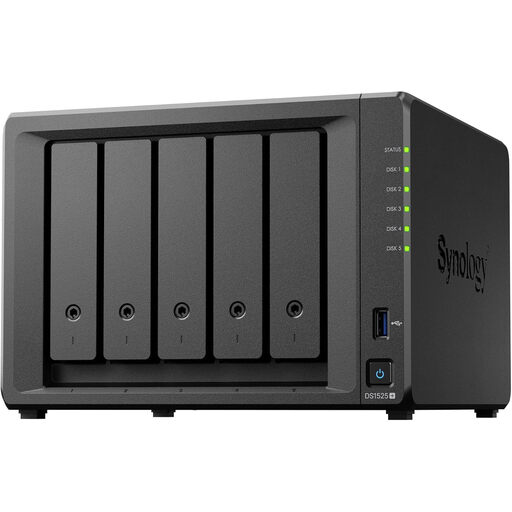 No image available
Consider this five-bay model if the studio needs to plan storage for a growing shared-media archive.
It is listed as diskless: check compatible drives, usable capacity under the chosen layout and the separate destination for recovery copies.
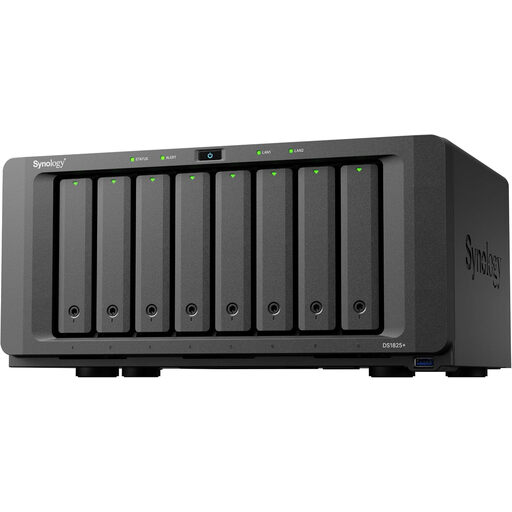 No image available
Consider this eight-bay model when a larger shared-production archive justifies planning for more internal drives.
It is listed as diskless: confirm drive compatibility, protected usable capacity and the network configuration needed by the studio. Keep a separate recovery copy.
 No image available
Consider this two-bay model for a shared resource library where backup to another destination is part of the plan.
It is listed as diskless. Check compatible drives and usable capacity, along with folder permissions, backup scheduling and restore procedures for the intended setup.
 No image available
Consider this four-bay model when a shared teaching-resource library needs more internal-drive planning room than a two-bay setup.
Check compatible drives, protected usable capacity, network ports and how backups will reach a separate destination. Do not treat local snapshots or drive redundancy as that separate copy.
No: a mirror can help when one drive fails, but both drives remain in the same NAS. The Department for Education recommends an off-site copy as part of its backup approach; protect a separate copy and test that you can restore teaching files from it.
Give staff named accounts with access appropriate to their work, rather than a shared administrator login. The National Cyber Security Centre advises separate backup-administration credentials, access reviews and stronger authentication for actions that could alter or destroy data.
Assess the files and apply security measures appropriate to their risks, including whether encryption and tighter access controls are needed. The Information Commissioner’s Office advises maintaining the ability to restore access to personal data; follow your organisation’s data-protection policy for the particular resources.
Consider it when staff regularly transfer large media files and the NAS, switch and relevant workstations can use a 2.5GbE wired path. ASUSTOR and TerraMaster specify 2.5GbE on the models discussed here, but a Gigabit-only link elsewhere in the path restricts that connection.