What matters when choosing a NAS?
Set the recovery plan and usable-capacity target before choosing a network-speed tier. Faster access becomes a more important consideration when archived projects are regularly reopened for editing or shared between workstations.
| Concern |
What to check |
Who this matters to |
| Recovery without cloud storage |
Check the intended backup destination and versioning options; plan a separately stored copy that can be disconnected. |
If a mistake or network attack affects my archive, I need a copy I can recover without relying on the NAS itself. Around 36% of consumers would make recovery their primary concern. |
| Usable capacity and expansion |
Compare bay count and the usable space under the exact drive mix and RAID layout; check supported expansion before choosing drives. |
As completed projects accumulate, I need enough usable space without assuming that raw drive totals are all available for files. Roughly 29% of consumers would put capacity and expansion first. |
| Retrieval and editing speed |
Confirm the NAS Ethernet configuration and compatible switch, cabling and computer connections. |
When I reopen large projects often or edit from shared storage, waiting for transfers can interrupt my work. For around 21% of consumers, access speed would be the leading concern. |
| Shared access |
Check folder permissions, concurrent access needs and compatibility across the workstations and network. |
If several people work with the same project folders, I need controlled access that fits our existing computers and network. Shared access would come first for roughly 14% of consumers. |
Joybuy NAS choices
These two multi-bay Synology models are relevant to different parts of a local video-archive workflow: consider the five-bay DS1525+ if shared editing is also part of the plan, or assess the four-bay DS925+ for an archive-focused setup. Either way, plan a separate recovery copy and confirm the configuration you need.
 No image available
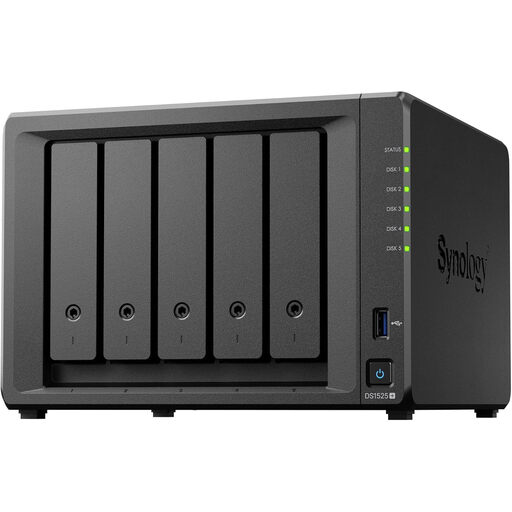
Synology DS1525+ five-bay diskless NAS
Consider this model if your video archive must also serve an editing workflow. It is a five-bay, diskless NAS; confirm the exact network configuration, supported drives and expansion options for your intended setup, and keep a separately stored, disconnected backup copy.
View on Joybuy
 No image available
Synology DiskStation DS925+ four-bay NAS
Consider this four-bay NAS for retaining finished projects locally. Check supported drive models and whether DX525 or DX517 is compatible before planning expansion; also arrange a separately stored, disconnected backup copy.
View on Joybuy
Frequently asked questions
Is RAID enough to protect archived video projects?
No. RAID can provide fault tolerance for certain drive failures, but Synology states that it is not a backup. The National Cyber Security Centre advises keeping a recent offline backup of important files; store a separate copy away from the NAS and test that you can restore it.
Can I archive video projects on a NAS without cloud storage?
Yes, a NAS can hold projects on your local network without making public-cloud storage part of the archive workflow. Confirm that the model supports your intended local access and backup arrangement, and retain an independently protected copy in case the NAS or its location is affected.
Do I need 10GbE for a video archive NAS?
Not necessarily if you mainly store completed projects and retrieve them occasionally. Faster Ethernet matters more when you regularly edit from the NAS, move large projects or serve several workstations; check the NAS, switch, cables and computers together. ASUSTOR notes that its published throughput figures are obtained under optimised conditions.
How should I maintain a local NAS archive?
Maintain both the accessible archive and a separate recovery copy, and periodically test restoration of an earlier project version. The National Cyber Security Centre advises isolating backups so that an attacker with network access cannot readily reach every copy.
What should I do with an old NAS in the UK?
Check the electrical-equipment collection or retailer route available where you live, and protect the project data on its drives before handing them over. GOV.UK explains that waste electrical and electronic equipment is regulated to reduce disposal through incineration and landfill; collection arrangements and the steps needed for your data should be checked for your circumstances.


