What matters when choosing a NAS?
Work out the library’s size and handover window before choosing bay count or network ports. Then check the drives, recovery copy and client access arrangements needed to make the setup usable.
| Concern |
What to check |
Who this matters to |
| Usable capacity and recovery |
Measure the library and expected growth against usable capacity after the chosen redundancy layout. Arrange a separately protected copy and test a restore. |
I need the full library to fit and still be recoverable if the NAS copy is lost; around 33% of consumers put capacity and recovery first. |
| Copy time |
Check the source connection, workstation, network equipment and disks against the available copy and validation window. |
With a handover deadline approaching, I need enough time to transfer and check the files. Copy time is the main concern for around 27% of consumers. |
| Client access and protection |
Establish whether the archive contains personal data, who needs access and who will hold administrator credentials and any encryption keys. |
If identifiable people appear in the archive, I need the client to receive controlled access without retaining unnecessary access myself; around 27% of consumers prioritise secure handover. |
| Setup and drive compatibility |
Check package contents and the exact drive models against the enclosure maker’s compatibility guidance before installation. |
For a one-off transfer, I want to get the NAS running without discovering that a required drive or compatible component still needs arranging. A simpler setup comes first for around 13% of consumers. |
Relevant brands for reference
Compare the exact enclosure and drive models rather than treating a brand name as a compatibility guarantee.
Synology
Synology offers managed NAS enclosures for centralised storage and backup workflows. Its compact DS224+ illustrates a two-bay route for a smaller team or handover archive.
- Synology describes one-drive RAID redundancy for the DS224+ and backup options using other destinations.
- Drive-compatibility guidance varies by system series and release year. Check the list for the exact enclosure and drives before buying.
QNAP
QNAP’s TS-264 is a two-bay enclosure to consider when a compatible faster network is part of the handover plan.
- QNAP specifies two built-in 2.5GbE ports, two M.2 slots and optional networking expansion for the TS-264.
- Higher published transfer results depend on the network configuration. QNAP states that drives and SSDs for this model are sold separately.
ASUSTOR
ASUSTOR’s LOCKERSTOR 4 Gen3 represents a four-bay route for an expanding archive or repeated transfers over a suitable network.
- ASUSTOR lists dual 10GbE, dual 5GbE, ECC memory, four NVMe slots and USB4 for this model.
- ASUSTOR’s throughput figures come from optimised laboratory conditions and need not reflect an ordinary client computer or network.
Seagate IronWolf
IronWolf is Seagate’s NAS hard-drive range for multi-bay storage and recurring backup or media-library use.
- Seagate identifies IronWolf drives as using conventional magnetic recording (CMR).
- A NAS-oriented drive range does not establish compatibility with every enclosure. Check the exact drive model against the enclosure maker’s guidance.
Western Digital WD Red
WD Red covers different hard-drive lines, so the precise model matters for a sustained archive or ZFS-based workflow.
- Western Digital identifies WD Red Plus and WD Red Pro as CMR drives and says those lines should be used with ZFS systems.
- Western Digital says some WD Red models use DMSMR and favour idle time for background operations. Do not select solely by the WD Red family name.
Joybuy NAS enclosures
These two-, four- and five-bay Synology enclosures relate to different video-library sizes and handover workflows. Check usable capacity, compatible drives and the rest of the backup plan against your own library before choosing.
 No image available
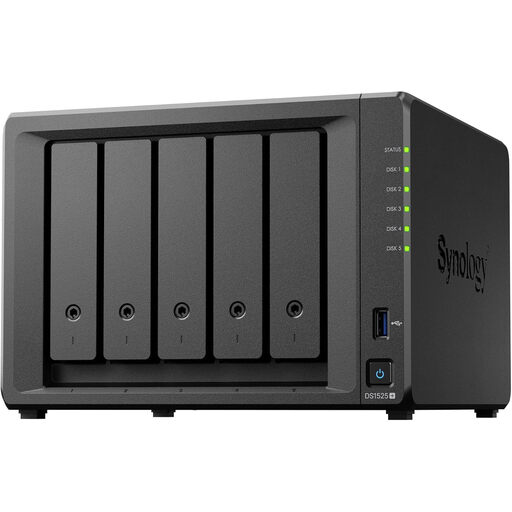
Synology DS1525+ five-bay diskless NAS
Consider the five-bay format if the video library is expected to grow beyond a simpler two-bay plan. The enclosure is diskless, so choose compatible internal drives and calculate usable capacity for the intended layout.
Keep a separately protected copy for recovery rather than relying on the NAS alone.
View on Joybuy
 No image available
Synology DS225+ two-bay diskless NAS
The two-bay format is worth considering when a straightforward handover setup has enough usable space for the library and its expected growth. This enclosure is described as diskless, so select compatible internal drives separately.
If using mirroring, account for its effect on usable capacity and retain a separately protected backup copy.
View on Joybuy
 No image available
Synology DiskStation DS925+ four-bay NAS
The four-bay layout may suit an archive expected to grow or remain in shared use after handover. Check the exact compatible drives, package contents and usable capacity for the storage layout you intend to use.
Plan an independent recovery copy even if the NAS uses a redundant drive layout.
View on Joybuy
Common questions
Is a mirrored NAS a complete backup of my video library?
No. Mirroring can keep a NAS available after one drive fails, but it does not provide an independent recovery copy. The National Cyber Security Centre reports ransomware incidents affecting connected backup storage, so keep another copy separately protected and test a restore before handover.
When should I choose two bays instead of four?
A two-bay mirrored setup can suit a handover when the library and its expected growth fit within one drive’s usable capacity. Consider four bays if the archive will grow beyond that plan or the NAS will remain in use for ongoing shared storage; the bay count alone does not determine how long copying will take.
Which hard drives should I check for a NAS archive?
For sustained archive work or a ZFS-based setup, check NAS-rated CMR drives against the exact enclosure’s compatibility guidance. Seagate identifies IronWolf as a CMR NAS range, while Western Digital says WD Red Plus and WD Red Pro are CMR and should be used with ZFS systems.
Must a client video archive be encrypted?
Whether encryption is an appropriate measure depends on the archive and how it will be stored and accessed; it is not a substitute for controlling accounts and keys. If the footage contains personal data, the UK Information Commissioner's Office explains that UK GDPR calls for security measures appropriate to the risk and identifies encryption as a way to protect stored personal information from unauthorised access.
What should I settle before giving the client control of the NAS?
Agree who will administer the NAS, receive any encryption keys, access the archive and maintain its recovery copy after acceptance. If personal data is involved, establish the parties’ responsibilities and the arrangements for its transfer and retention; the Information Commissioner's Office treats transfers of databases or lists of individuals as a form of data sharing.


